Robert the Bruce: a life in context
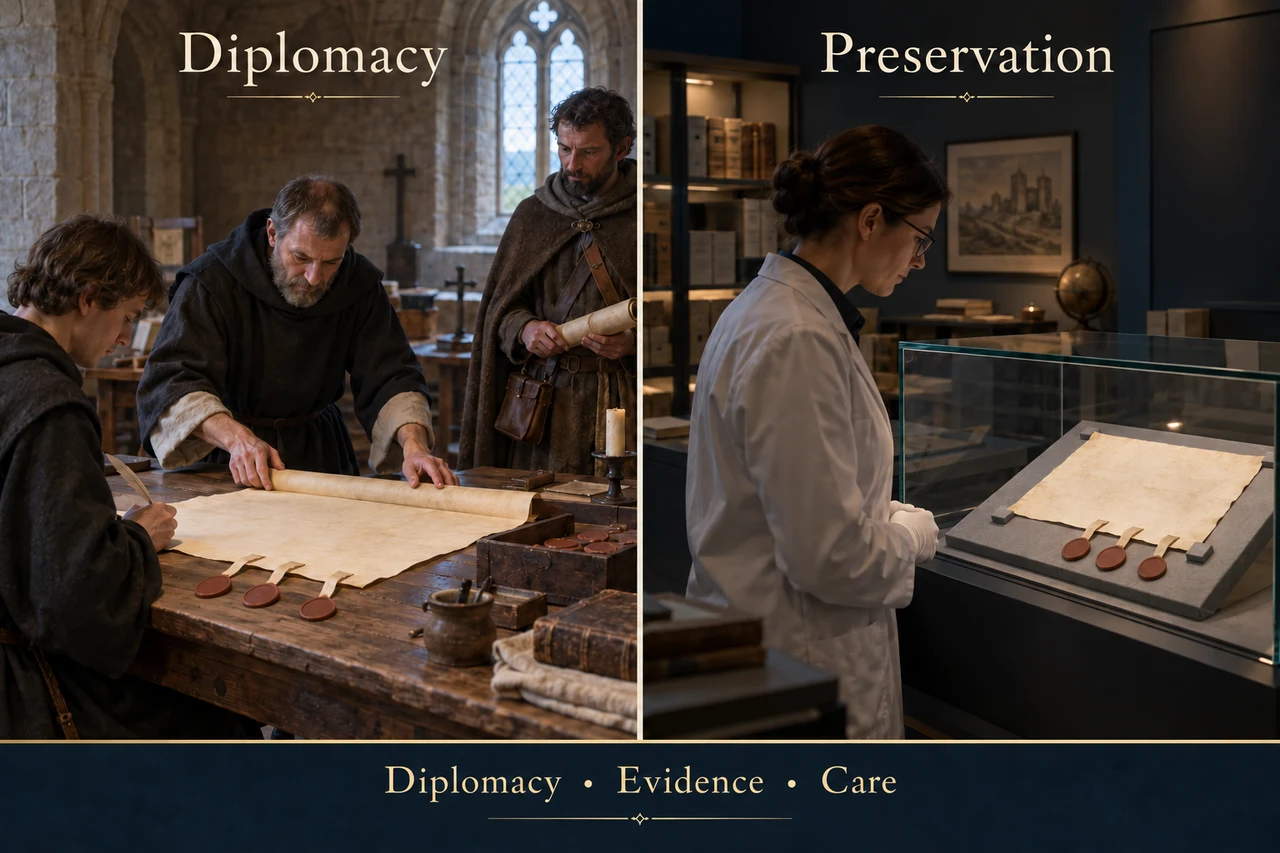
Image: illustration, not a documentary photograph. Imagined diplomacy and preservation scenes; the blank documents and plain seal discs are teaching symbols, not a facsimile or a count of the Declaration of Arbroath’s surviving seals. · Original myAudience teaching illustration
Robert the Bruce became king of Scots in 1306 amid a disputed succession and conflict with English royal power. His rise involved elite rivalry and difficult alliances, not a straightforward national election in which everyone already agreed on one leader.
Military campaigns and political recognition required resources and support. Victory at Bannockburn in 1314 was important, but did not immediately settle every issue. Further warfare and diplomacy shaped the durability of his royal authority.
The Declaration of Arbroath in 1320 belongs to the diplomatic assertion of Scottish independence. Its language should be interpreted in its medieval political context, rather than treated as a modern democratic constitution representing every inhabitant on equal terms.
Recognition of kingship could be sought through military success, elite support and diplomatic argument, each with a different audience. A document asserting independence should therefore be read for the obligations and authority it describes, rather than assumed to promise modern equality to every person. Looking at those mechanisms together explains why a victorious battle did not finish the political struggle. It also makes room for competing loyalties within Scotland. Bruce's authority developed through specific decisions and relationships, not simply the unfolding of a national identity already shared in the same way by everyone.
Diplomatic recognition developed after Bannockburn: the 1320 declaration addressed the pope, and the Treaty of Edinburgh–Northampton followed in 1328. Military victory and negotiated recognition were different achievements, separated by years of conflict. The familiar spider tale belongs to later memory, rather than serving as contemporary proof of how the king chose his strategy.
Further reading
A battlefield victory and recognised political authority are different achievements. National Records of Scotland explains that Robert’s success at Bannockburn in 1314 did not immediately secure English recognition of his kingship or Scotland’s independence. In 1320, the Declaration of Arbroath addressed Pope John XXII as part of a diplomatic effort. The document concerns persuasion, recognition and the position of the kingdom within a wider political world. Its purpose cannot be understood simply by treating it as the written result of one battle.
The letter’s support for Robert is not unconditional in its own argument. The selected Latin text says that if he sought to submit the kingdom to English rule, its authors would seek another king able to defend it. That is a condition within an elite diplomatic appeal. It does not, by itself, establish a modern electoral system, universal voting rights or agreement by every person in Scotland. Read who speaks, whom they address and what condition they assert before turning a forceful sentence into a timeless constitutional rule.
The text available today also has an editorial history. NRS explains that its transcription follows Fergusson’s reconstruction of the version thought to have reached the pope, rather than an absolutely exact reading of the surviving document. The original Latin, a scholarly reconstruction and a later English translation should not be treated as interchangeable physical objects. Here the selected argument is explained independently, without reproducing modern translated sentences. A reader should be able to identify the edition used and the limits its editor declares.
Material survival raises a further question. NRS identifies its document as the surviving file copy, authenticated by seals, with many seals lost or damaged. A gap does not tell us that the missing participant never supported the letter. Nor does an attached seal make the appeal a modern ballot. The archive’s accounts use different descriptions of named supporters and possible original seals; these are not a reliable basis for an exact population percentage. Separating authentication, named participation and survival prevents a neat number from hiding an uncertain denominator.
Consider an explicitly invented seal exercise: a fictional document was originally associated with 24 seals and nine now survive. The surviving fraction is 9 ÷ 24 = 37.5%. Change the hypothetical original total to 30 while leaving nine survivors, and the fraction becomes 30%. Neither result is the Declaration’s actual survival rate. The changed calculation shows why uncertainty about an original total matters. Counting what is visible cannot reconstruct all missing evidence, and the fraction of surviving seals is not the fraction of inhabitants who approved a political claim.
Preserving the record requires careful control, not only a dramatic display. Conservator Hazel de Vere’s 2025 NRS account describes preparations for a 2023 exhibition: checking the document and its seals, protecting it during transport, stabilising the case’s humidity and using 20 lux at the display. These are reported controls for that particular exhibition, not a universal recipe for every parchment. Conservation makes continued reading possible while respecting the physical limits of an old object; a digital photograph helps access but does not replace all information in the original.
Try an invented light-exposure model with the reported 20-lux level as an input. Four hours at that constant level gives 20 × 4 = 80 lux-hours. Six hours gives 120 lux-hours, an increase of 40 or 50%. Does this prove 50% more deterioration? No. It measures a simplified exposure dose, not actual damage. Material sensitivity, spectrum, prior exposure and the conservator’s evidence also matter. The changed question demonstrates a useful calculation while preventing an easy numerical answer from becoming an unsupported preservation prediction.
A responsible illustration should show the idea of a diplomatic document and its care, without pretending to reproduce the Declaration, Robert’s face or the exact meeting at which it was prepared. The historical achievement remains substantial without adding a spider anecdote, a modern voting system or an exact seal census unsupported by the selected evidence. NRS dates acknowledgment of independence to 1328, so the 1320 appeal should not be presented as an instantly successful decree. Victory, advocacy, recognition and later preservation form related but separate stages.
The physical record and the text it carries have related but different histories. National Records of Scotland identifies the surviving Declaration as a file copy. Its overview explains that an early-eighteenth-century engraving preserves the full text, while the parchment later suffered damage; a further engraving appeared around 1815. A later witness can therefore help reconstruct writing that is now difficult to read. That does not make every copy identical in material, lettering or purpose. For a disputed word, establish which witness supplies the reading and whether an editor has explained a reconstruction.
A document addressed to a powerful outsider is also an intervention. The letter sought papal recognition of Robert and Scottish independence. Its language should be analysed as an attempt to persuade that audience, not treated as a neutral poll of inhabitants. Ask what the authors wanted the recipient to do, which claims would strengthen their request and who could participate in making it. A claim to speak for a community is itself evidence of political argument; it does not, without more evidence, establish how every member of that community understood or supported the claim.
New observation can improve a record without settling every historical question. In her account of preparations for the 2023 display, conservator Hazel de Vere describes photography revealing red wax flecks in many green seals. She presents earlier attachment of red seals as a possibility. Preserve that uncertainty: an observed colour trace and a suggested sequence are not the same statement. To strengthen the sequence argument, one would need further examination capable of distinguishing alternative ways the trace could have formed. Our uninscribed teaching parchment depicts neither those traces nor an authenticated arrangement of the surviving seals.
Compare exposure in a fresh invented display schedule. Two hours at 15 lux followed by three hours at 20 lux produces 15 × 2 + 20 × 3 = 90 lux-hours. A changed schedule of one hour at 15 lux and four at 20 lux produces 95 lux-hours. Both last five hours, but the second adds five lux-hours, or about 5.56%. This arithmetic tracks an exposure quantity; it does not predict a 5.56% increase in damage. Conservation depends on the object, light spectrum, material sensitivity and other conditions. The museum's reported precautions are a case study, not instructions for handling an irreplaceable record.
Original worked exercise — Question: For the fictional document only, what fraction survives with 9 seals out of an assumed 24, and how does an assumed 30 change it?
Original worked exercise — Full answer: 9/24 = 0.375 = 37.5%; 9/30 = 0.30 = 30%. Only the assumed denominator changed. These are not the Declaration’s actual original totals or survival percentages, and neither fraction measures population support.
Original worked exercise — Changed question: At a constant 20 lux, compare 4 and 6 hours. Does the change establish 50% more physical deterioration?
Original worked exercise — Changed full answer: 20 × 4 = 80 lux-hours; 20 × 6 = 120 lux-hours. The increase is 40 lux-hours, 40/80 = 50%. It does not establish proportional deterioration: material, spectrum, exposure history and conservation evidence remain necessary.
Original worked exercise — Worked rationale: The numerator counts surviving seals, while the assumed denominator concerns the fictional original total. Changing only that assumption changes the ratio; neither result reveals the real Declaration’s original total or public consent. A conditional elite appeal addressed to the pope does not establish universal suffrage.
Original worked exercise — Changed rationale: Multiplying constant illuminance by elapsed hours gives lux-hours, a simplified exposure quantity. The percentage compares the change with the initial 80 lux-hours. It does not supply a material-damage law; the paper or parchment, spectrum, history and conservator’s findings would be needed to infer deterioration.
Additional worked exercise — Question: An invented display uses 15 lux for two hours and 20 lux for three hours. Find total duration, exposure and time-weighted mean illuminance. Does the result measure damage?
Additional worked exercise — Full answer: Duration = 2 + 3 = 5 hours. Exposure = 15 × 2 + 20 × 3 = 30 + 60 = 90 lux-hours. Mean illuminance = 90/5 = 18 lux. It is a time-weighted mean, not the unweighted mean of two settings. The calculation measures the defined exposure proxy only; no damage percentage follows.
Additional worked exercise — Changed question: Change the schedule to 15 lux for one hour and 20 lux for four hours. Find exposure, mean illuminance and percentage change relative to the first schedule. Can equal duration establish equal exposure?
Additional worked exercise — Changed full answer: Duration remains five hours. Exposure = 15 × 1 + 20 × 4 = 95 lux-hours; mean = 95/5 = 19 lux. Increase = 95 − 90 = 5 lux-hours. Relative increase = 5/90 × 100 = 50/9%, approximately 5.56%. Equal duration does not imply equal exposure because the time spent at each illuminance differs. This percentage is not a predicted increase in damage or a historical exhibition measurement.
Additional worked exercise — Method and error rationale: Multiply each illuminance by its own duration before summing; lux-hours express accumulated exposure. Divide by total duration for a weighted mean. Use the original 90 lux-hours as the percentage-change denominator. Distinguish measured traces, an interpretation of their sequence, and evidence sufficient to test that interpretation; do not turn a qualified possibility into a documented event.
Image: illustration, not a documentary photograph. Imagined diplomacy and preservation scenes; the blank documents and plain seal discs are teaching symbols, not a facsimile or a count of the Declaration of Arbroath’s surviving seals.