Great Barrier Reef: a mosaic, not one wall
By Natural wonders · myAudience
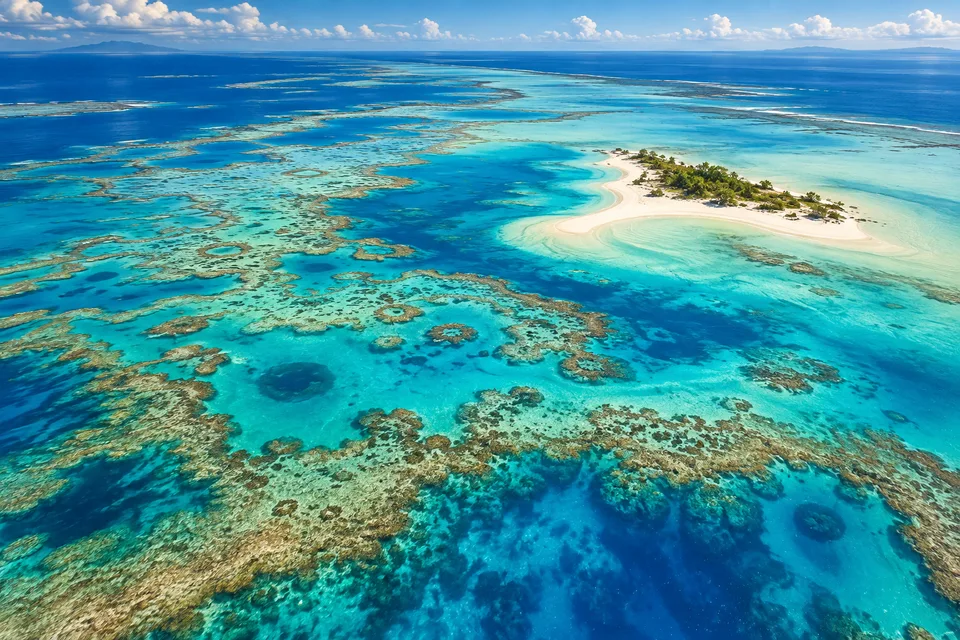
myAudience · original AI-generated landscape illustration · Original generated illustration; no documentary accuracy, current-condition or exact-viewpoint claim
The Great Barrier Reef is not a single continuous ridge. Off northeastern Australia, reefs, islands, shallow coastal waters and deeper offshore habitats form an enormous mosaic. From above, differences in shape and water depth give the seascape its changing pattern.
That variety continues underwater. Inshore areas, middle and outer reefs, and waters beyond the continental shelf provide different conditions for life. Their connections are part of the system: a reef is more than the bright coral visible in a close-up image.
Corals share these habitats with fish, molluscs, sponges, marine turtles and many other organisms. Some islands also support important seabird and turtle breeding sites. The remarkable diversity comes from a combination of habitats rather than one uniformly colourful underwater garden.
The distinction matters when reading a picture of the reef. One thriving coral scene cannot establish the condition of the entire World Heritage property, while an aerial turquoise pattern does not reveal every ecological process below it. Beautiful images are an invitation to learn about this connected marine landscape, not a substitute for monitoring it.
Image: illustration, not a documentary photograph.
Further reading
An aerial reef scene invites you to read the sea as a landscape. Shallow patches, darker channels and a low island occupy different positions within one view. The Great Barrier Reef is a connected marine region containing many reefs and habitats, rather than one uninterrupted wall of coral. Its beauty becomes more interesting when we ask how living organisms create structures large enough to influence water movement and shelter other life. The illustration introduces this question; it cannot show a particular reef's present condition or identify every submerged shape.
UNESCO describes the Great Barrier Reef as an exceptional Australian marine heritage area with reefs, islands and diverse habitats. World Heritage recognition concerns this wider system, not simply a collection of attractive diving locations. The Reef Authority also works with Traditional Owners, scientific partners and tourism operators in assessing conditions. A useful account therefore includes both ecological relationships and continuing human responsibilities. Naming a protected place does not mean every part is equally healthy or equally accessible; management needs observations made at specific sites and times.
The Reef Authority explains that reef-building hard corals are colonies of small animals that produce limestone skeletons. Microscopic algae living within their tissues supply food through photosynthesis. This partnership connects sunlight, living tissue and the growth of a mineral structure. Distinguish three things when drawing a simple model: the coral animals, their algal partners and the skeleton they construct. Calling the whole structure a colourful underwater plant misses the animal host and the accumulated framework. The model also leaves out other reef organisms rather than pretending that corals explain the entire ecosystem.
Under environmental stress, corals can lose their algal partners and appear bleached. The Reef Authority identifies excessive heat as a major cause and explains that recovery is possible if conditions improve, while persistent stress can lead to death. Bleaching is therefore a condition of living coral, not a synonym for an already dead colony. An observation needs a date, location and method. A photograph of pale tissue cannot by itself tell us how long stress lasted, whether recovery followed or what fraction of a much larger reef experienced similar conditions.
Consider an original monitoring exercise in which one fixed survey records forty of one hundred observed colonies as bleached. Forty per cent describes that sample under its stated classification; it does not automatically describe the whole Great Barrier Reef. The survey might favour a particular depth, habitat or coral type. To improve comparison, keep the observation method consistent, record where the sample was taken and return to see what changes. Tracking an outcome over time answers a different question from counting a visible condition once, so those records should remain distinguishable.
A second distinction concerns area and function. A reef surface could retain living cover while the mix of organisms or the structure of its habitat changes. A simple classroom diagram can show branching spaces, broad surfaces and channels without claiming that one shape represents every reef. Ask which organisms would need shelter, where water could pass and what evidence would test those ideas. This is reasoning about relationships, not a prescription for manipulating a real reef. Responsible learning can combine a compelling landscape with humility about the observations required to evaluate its condition.
The rendered image shows turquoise shallows, dark water, irregular reef-like patches and a sandy island with vegetation. The main, medium and small versions preserve that contrast, making it a useful hook for thinking about spatial variation. Water colour also depends on light, depth and the material beneath or within it; it is not a health score. The image supplies no dated survey, named reef boundary or verified species inventory. Its appealing clarity should encourage questions about a living marine system without becoming evidence that every coral shown is currently thriving.
Check: A fictional survey finds forty bleached colonies among one hundred observed, and a later survey finds twenty among one hundred. Calculate the two sample proportions and decide whether this proves twenty colonies recovered. Answer: The recorded proportions are forty per cent and twenty per cent, a decrease of twenty percentage points. Unless the same colonies were individually tracked, the second sample does not identify what happened to the first forty. Recovery, mortality or a changed sample could affect the result. Bleaching and death are distinct, and a local observation cannot establish the condition of the entire reef region.