Galápagos: islands that are still becoming
By Natural wonders · myAudience
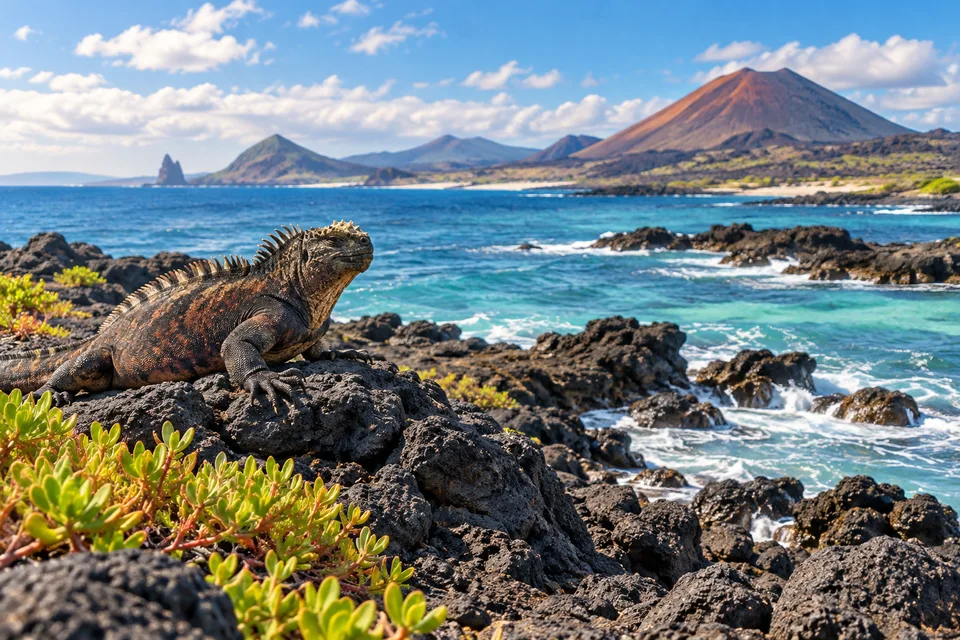
myAudience · original AI-generated landscape illustration · Original generated illustration; no documentary accuracy, current-condition or exact-viewpoint claim
The Galápagos lie in the Pacific, about a thousand kilometres from mainland Ecuador. Their volcanic origin is visible in the land itself, while isolation and the meeting of ocean currents help explain the unusual combination of terrestrial and marine life.
The islands are not all the same age. Younger volcanic landscapes lie toward the west, while older islands to the east show longer histories of erosion and biological change. The archipelago provides several stages of island development within one region.
Marine iguanas, giant tortoises, flightless cormorants and different finches and mockingbirds illustrate the variety that made the islands important to evolutionary thinking. Darwin visited in 1835, but the scientific interest is not confined to that voyage: ecological and evolutionary processes continue today.
The surrounding marine reserve is essential to the picture. Currents and climatic events such as El Niño influence marine conditions, linking the islands to forces operating beyond their shores. An animal portrait can be memorable, yet the deeper story concerns how organisms, isolation, climate and newly formed land interact over generations.
Image: illustration, not a documentary photograph.
Further reading
A dark shore, a resting iguana and volcanic forms beyond the water bring several Galápagos stories together. The islands are made by geological processes, reached by living organisms and connected to the surrounding sea. Their separation from the mainland matters, but separation is not complete isolation from every movement. Water, organisms, people and goods cross boundaries in different ways. Reading the scene therefore means asking both how distinctive island communities developed and how new arrivals can change the relationships within them.
UNESCO connects the archipelago's volcanic origins, relative isolation and oceanic setting with its distinctive life. Different islands present different stages of geological development, while the marine reserve links the land to ocean currents and ecological processes. The site's history also includes Darwin's visit in 1835 and the later importance of island observations to evolutionary thinking. These are connected themes rather than a claim that one short visit instantly produced a completed theory. The islands remain places where relationships between organisms, environments and change can be studied.
Adaptive radiation concerns diversification from an ancestral lineage into forms occupying different ecological roles. To understand the idea, begin with inherited variation and differences in survival or reproduction under particular conditions. Across generations, population composition can change; separated populations may follow different trajectories. This is a general mechanism, not a purposeful decision by an animal to acquire the trait it needs. Individual organisms do not have to anticipate a future environment for inherited variants to become more or less frequent in a population.
A fictional population shows the distinction. Begin with one hundred birds, forty carrying a specified heritable variant. In a simplified next generation, eighty birds are recorded and forty have the variant. Its frequency rises from forty per cent to fifty per cent even though its recorded number stays forty. The calculation alone does not show which biological mechanism caused the change. Selection, migration, chance, measurement differences or a mixture could matter. Explaining evolution requires more evidence than noticing that a fraction changed, but calculating that fraction correctly is a necessary first step.
The Galápagos National Park's invasive-species account treats management as a scientific, technical and social problem. It distinguishes preventing further introductions from controlling or reducing impacts of organisms already present. That distinction avoids an unrealistic promise that every introduced organism can simply be removed. A management action needs to identify the organism, the pathway and the ecological effect it aims to change. Controlling a damaging introduction is a different goal from making a place contain no arrivals of any kind, and both goals have practical consequences for residents and visitors.
The park's account names management programmes for organisms as different as goats, introduced ants, African snails, feral cats and rodents. The examples illustrate why a single treatment does not fit every problem. An inspection aimed at a transport pathway differs from removing an established population, while ecological recovery needs evidence after the intervention. A lower count of the target organism may be encouraging without proving that all native relationships have recovered. Good monitoring follows the intended ecological outcome as well as the immediate action. This connects island biogeography with practical care: distinctive communities depend on what happens at boundaries and within habitats.
The image places an iguana at the boundary between land and sea, with textured dark rock leading towards water and distant volcanic slopes. That arrangement helps introduce the connections described by the heritage sources. It is an illustration, not a species-identification record or an image of a surveyed individual on a named island. The apparent abundance of shore plants does not establish the absence of invasive species, and a healthy-looking animal does not measure population recovery. Its value is to draw attention towards organisms and their setting before the reading follows the evidence.
Check: In the fictional bird example, a guide says the variant's frequency rose by ten per cent and that this proves natural selection. Correct the calculation and interpretation. Answer: The frequency rises from 40/100, or forty per cent, to 40/80, or fifty per cent. That is ten percentage points, and a twenty-five-per-cent increase relative to the original frequency. Its count did not rise. The observations alone do not isolate selection from other processes or sampling differences. To argue for selection, investigate inheritance, differential reproduction or survival, migration and measurement. No fictional figure here describes a measured Galápagos bird population.