Lake District: a landscape shaped by glaciers and farming
By Landscapes worth protecting · myAudience
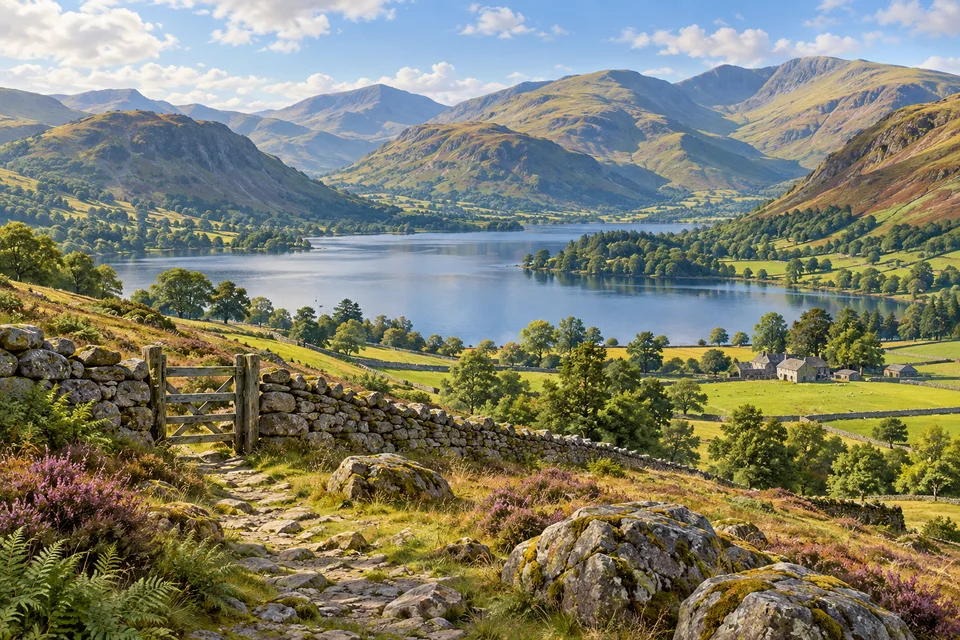
myAudience · original AI-generated landscape illustration · Original generated illustration; no documentary accuracy, current-condition or exact-viewpoint claim
The English Lake District is a cultural landscape as well as a mountainous one. Its valleys, lakes and uplands provide the physical setting, but farming, settlement and changing ideas about scenery helped create the landscape recognised by UNESCO.
Traditional agro-pastoral land use connects grazing areas, farms and valley communities. The result is not an untouched wilderness: the visible pattern records a long interaction between people and terrain. Working farms remain part of the place rather than incidental objects in a scenic picture.
The region also influenced ways of thinking about landscape. Picturesque and Romantic responses helped establish the idea that scenery had value worth protecting and that people should be able to appreciate it. Those ideas contributed to a conservation movement with effects beyond England.
Protection therefore has several responsibilities at once. Maintaining landscape character involves agricultural livelihoods, heritage, ecological change and the pressure of tourism. A view across a lake toward stone walls and fells can hold all these histories together: the apparently simple composition has been made by both natural processes and generations of human choices.
Image: illustration, not a documentary photograph.
Further reading
A stone wall can be as useful a starting point as a mountain summit. Follow it across the foreground, then look towards the fields, farm buildings and water. Those different shapes invite different questions: how was the valley formed, who divided the land, and what work keeps the pattern recognisable? Reading the Lake District in this way connects scenery to decisions. A landscape is more than the sum of attractive objects within a frame; the relationships between them carry much of its history.
The UNESCO account describes glaciated valleys subsequently shaped by an agro-pastoral system. That sequence separates a physical setting from later uses of it. Ice helped model the terrain; grazing and farming did not create the entire valley, while terrain did not build the walls unaided. This is a useful correction to either extreme explanation. To reconstruct a particular field's history, however, the broad regional account must be combined with local maps, records and material evidence rather than applied as an exact date for every visible boundary.
UNESCO also identifies common fell grazing, farms and local sheep breeds as connected attributes of the cultural landscape. Think about what such a relationship means: grazing land, buildings and access arrangements support an activity together. Preserving a farm's facade while removing the activity behind it could retain an object while changing the system. That does not prove that every change is undesirable. It shows why an account of continuity needs evidence of use and organisation as well as a photograph of surviving masonry.
The region's influence on Picturesque and Romantic ways of valuing scenery offers another layer. UNESCO connects those responses with conservation ideas and designed additions such as gardens and villas. A view that feels natural may therefore include features deliberately arranged to be seen. Looking for those layers need not diminish enjoyment. It helps us ask whose preferences shaped a scene and which activities are less visible from a viewpoint, including the ordinary labour on which a carefully maintained appearance may depend.
Langdale provides a particular history behind the region's broad farming pattern. The National Trust records ten farms there by the sixteenth century and describes its continuing association with Herdwick sheep. In the twentieth century, George Macaulay Trevelyan bought Old Dungeon Ghyll, Stool End and Wall End farms, then Low Millbeck and Harry Place, and donated them to the Trust. His acquisitions connected open countryside with working holdings rather than saving scenery as an isolated picture. This example explains why a farm building, its surrounding grazing land and the arrangements supporting its use belong in the same account of the landscape.
Literature helped people notice particular places within that landscape. The National Trust links Wordsworth's writing about Blea Tarn in The Excursion and Dungeon Ghyll Force in The Idle-Shepherd Boys with appreciation of Langdale. The poems belong to a history of attention: named features became subjects that readers could imagine and seek out. Later donations by Trevelyan and Beatrix Potter connected appreciation with protective ownership. The valley therefore brings together different forms of work: farming sustained its use, writing developed its cultural associations, and land acquisition changed how parts of it were cared for. None of these histories requires identifying the illustrated lake as Langdale, which the Trust describes as a valley without a lake.
In the illustration, the wall and gate give the eye a nearby boundary before the fields and buildings lead towards the lake and fells. Compare their different textures and scales. The composition makes the connection between human work and terrain easy to discuss, but it is an interpreted landscape, not a dated survey of one holding. It does not identify the lake, establish a farm's present operation or show how any grazing agreement works. Those are questions to follow into records, not conclusions supplied by the image.
Check: A fictional project retains every wall but stops farming in all nearby holdings. Its guide says that the unchanged skyline proves the agro-pastoral landscape is unchanged. Is this justified? Answer: The skyline and walls preserve some visible attributes, but ending the associated activity changes a relevant relationship. Compare recorded land uses, grazing arrangements, farm viability, habitats and access across time. The project may have achieved its structural aim while changing other values. An unchanged view is evidence about appearance, not sufficient proof of continuity of the whole living system.