Dolomites: ancient seas lifted into mountain walls
By Landscapes worth protecting · myAudience
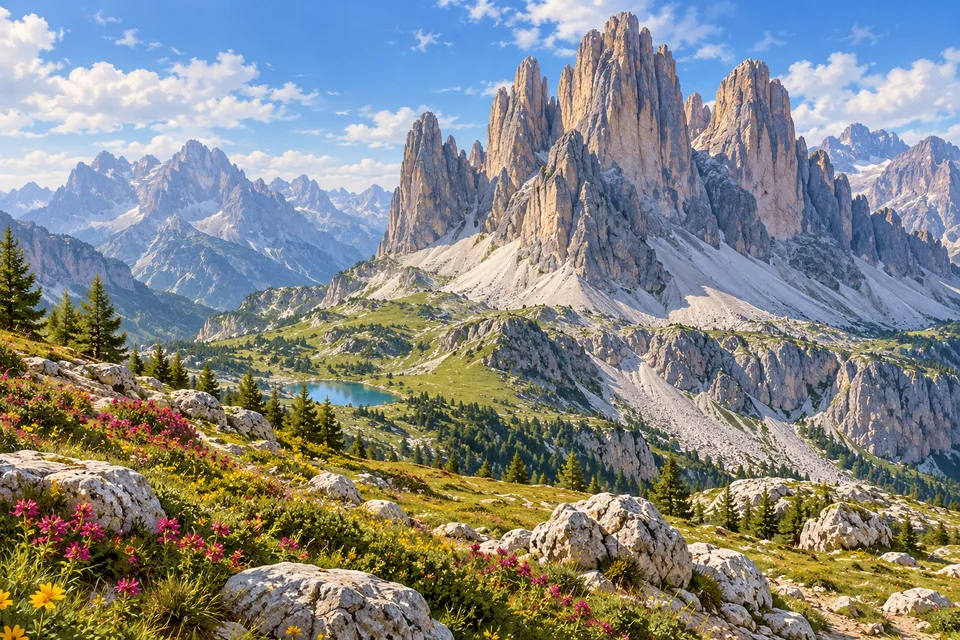
myAudience · original AI-generated landscape illustration · Original generated illustration; no documentary accuracy, current-condition or exact-viewpoint claim
The Dolomites turn the history of marine environments into a mountain landscape. Their geological record includes ancient carbonate platforms and reefs, preserved in formations now exposed far above sea level. The cliffs are evidence of environments very different from the present mountains.
Uplift, deformation, erosion and glaciation helped produce the towers, pinnacles and steep walls. The resulting landscape is not explained by one process alone. Rock type provides the material, while subsequent forces determine how that material is arranged and worn away.
The World Heritage property has nine separate components rather than one continuous protected block. These preserve important landforms and geological relationships across the region. Thinking of them as a connected scientific record helps explain why the inscription extends beyond a single famous peak.
Protection also has to operate across administrative boundaries. Several provinces and different kinds of protected areas participate, while tourism and infrastructure require coordinated management. The mountain silhouette is immediately compelling; knowing that it preserves the structure of ancient seas adds another layer to the view without turning it into a simple geological cartoon.
Image: illustration, not a documentary photograph.
Further reading
A pale mountain wall can hold a history of water without resembling a shoreline. That is part of the fascination of the Dolomites: present scenery and the environments recorded in its rocks are different things. Begin by separating three questions. What produced the material, how was it later rearranged, and how did today's landforms develop? Asking them in order avoids the tempting story that one force created every feature. It also makes the landscape a record to investigate rather than a shape that explains itself.
UNESCO identifies ancient carbonate platforms and reef relationships among the geological values of the property. Marine deposits now exposed in mountains can provide evidence of environments unlike the present setting. A fossil's surrounding rock and its position within a sequence matter to that interpretation. Finding a marine organism's remains at elevation does not mean that it lived on a mountain summit. Present location is the result of a history that includes processes after the organism's lifetime.
The UNESCO account also connects the landforms with tectonism, erosion and glaciation. These do different work: rearranging and elevating rocks is not the same process as removing material or shaping a valley. An exposed cliff can preserve evidence while also being a product of later change. To distinguish these stages, geologists compare relationships in the rock record with the landforms. The view alone does not reveal an exact uplift rate or tell us which process acted at a particular moment.
The World Heritage designation comprises nine components. A serial property can protect related evidence distributed across separated areas; it need not be one continuous block or nine copies of the same mountain. The official account emphasises geological relationships as well as striking forms. This gives conservation a purpose beyond keeping a single silhouette in view. Protecting how features relate can preserve information that would be lost if an isolated specimen or famous peak were treated as the entire record.
The Dolomites Foundation's geological sequence describes a Triassic sea with uneven depth, rather than a uniform flat floor. Tectonic stretching and subsidence produced shallow and deeper zones. Communities including algae, corals and sponges grew in the shallower areas, building carbonate platforms while different sediments accumulated between them in deeper water. Their relationships preserve a former geography: neighbouring rock bodies can represent environments that existed side by side, not simply one layer repeated everywhere. Temporary emergence exposed parts of these platforms to erosion. The mountain record consequently includes both the accumulation of sediment and interruptions or changes in the environments that supplied it.
A later episode turned that marine record into a mountain landscape. The Foundation describes compression associated with the convergence of Africa and Europe, producing uplift, faults and thrusts. Rock that bends or fractures responds differently according to its properties, so mountain building rearranged the earlier deposits without making them all identical. Water, gravity and ice subsequently removed and reshaped exposed material; repeated glaciations left a further imprint on the valleys and rock faces. The sequence is therefore deposition, deformation and uplift, then continuing erosion and glacial modification—not a single event in which a reef instantly became a tower. The nine World Heritage components preserve different parts of this connected record.
The illustration's towers rise above pale sloping material, with woodland, meadow and a small lake adding contrasts below. Follow the transition from steep rock faces to gentler ground. It invites questions about material, structure and erosion, but no peak or layer is authenticated by this composite. The slopes are not calibrated, fossils are not visible, and the image supplies no dating result. Its strength is in encouraging a sequence of questions that real geological evidence can test.
Check: A marine fossil occurs in a high mountain bed. A caption says its organism lived at that altitude and that the cliff's height measures its age. Is this warranted? Answer: No. Present elevation and geological age are different variables. The fossil and its context may support an earlier marine environment; subsequent deformation, uplift and erosion require separate evidence. Stratigraphic relationships and suitable dating methods constrain age, not height alone. Explain the stages without inventing an exact chronology from a scenic view.