Yellowstone: heat, water and a living ecosystem
By Landscapes worth protecting · myAudience
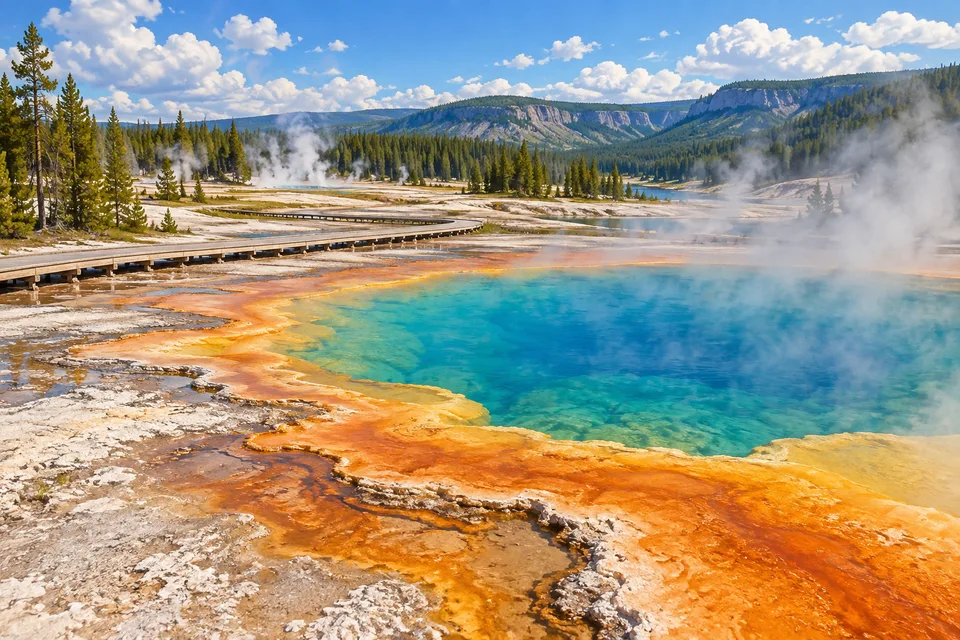
myAudience · original AI-generated landscape illustration · Original generated illustration; no documentary accuracy, current-condition or exact-viewpoint claim
Yellowstone is famous for geysers, but its geothermal landscape includes hot springs, mudpots and fumaroles too. Together these surface features reveal heat and water interacting beneath a large volcanic region. They are related phenomena with different visible behaviour.
The wider park also contains forests, rivers, waterfalls and abundant wildlife. Its value comes partly from the scale of the ecosystem, where physical processes and biological communities can be studied together. A geyser close-up is one chapter in a much larger landscape.
Fire and ecological succession are among the processes that shape the park. Its conservation story is not simply about keeping every tree or hillside unchanged. Natural systems involve renewal and disturbance, while management must consider how those processes interact with human activity.
Bison and grizzly bears are important parts of Yellowstone’s wildlife, but a scenic image should not suggest that close contact is safe or guaranteed. The same applies to geothermal water: extraordinary colours and steam do not make it suitable for bathing. The visual wonder comes from observing an active natural system, not treating it as a staged attraction.
Image: illustration, not a documentary photograph.
Further reading
A bright pool, pale mineral ground and drifting vapour make Yellowstone's hydrothermal landscape immediately striking. The colours invite questions, but appearance alone cannot explain where the heat comes from, why one feature erupts while another circulates quietly or what lives at its edges. The useful starting point is a system with several parts: heat beneath the ground, water entering and moving through rock, and openings through which it returns to the surface. Each visible feature expresses a particular arrangement of those parts rather than a single interchangeable kind of hot pool.
The National Park Service explains that surface water penetrates rock, is heated by Yellowstone's magmatic system and returns through underground pathways. In a hot spring, relatively open plumbing permits circulation and heat loss. Geysers have constrictions that can limit that circulation. Pressure affects when hot water boils; steam formation and a drop in pressure can then contribute to an eruption. This joins a general physical relationship with the park's specific explanation. It does not mean an attractive pool necessarily erupts, or that a distant view reveals the dimensions of its concealed plumbing.
A simple diagram can separate the roles of heat source, reservoir, passage and outlet. Change the opening while leaving the heat source unchanged and the surface behaviour may change; change the water supply and a feature may behave differently again. This is why drawing one arrow labelled volcanic heat is incomplete. An eruption involves interacting conditions rather than heat alone. The model also distinguishes a geyser eruption from an eruption of magma: both belong to a volcanic setting, but they involve different materials and processes and should not be described as the same event.
Yellowstone's coloured margins also introduce living communities. The National Park Service's separate thermophile account describes microbial mats whose structure and distribution vary with temperature, acidity, light and chemistry. A mat can contain several layers and kinds of organisms rather than one uniform species. Some communities use sunlight, while others draw energy from chemical reactions. A visible band is therefore a starting point for investigation, not a full identification. Microscopy, chemical measurements and other biological methods provide information that the broad colour pattern cannot supply by itself.
The thermophile account describes changes in communities over a day or season as conditions vary. It also explains how mineral material can become caught in microbial mats, helping to shape their appearance. This is a useful example of organisms and physical surroundings interacting rather than occupying separate stories. Colour can reflect several influences, including organisms, minerals and light. Even in a documentary photograph, assigning every orange area to one organism would be too simple. In an illustration, the limit is stronger: its palette cannot serve as a measured environmental or biological record.
A fictional comparison helps distinguish sensible heating from a more complex eruption. Heating one kilogram of liquid water by fifty degrees requires about 210,000 joules when its specific heat capacity is approximated as 4,200 joules per kilogram per degree. That calculation ignores heat losses and phase change. Turning water into steam requires additional energy, and pressure changes the conditions under which boiling occurs. The small arithmetic explains only one part of the process; it cannot calculate a Yellowstone eruption's energy without actual masses, temperatures and a model appropriate to the event.
The illustration shows a blue-green pool, orange margins, vapour, mineral ground and a boardwalk. It supports questions about circulation and microbial communities but is not a sample of a named spring's water, a temperature map or a verified geological section. The smallest image preserves the strong pool-and-margin contrast; fine textures and microbe identity are not legible evidence. Boardwalks belong to managed access, not proof that the ground nearby is safe. For an actual visit, conditions and access guidance must come from the park rather than the scene's apparent calm.
Check: For the fictional kilogram of water, calculate the energy for a fifty-degree rise using the stated specific heat capacity. Does that value describe all the work involved in a geyser eruption? Answer: One multiplied by 4,200 multiplied by fifty gives 210,000 joules. It covers sensible heating under the model's assumptions. Phase change, pressure, losses, water movement and actual quantities require additional treatment, so it is not an eruption-energy estimate. A geyser's constricted plumbing and changing pressure also affect behaviour. Heat input alone cannot establish when a particular feature erupts or what its total energy will be.