Mount Fuji: a mountain seen through centuries of art
By Landmarks and their stories · myAudience
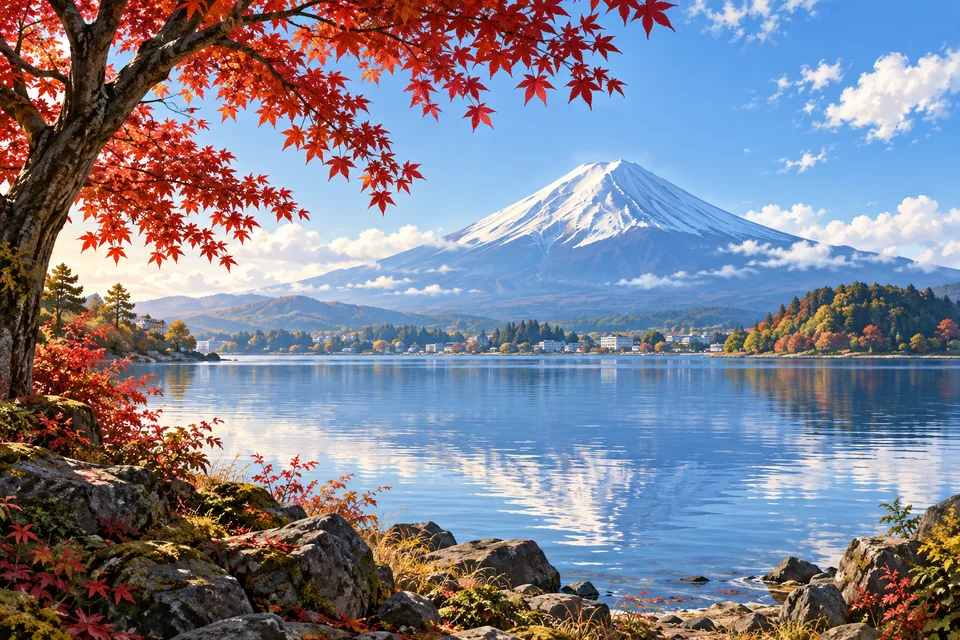
myAudience · original AI-generated landscape illustration · Original generated illustration; no documentary accuracy, current-condition or exact-viewpoint claim
Mount Fuji is a volcano and a cultural landmark at the same time. Its isolated form inspired religious practices, pilgrimage and artistic representations long before it became a familiar international travel image. The mountain’s outline carries a history of human meaning as well as geology.
The World Heritage inscription is cultural and comprises twenty-five associated sites. These include pilgrim routes, shrines and lodging houses, together with revered features around the mountain’s base. The recognised landscape is more extensive than a summit photograph.
Pilgrimage linked practices associated with Shinto and Buddhism. Routes, supporting buildings and rituals developed as worshippers approached and ascended the mountain. Springs and lakes also mattered, demonstrating that the sacred geography continued below the high slopes.
Woodblock prints helped make Fuji internationally recognisable in the nineteenth century. Artists such as Hokusai and Hiroshige placed its form within varied compositions, rather than simply repeating one front-facing view. The mountain became a subject through which landscape, everyday life and artistic design could be connected. Modern images inherit that visual history even when they show only snow, water and a distant cone.
Image: illustration, not a documentary photograph.
Further reading
A snow-lined summit appears beyond a lake, with leaves framing the foreground. It is easy to read Fujisan as a solitary object, yet the mountain's cultural history depends on connections: routes lead towards it, shrines establish starting places, lodging houses support travellers, and pictures carry its form elsewhere. The view therefore offers two directions for exploration. Follow the land towards the cone to consider its physical presence, or follow the people and images associated with it to understand why that presence acquired such enduring meaning.
UNESCO's inscription comprises twenty-five components rather than only the summit. These include ascending routes, shrines, lodging houses and natural features associated with worship. Pilgrims approached through different zones of the mountain, while some practices involved water around its foot. The Sengen shrines, Oshi accommodation and Fuji-ko associations belong to a network supporting movement and belief. This is why the heritage title combines a sacred place with artistic inspiration: the mountain's shape matters, but so do activities, relationships and representations that developed around it.
The Fujisan World Cultural Heritage Council's route study explains that lower-slope paths were not one simple line. Different people travelled for different purposes, and routes changed over time. Some historical paths are now roads or are no longer used, making relationships between surviving places harder to recognise. A map with one arrow from a lake to the summit would therefore hide part of the history. The study's purpose is to reconstruct connections through research and interpretation, not to declare every historical route a current public trail.
Think of this network as a set of places and links. A lodging house may connect travellers arriving from several directions with guides and a route upwards. Removing one link can leave the house physically present while making its former role less obvious. Conversely, adding an interpretive explanation can help a visitor understand a relationship even when the original journey cannot be retraced. This simple network model helps distinguish conserving an object from explaining a system. It does not require reducing a living religious tradition to a transport diagram; the diagram addresses only one part of how places worked together.
UNESCO describes the mountain's influence on artists, including the nineteenth-century prints of Hokusai and Hiroshige. A repeated subject allows a different kind of comparison from one spectacular image. Changing the foreground, weather, activity or viewing distance can make the same mountain participate in different stories. The mountain may be the subject, a distant orientation point or a contrast with human work nearby. Its international recognition grew through circulated images, which means the history of seeing Fujisan includes people who encountered representations long before they encountered the mountain itself.
A representation can be both recognisable and selective. Suppose an artist excludes roads and settlements to make a view feel remote. The resulting composition may communicate solitude effectively, but it cannot establish that no infrastructure exists. A historian of art asks what a work emphasises and how it was made and circulated; a historian of pilgrimage asks about routes, communities and practices. These approaches can inform each other without becoming interchangeable. Distinguishing their questions allows us to appreciate a beautiful image while learning about the less visible arrangements behind it.
In this illustration, the lake gives the mountain space and repeats its outline in reflection. The red foliage creates a nearby scale, while the settlement on the opposite shore reminds us that the scene includes habitation. No lake, shrine or historical route is identified by the picture alone. Use it to practise noticing relationships and then consult maps and heritage records for specific identities. Its snow and clear sky describe an interpreted moment, not current conditions, permission to ascend or an assessment of volcanic or mountain hazards.
Check: A fictional exhibition displays a surviving Oshi house beside a print of Fujisan and says that the two objects fully explain the pilgrimage system. What is missing? Answer: The objects provide useful starting points, but the system also involved guides, associations, routes, shrines and changing practices. Establish the house's documented role and its links to other components, while explaining the print's own context and circulation. A shared mountain motif does not prove that the artist used that house or followed a particular route. Evidence can connect the objects to wider histories without inventing a direct relationship between them.