Table Mountain’s wider story: the Cape floral landscape
By Landmarks and their stories · myAudience
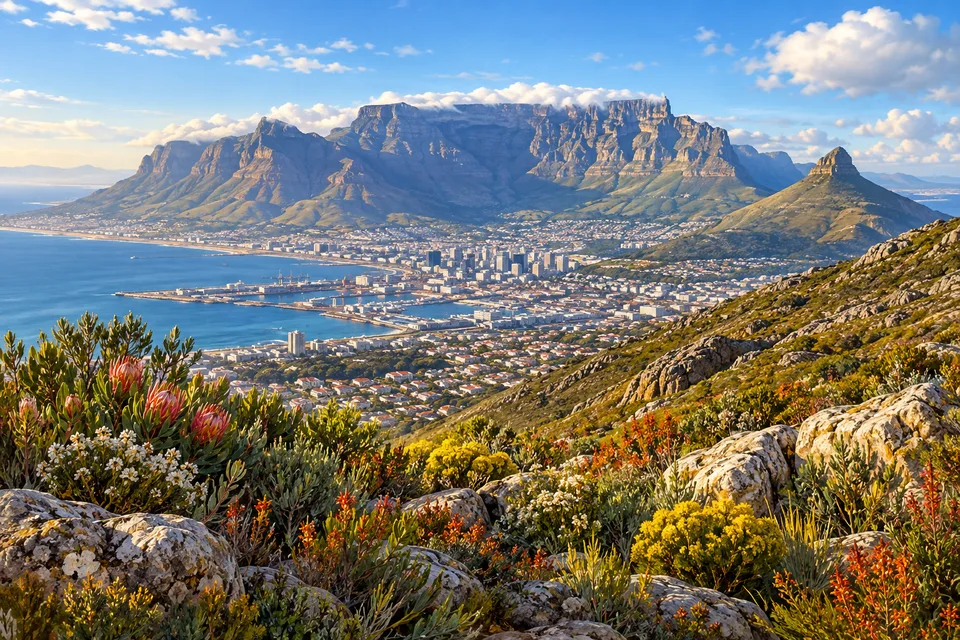
myAudience · original AI-generated landscape illustration · Original generated illustration; no documentary accuracy, current-condition or exact-viewpoint claim
The Cape’s dramatic mountain scenery also belongs to an extraordinary botanical region. The Cape Floral Region World Heritage property protects a series of areas across southwestern South Africa, showing that the landscape’s significance extends well beyond a single skyline.
Its characteristic fynbos vegetation contains exceptionally diverse plant life, including many species found only in this region. These low, often fine-leaved shrub communities can look modest beside a mountain wall, yet they are a major reason the area matters globally.
Plants here reveal distinctive ecological relationships. Fire adaptation, pollination and seed dispersal are important parts of the region’s scientific value. Some dispersal involves ants and termites, while pollinators include insects, birds and mammals. Small interactions help explain a landscape usually photographed at a much larger scale.
Protection has to address invasive species, changing fire conditions and development pressures. A mountain illustration becomes more informative when its foreground includes plausible native vegetation rather than generic tropical foliage. The Cape’s recognisable scenery and its botanical diversity belong together: the outline catches attention, while the plants provide much of the deeper ecological story.
Image: illustration, not a documentary photograph.
Further reading
Table Mountain makes a useful distinction between a striking landform and the living systems that occupy it. The broad summit and steep slopes catch the eye, but the vegetation is not merely a coloured covering laid over the rock. Conditions vary with exposure, moisture and the ground beneath the plants. SANParks' account of the Cape Floral Region links its exceptional diversity with those interactions, including nutrient-poor settings and specialised adaptations. A small plant can therefore tell a large environmental story. The question is not simply why so many flowers look different. It is how different combinations of conditions create opportunities for different organisms, and why changes to those conditions can affect some species much more than others.
Nutrient availability is one part of that story. A soil may support a rich variety of plants without providing abundant nutrients for rapid growth. Diversity and productivity are different ideas: the number of kinds of organism is not a measure of how much plant material a site produces in a year. This helps explain why a spectacular flowering landscape should not automatically be compared with a fertilised crop field. A species adapted to a restricted setting can persist through characteristics suited to that setting, while struggling when conditions change. Competition, access to resources and the timing of growth all belong to the explanation. Reading the landscape this way replaces the idea of effortless natural abundance with a more interesting account of constraints and adaptations.
Relationships with animals add another level. UNESCO and SANParks identify specialised pollination and seed dispersal among the region's important ecological processes. Pollination moves pollen between the relevant flower structures; dispersal moves seeds or fruits away from where they developed. They are related to reproduction but are not the same event. An animal visiting a flower may participate in the first process, while ants or termites can participate in the second. Separating those jobs makes a flowering landscape easier to understand. The visible bloom is one stage within a longer sequence: reproduction, the movement of offspring and establishment elsewhere. A beautiful flowerhead is thus also part of a set of interactions extending beyond the plant itself.
Specialisation can create vulnerability as well as opportunity. If a plant succeeds only within a narrow combination of conditions, losing those conditions may leave it with few alternatives. Likewise, a relationship involving a particular kind of pollinator can be affected by changes to the animal's habitat. That does not mean every local species has only one partner or that one missing insect always causes extinction. SANParks explicitly contrasts more specialised interactions with visitors that use a broader range of flowers. The point is to examine the dependencies rather than assume that all species respond alike. Conservation needs to include the connections that allow organisms to reproduce and persist, not only a count of conspicuous individual plants.
Fire is another process that cannot be reduced to a simple label of good or bad. The Cape Floral Region's official descriptions identify fire as part of its ecology and regeneration. Yet a fire-adapted system is not a system in which any fire at any time is harmless. A population's ability to recover depends on its reproductive stage, the survival of appropriate material and conditions after disturbance. This explains why the interval between disturbances matters conceptually: plants need opportunities to grow and reproduce between them. Our reading is about that ecological relationship, not an instruction to burn vegetation or a prescription for managing a particular site. The useful insight is that apparent destruction can be part of a longer biological sequence, while mistimed or altered disturbance can still damage it.
Moisture can also arrive in a form different from a downpour. SANParks describes the familiar tablecloth of cloud over the mountain as a product of particular wind and topographic conditions, and identifies fog as a source of water for summit vegetation. Tiny droplets contacting vegetation can contribute water to the local setting. This connects weather seen at a distance with the environment experienced by plants at ground level. It also shows why a general description of the region's climate is not enough to explain every habitat on the mountain. A wet summit patch and a more exposed slope can exist within the same wider landscape. Differences in moisture help create differences in what can grow there.
The foreground of our illustration brings these ideas back to a scale that is easy to notice: low shrubs, varied flowers and rocky ground before the city and mountain. It does not identify each depicted plant or prove that this exact combination grows at one viewpoint. It is a starting point for recognising that the vegetation deserves attention alongside the summit. SANParks identifies pressures including urbanisation, invasive species and climate change; their significance comes from their capacity to alter the processes just described. The landscape is impressive because of the connections between geology, weather and life. Looking closely at those connections makes Table Mountain an introduction to ecological thinking, rather than only a skyline to collect in a photograph.