Paris: reading a city along the Seine
By Cities to get lost in · myAudience
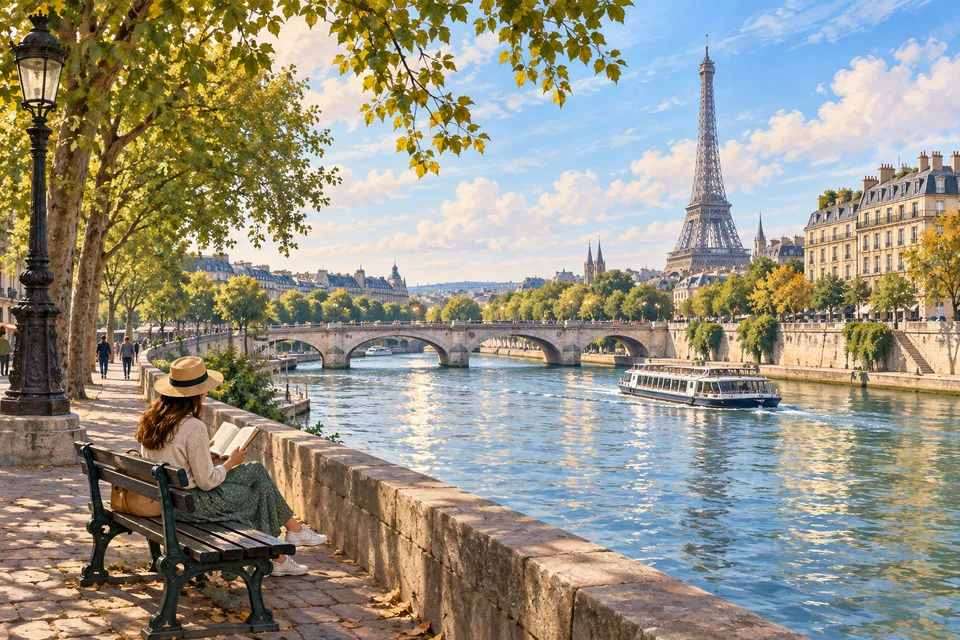
myAudience · original AI-generated landscape illustration · Original generated illustration; no documentary accuracy, current-condition or exact-viewpoint claim
The Seine provides a way to read several centuries of Paris without treating the city as a list of disconnected monuments. Bridges, quays, islands and buildings form a riverside sequence in which different periods remain visible together.
The World Heritage property includes the historic riverbanks between the Pont de Sully and Pont d’Iéna, together with the Île de la Cité and Île Saint-Louis. It is a defined part of the city, not a designation applied to every neighbourhood.
Notre-Dame and Sainte-Chapelle represent medieval architecture, while later palaces, urban ensembles and exhibition buildings add other layers. The Eiffel Tower belongs to the history of international exhibitions and iron architecture. Its visual relationship to the river is part of a much broader composition.
The large avenues and squares associated with Haussmann influenced urban planning elsewhere, but they are another chapter rather than the whole story of Paris. Looking at the river’s edges reveals how transport, state power, architecture and public space accumulated. The city’s recognisable skyline becomes more interesting when the differences between its buildings are allowed to remain visible.
Image: illustration, not a documentary photograph.
Further reading
Looking along a river changes how a city is read. Buildings that appear separate on a checklist become connected by crossings, embankments, islands and views. Along the Seine, the space between monuments matters as well as the monuments themselves. Ask how a route reaches a bridge, how a bank meets the water and which buildings address that shared edge. These relationships help explain an urban ensemble without reducing Paris to one landmark or assuming that every part of the city has the same history.
UNESCO describes a defined riverbank property, including bridges, quays and the two islands, between the Pont de Sully and Pont d'Iéna. Its boundary is a useful discipline: recognition of this ensemble is not a designation of every Paris neighbourhood. Within it, different periods are placed in relationship. To understand a particular building, distinguish its own history from the larger reasons that a stretch of river and its edges are considered together.
The official account identifies medieval buildings, later urban ensembles and structures associated with international exhibitions. Those are different categories of evidence, not variations of one timeless style. A building's relationship to a river view can be important while its fabric and purpose belong to a specific period. Reading the city means asking how those layers were added and connected. Visual similarity alone cannot tell us whether two structures share a date, an original function or a patron.
Pont Neuf offers a concrete example of crossing and city-making. The Musée Carnavalet records the laying of its first stone in 1578, interruption during the Wars of Religion, resumed work in 1592 and inauguration in 1607. Built at the downstream end of the Île de la Cité, it supplemented crossings damaged by floods and ice. The museum places the ensemble among early Parisian urban-planning projects. Its name, meaning 'new bridge', thus belongs to the history of its creation rather than a claim about recent construction. A crossing connects banks, but choosing its position also changes how an island and nearby streets participate in the city.
Decoration made this infrastructure a place to look as well as a route to cross. Carnavalet's collection includes a carved mascaron from Pont Neuf; its account describes masks representing figures from ancient mythology in the original decoration. A sculptural fragment can preserve evidence of this visual programme even when it is separated from the bridge. Set that example beside UNESCO's riverbank ensemble, which brings medieval Notre-Dame and Sainte-Chapelle into relationship with later developments such as the Louvre and the Eiffel Tower. Paris's riverside history is not one consistent style: it is a succession of religious, royal, civic and exhibition projects organised around a shared river edge.
The UNESCO account connects Haussmann's avenues and squares with an influential period of urban planning. Influence does not mean that every broad street in another city has the same origin or that one planning approach explains all of Paris. Comparisons need dated plans, records and attention to local conditions. They can identify a relationship while allowing differences to remain. This avoids treating familiar visual vocabulary as a substitute for the histories of people, construction and changing uses.
The illustration places a bridge between two banks, with quays, a boat, buildings and an Eiffel-inspired silhouette forming a readable sequence. Follow those edges before choosing a single focal point. The scene demonstrates how a river can organise a composition, but it is not an authenticated view from a surveyed position. It cannot identify the bridge, date all the facades or establish present boat services. Its inviting public space prompts questions about use without documenting who can use each part today.
Check: A fictional plan keeps a bridge facade but disconnects one end from surrounding streets. Its author claims that the riverside ensemble is unchanged because the monument remains. Assess the claim. Answer: The visible facade may remain, but connectivity and use change. Compare architectural fabric with route maps, bank and island relationships, and evidence of use. Preserving one object does not prove that an ensemble's relationships are unchanged. This is a reasoned model argument, not a finding about a real Paris bridge.