Rome: buildings that kept changing their jobs
By Cities to get lost in · myAudience
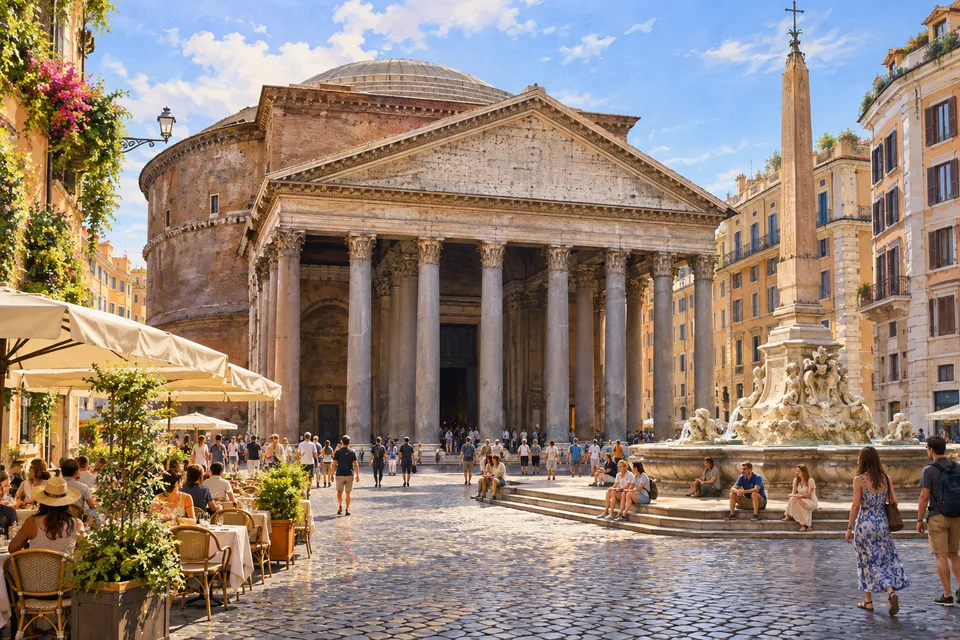
myAudience · original AI-generated landscape illustration · Original generated illustration; no documentary accuracy, current-condition or exact-viewpoint claim
Rome’s historic centre contains ancient remains within a continuously inhabited city. Its character comes partly from that layering: streets, monuments, churches and palaces belong to different periods but occupy a shared urban fabric.
The Roman and Imperial Forums, Pantheon and monumental columns preserve aspects of the ancient city. Later Christian Rome reused spaces, buildings and materials, so the change was not simply a replacement of one complete city with another. Older structures continued to affect new uses.
Renaissance and Baroque projects added another strong layer, including palaces, churches and public squares. These buildings helped shape architectural models that travelled beyond Rome. The historic centre therefore records both local change and the city’s wider influence.
Water is another thread through its history. Aqueducts, drainage systems, fountains and later river works show that a capital depends on infrastructure as well as monuments. The legendary foundation story of Romulus and Remus belongs to Rome’s cultural memory; it should not be confused with a precisely verified account of the city’s earliest development. The visible city offers evidence accumulated over many centuries.
Image: illustration, not a documentary photograph.
Further reading
An old column can become part of a newer building, and a newer use can give an old structure a different place in daily life. Rome offers an introduction to this kind of layered evidence. Rather than choose one date for a whole scene, ask separate questions about manufacture, assembly, alteration and use. A city can retain material from an earlier period while changing its institutions and purposes. Its history is therefore not simply a sequence in which each new city removes the one before it.
The UNESCO account describes archaeological areas integrated into Rome's urban fabric and the reuse of spaces, buildings and materials in later Christian Rome. Reuse is a process with more than one chronology. A component may be older than the structure that contains it, while the current activity may be newer than both. To investigate a particular example, the broader account must be joined with contextual evidence: how the material is fitted, what records survive and which changes can be identified in the fabric.
Renaissance and Baroque projects added further forms to the city. That is not merely an afterword to antiquity. A later square, church or palace can be historically significant in its own right, and the relation between old and new can itself be evidence. Treating every later alteration as an obstacle to an original ideal risks losing the history of those decisions. A careful explanation distinguishes identifying a change from deciding how its value should be assessed.
Water systems widen the story beyond prominent monuments. UNESCO includes drainage, aqueducts, fountains and later works along the Tiber among the city's layered infrastructure. These features concern movement, supply and urban organisation as well as appearance. Their mention does not make every fountain in an illustration part of one unchanged ancient network. Different structures can serve related needs in different periods; plans, material relationships and dated records are needed to connect an individual object to a particular system.
The Pantheon provides a named case in which an old building acquired a different role. Rome's municipal account distinguishes Agrippa's earlier commission from the present building rebuilt under Hadrian, and records its dedication as Santa Maria ad Martyres in 609. Its portico and circular interior belong to an ancient architectural form that continued within Christian use. The interior receives daylight through the opening at the dome's centre, so the experience of the space also depends on a physical design decision. Reading the building through these stages makes reuse more concrete: a change of institution can preserve substantial fabric while adding a new history to it.
Water supply shows a related pattern beyond the famous monument. The municipality dates Trajan's aqueduct to 109 and traces water from springs near Lake Bracciano towards Rome, largely underground and then along arches to the Janiculum. Its account records repeated interruption and repair, followed by abandonment around the ninth century. In 1612, Paul V enlarged and altered the route as the Acqua Paola, ending it with a monumental fountain. This is a documented history of reworking infrastructure, not uninterrupted service from antiquity. A fountain can be the visible endpoint of a much longer system of sources, conduits and rebuilding that a square alone does not reveal.
The illustration presents a Pantheon-inspired portico and rotunda alongside an obelisk, fountain, surrounding buildings and contemporary activity. Compare the forms without assigning them one date. It makes coexistence visible, but the arrangement is interpreted rather than a certified archaeological or architectural survey. No inscription is authenticated, and the people are not historical evidence about a community. The scene can invite a layered reading of the city while leaving exact dates and construction relationships to appropriate sources.
Check: A later church contains a reused ancient column. A caption dates the whole building to the column and describes every later alteration as a loss. Evaluate it. Answer: The column can predate the structure that reuses it. Separate material manufacture, assembly and subsequent changes using contextual records and fabric relationships. Later work may be historically meaningful too. An age inference for one component is not a date for the whole building, and identifying an alteration does not by itself decide its conservation value.