Tokyo through Asakusa: temple, shops and river
By Cities to get lost in · myAudience
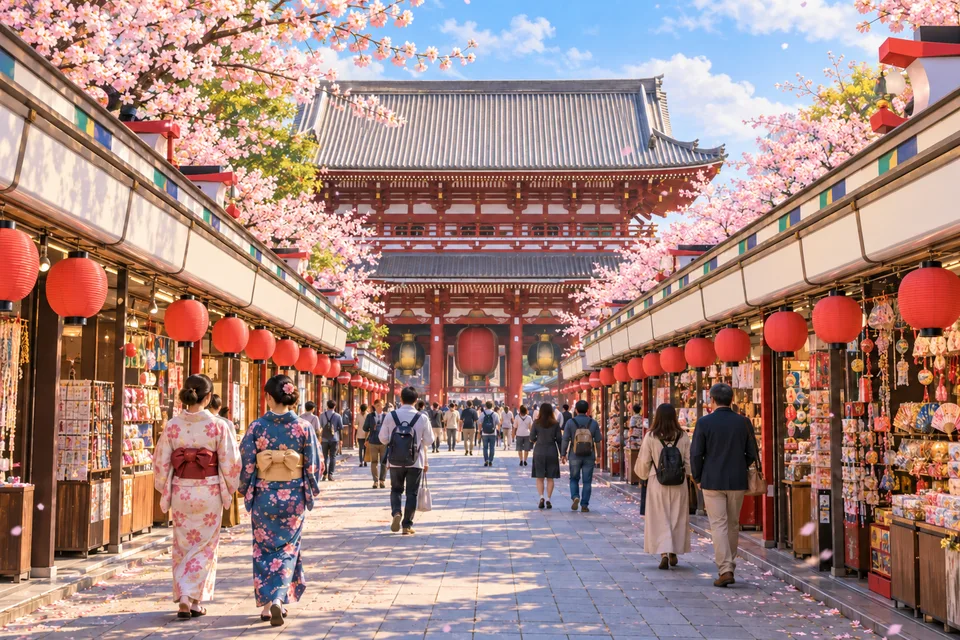
myAudience · original AI-generated landscape illustration · Original generated illustration; no documentary accuracy, current-condition or exact-viewpoint claim
Asakusa offers one way into Tokyo’s layered urban life. Sensō-ji, the Kaminarimon gate and the shop-lined Nakamise approach form a familiar sequence, while the nearby Sumida River connects the district to the wider city.
The temple’s origin story describes a statue of Kannon found by fishermen in the river. That is a religious tradition, not an archaeological report. The current main hall is also more recent than the temple’s long institutional history: it was rebuilt after destruction during the Second World War.
Nakamise combines the temple approach with commerce. Crafts, souvenirs and snacks make the street an active place rather than a museum corridor. Nearby Kappabashi adds another specialised urban world through kitchen equipment and realistic food models used for display.
The riverfront introduces a different scale, with bridges, boats and views toward Tokyo Skytree. A single district can therefore connect religious practice, shopping, entertainment and transport without representing every side of Tokyo. Its appeal lies in those overlapping activities, not in imagining that a modern metropolis has somehow stopped changing around an isolated old neighbourhood.
Image: illustration, not a documentary photograph.
Further reading
The approach to Sensō-ji offers a useful way to read a city on foot. A gate establishes a threshold, a line of shops gives the route direction, and a religious destination draws people along it. These are different functions operating in the same space. Someone buying kitchenware, a worshipper arriving for prayer and a visitor admiring the roofline may share part of a journey without sharing its purpose. That makes Asakusa more interesting than a simple contrast between old and new Tokyo. Its institutions keep working because people continue to use them in overlapping ways. The district is a place of relationships: between a temple and its approaches, businesses and their customers, and a neighbourhood and the wider riverfront.
The temple gives a specific account of its beginnings. Its tradition places the discovery of an image of Kannon by two fishermen in 628, followed by recognition and worship of the image within the community. It also associates the concealment of the principal image with the priest Shōkai in 645. Those are statements about the temple's remembered sacred history, rather than a claim that every detail has archaeological confirmation. A concealed sacred image changes what a visitor is there to do: devotion need not depend on inspecting the object like a museum exhibit. The institution, rituals and buildings around it sustain the relationship. Recognising that difference helps explain why a religious site's significance cannot be reduced to the age of its oldest visible material.
Reconstruction is essential to the story of the present buildings. Sensō-ji identifies the destruction of its main hall in the air raid of 10 March 1945 and the completion of the rebuilt hall in 1958, supported by donations. Its pagoda was also lost in the war and rebuilt in 1973. The Kaminarimon gate has a different sequence: destruction by fire in 1865 and reconstruction in 1960. These dates separate three histories that a photograph can easily collapse into one. They also show why rebuilding can be an expression of continuity rather than evidence that a place has ceased to matter. People chose to restore a recognisable setting for worship and public life after immense destruction. The age of the institution and the construction date of a particular building answer different questions.
A large temple hall organises movement internally as well as from the street. Sensō-ji describes an outer worship area and an inner sanctuary within its main hall. The distinction helps make sense of a building that accommodates many visitors while protecting a more restricted sacred focus. Architectural scale is therefore connected to practice: an approach can gather people, a broad hall can receive them, and a boundary can distinguish kinds of access. The same reasoning applies outside the hall. Passing beneath a gate directs attention forward, but it does not mean that every space beyond it has the same purpose or rules. Learning the institution's own terms is more useful than treating all roofed buildings as interchangeable examples of a single style.
Nakamise is also part of the experience, rather than an accidental distraction from it. The official Tokyo district guide presents its shops alongside the temple approach. Buying a snack or a souvenir is a different activity from worship, yet both contribute to the route's everyday use. A shopfront works at the scale of hands and faces; a large gate works at the scale of the street. The repeated smaller openings along the approach create opportunities to stop, while the monument at the end provides orientation. This is an interpretation of the visible arrangement, not a claim that we know every shop's history. It explains why looking at the spaces between buildings can reveal as much about urban life as looking up at a famous roof.
Nearby Kappabashi introduces a more specialised kind of commerce. GO TOKYO identifies kitchen utensils and the realistic food models displayed there. A model meal is an object made to communicate, rather than food made to nourish: its usefulness depends on showing shape, portion and arrangement convincingly. That difference offers a small lesson in design. A physical display can make an unfamiliar dish easier to recognise before ordering, while the makers and suppliers belong to an economy of restaurants and equipment. Moving from Nakamise to a kitchenware district therefore shifts the question from what a visitor might take home to what another business needs to work. It is a reminder that attractive neighbourhoods are supported by practical trades as well as landmarks.
The Sumida River broadens the view again. The district guide connects Asakusa with a riverfront and boat travel, so the water can be understood as a route as well as scenery. A street funnels movement along a narrow ground-level line; a river opens a longer view across banks, bridges and the skyline. Comparing those settings makes the scale of Tokyo easier to grasp. You can also use the contrast to organise a reading of the illustration: notice the close shopfronts, the central passage and the building that closes the view, then imagine how a wider waterfront changes that sense of enclosure. The point is to recognise a sequence of spaces, not to use an interpreted image as a map. Asakusa rewards attention because religious memory, reconstruction, trade and movement remain connected within an active modern city.