Atoms, elements and compounds
By UK GCSE Chemistry · independent study · myAudience
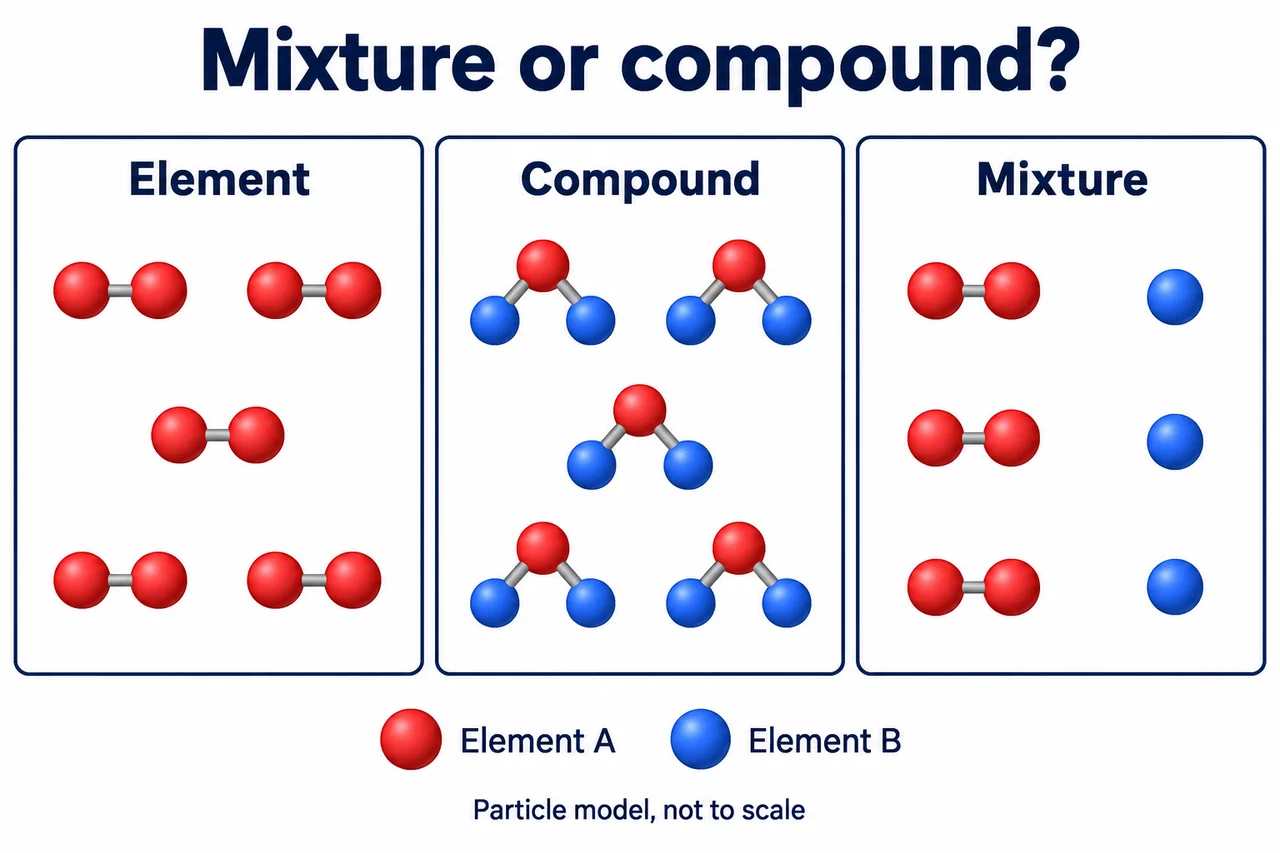
Image: illustration, not a documentary photograph. Original teaching model created for myAudience. · Original generated teaching illustration; no source textbook artwork reproduced.
Atoms, elements and compounds
An atom is the smallest unit that retains the chemical identity of an element. An element contains atoms with one particular proton number. Oxygen gas consists of pairs of oxygen atoms, O₂, but is still an element: joining two atoms of the same element does not create a compound.
A compound contains at least two different elements chemically joined in a fixed ratio. Water is H₂O: its formula describes two hydrogen atoms for each oxygen atom. Separating hydrogen from water requires a chemical change; filtering water cannot undo its chemical bonds. A mixture has no such fixed formula.
Equations record changes without creating or destroying atoms. In 2H₂ + O₂ → 2H₂O, four hydrogen and two oxygen atoms occur on each side. Balance by changing coefficients before formulas, never the small numbers inside them. Higher-tier ionic equations remove spectator ions; a valid ionic equation conserves both atoms and total charge.
The first twenty elements are hydrogen H, helium He, lithium Li, beryllium Be, boron B, carbon C, nitrogen N, oxygen O, fluorine F, neon Ne, sodium Na, magnesium Mg, aluminium Al, silicon Si, phosphorus P, sulfur S, chlorine Cl, argon Ar, potassium K and calcium Ca. Capitals matter: Co names cobalt, whereas CO describes carbon monoxide. A word equation such as hydrogen + oxygen → water records names; the balanced symbol equation adds atom counts. Higher-tier half-equations account explicitly for electron transfer, for example Na → Na⁺ + e⁻ and Cl₂ + 2e⁻ → 2Cl⁻.
Worked example: Balance hydrogen reacting with oxygen to form water.
Count H and O on both sides of H₂ + O₂ → H₂O.
Put 2 before H₂O to give two oxygen atoms on the right.
Put 2 before H₂ to give four hydrogen atoms on the left.
Answer: 2H₂ + O₂ → 2H₂O
Check your understanding: Is O₂ a compound?
Answer: No; it is an elemental molecule.
Why: Both atoms have the same elemental identity. A compound needs different elements.