Separating mixtures
By UK GCSE Chemistry · independent study · myAudience
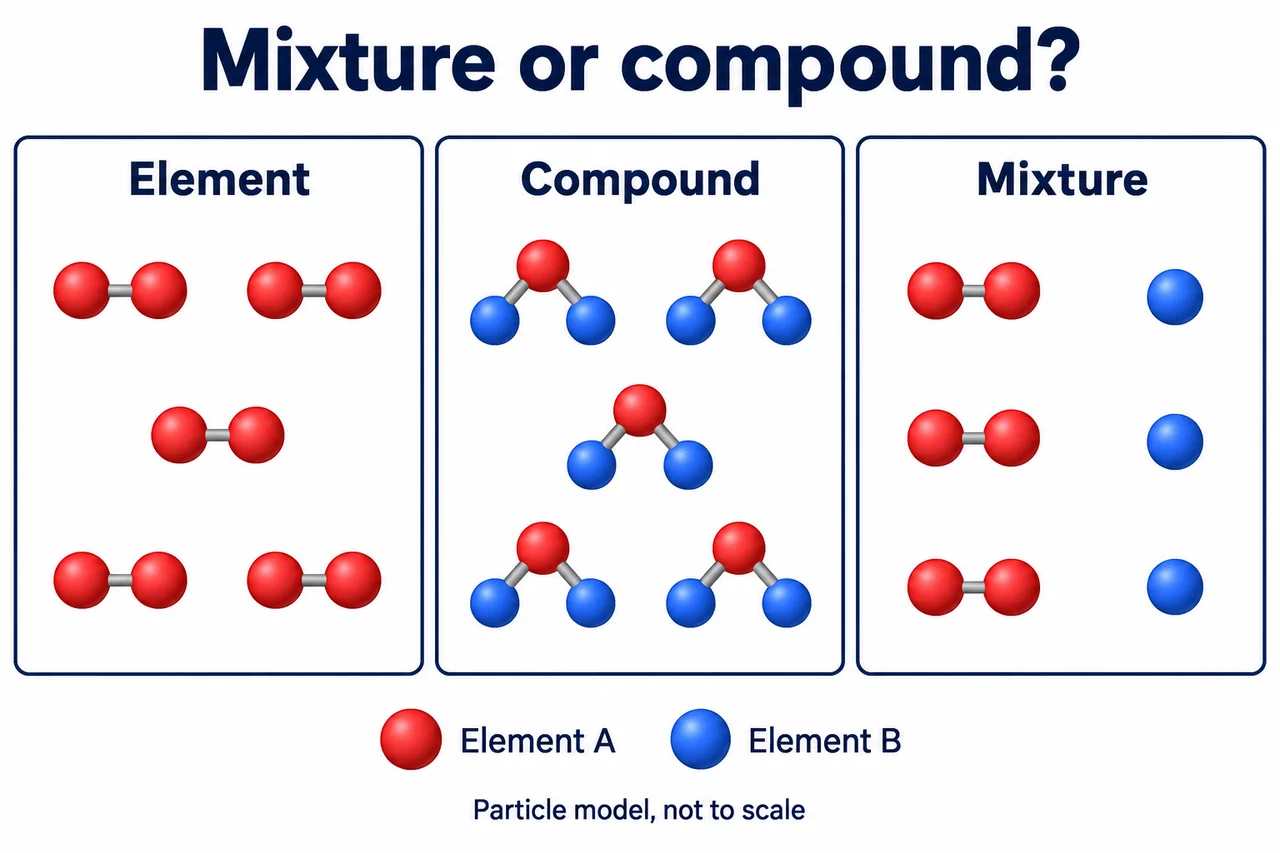
Image: illustration, not a documentary photograph. Original teaching model created for myAudience. · Original generated teaching illustration; no source textbook artwork reproduced.
Separating mixtures
In a mixture, substances occupy the same sample without all being chemically bonded together. Their proportions can vary. Physical separation exploits a difference such as particle size, boiling point or attraction to a surface; it does not turn one element into another.
Filtration separates an insoluble solid from a liquid. The solid is the residue and the liquid passing through is the filtrate. Dissolved salt passes through ordinary filter paper with water. Crystallisation can recover a dissolved solid by concentrating a solution and allowing crystals to form; excessive heating may damage some solutes.
Simple distillation evaporates a liquid then condenses its vapour into a separate container. Fractional distillation is used to separate liquids with different boiling points more effectively. In paper chromatography, components travel differently because of their interactions with the solvent and paper. These methods belong in a supervised laboratory with an appropriate risk assessment.
Worked example: Choose a way to recover clean water from salty water.
The salt is dissolved, so filtration cannot remove it.
Evaporate the water and collect its vapour in a condenser.
Keep the condensed water separate from the remaining salt.
Answer: Simple distillation
Check your understanding: Why is filtering salt water unsuccessful?
Answer: Dissolved salt passes through the filter with the water.
Why: Filter paper retains sufficiently large insoluble particles, not dissolved ions.