Evidence changes atomic models
By UK GCSE Chemistry · independent study · myAudience
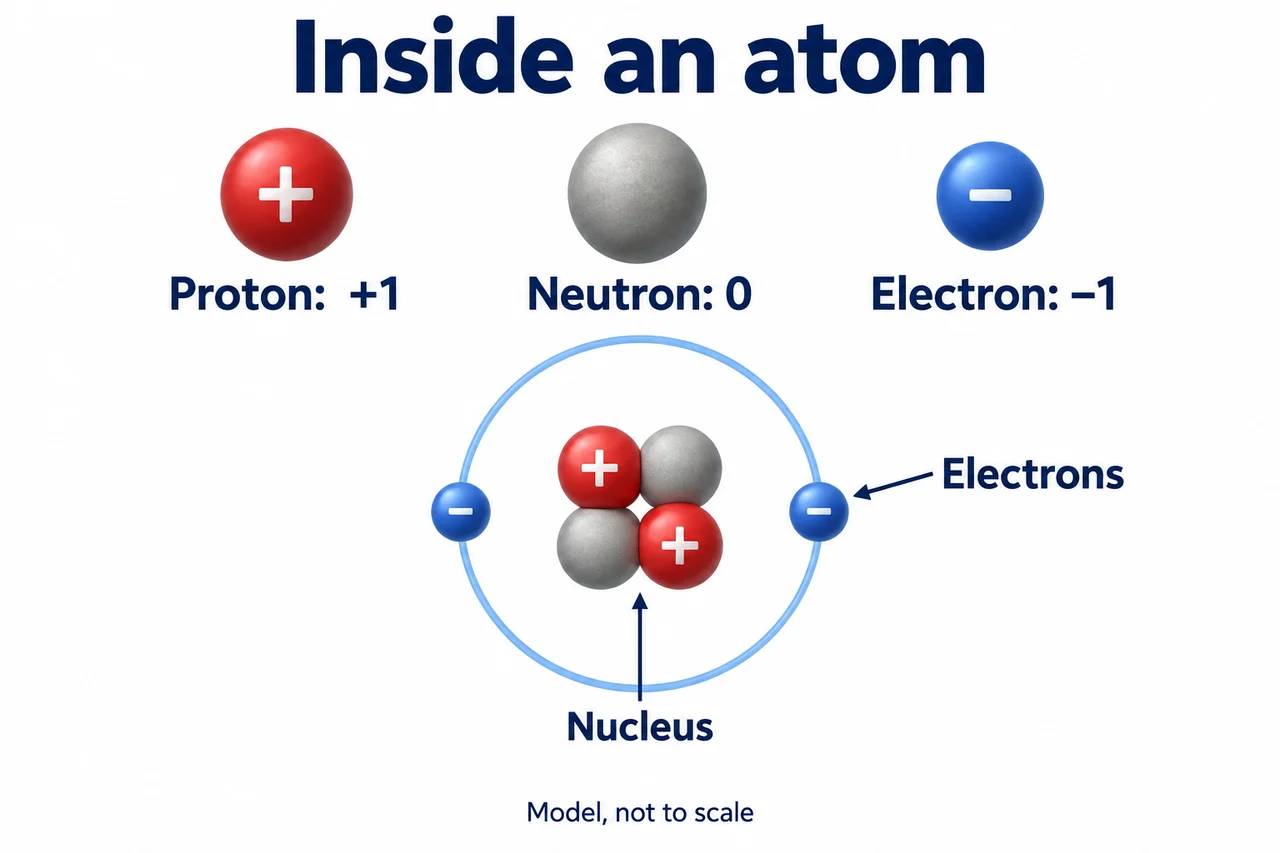
Image: illustration, not a documentary photograph. Original teaching model created for myAudience. · Original generated teaching illustration; no source textbook artwork reproduced.
Evidence changes atomic models
Atomic models are explanations built to fit evidence, not photographs of the inside of an atom. Early solid-sphere models helped explain chemical combinations. Discovering electrons showed that atoms contained smaller charged components, so an indivisible sphere was insufficient.
The plum-pudding model spread positive charge through the atom with electrons embedded in it. Alpha-particle scattering then found that most particles crossed thin metal foil, some deflected and a tiny fraction returned through large angles. A small, dense, positively charged nucleus accounts for those rare strong deflections; most atomic volume is empty in this model.
Later models placed electrons in discrete energy levels and incorporated neutrons into nuclei. Each revision retained useful earlier ideas while addressing evidence they could not explain. Shell diagrams are useful GCSE models but electrons are not miniature planets following measured circular paths.
Bohr added specified electron energy levels to the nuclear model. Chadwick provided evidence for neutrons later, helping explain nuclear mass without requiring extra positive charge. Their work addressed different questions; discovering a nucleus did not instantly establish all the components and arrangements used in a modern school model.
Worked example: Explain why rare large deflections mattered.
Alpha particles are positively charged.
A compact positive region can strongly repel a particle passing very close to it.
A diffuse positive background would not account for the same concentration of strong deflections.
Answer: The evidence supported a small concentrated positive nucleus.
Check your understanding: Did most alpha particles bounce back?
Answer: No; most passed through.
Why: The contrast between frequent passage and rare strong deflection was central to the inference.