Charges and neutral atoms
By UK GCSE Chemistry · independent study · myAudience
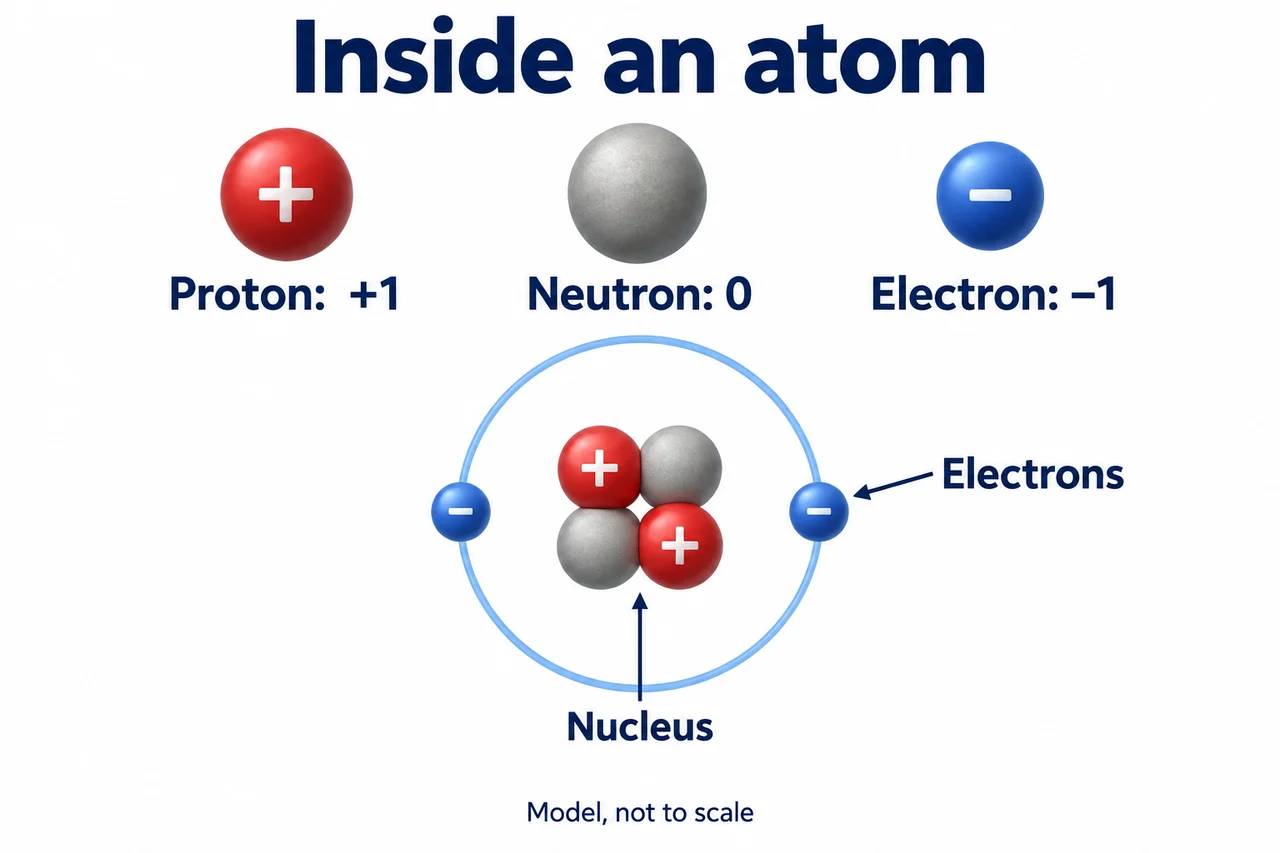
Image: illustration, not a documentary photograph. Original teaching model created for myAudience. · Original generated teaching illustration; no source textbook artwork reproduced.
Charges and neutral atoms
A proton carries relative charge +1, a neutron 0 and an electron −1. Protons and neutrons are in the nucleus. Electrons occupy the surrounding region. Relative charge compares particles on a common scale; it is not a charge measured in coulombs.
A neutral atom has equal numbers of protons and electrons, so its total charge is zero. Neutrons contribute no electric charge. Losing an electron creates a positive ion; gaining an electron creates a negative ion. Ordinary chemical reactions change electron arrangements rather than the proton number.
Keep elemental identity and net charge separate. A sodium atom and sodium ion both have 11 protons. The atom has 11 electrons; Na⁺ has 10. Changing the proton count would change the element, not merely charge the same atom.
Worked example: Find the charge of a particle with 12 protons and 10 electrons.
Protons contribute +12 in relative units.
Electrons contribute −10.
Add the contributions: +12 − 10 = +2.
Answer: Relative charge +2
Check your understanding: Does adding a neutron change the charge?
Answer: No.
Why: A neutron has zero electric charge, although adding one changes the isotope and mass.