Atomic number, mass and scale
By UK GCSE Chemistry · independent study · myAudience
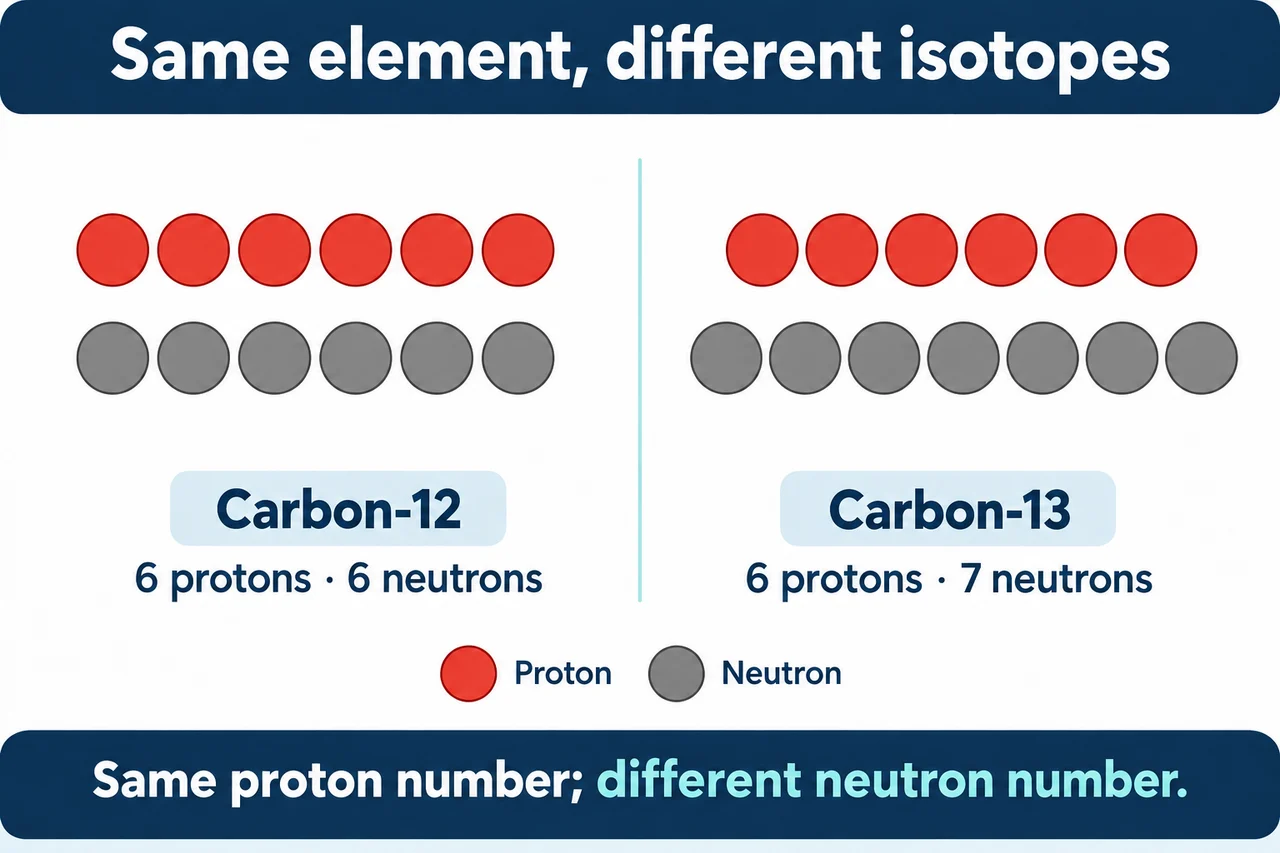
Image: illustration, not a documentary photograph. Original teaching model created for myAudience. · Original generated teaching illustration; no source textbook artwork reproduced.
Atomic number, mass and scale
The atomic number is the number of protons. The mass number of a particular isotope is the total number of protons and neutrons. Subtract atomic number from mass number to find neutrons. A neutral atom also has electrons equal to its atomic number.
A proton and a neutron each have relative mass approximately 1; an electron has a much smaller mass, about 1/1836 of a proton. Almost all atomic mass is concentrated in the nucleus. Mass number is a whole-number particle count, not the same as the weighted relative atomic mass shown on a periodic table.
A typical atomic radius is of order 10⁻¹⁰ m. A nucleus is far smaller, of order 10⁻¹⁴ m or less. These are approximate scales, not universal dimensions for every atom. Enlarging a model to display individual particles destroys a literal scale relationship, so teaching diagrams must say when they are not to scale.
A 0.1 nm atomic radius is 0.1 × 10⁻⁹ m, or 10⁻¹⁰ m. Comparing this with a 10⁻¹⁴ m nuclear radius gives a ratio of 10,000. If the atom in this rough scale model had a radius of 1 m, the nucleus would have a radius around 0.1 mm. Real nuclei differ; the exercise teaches order of magnitude rather than an exact universal size.
Worked example: Count particles in a neutral atom with atomic number 17 and mass number 35.
Protons = 17.
Electrons = 17 because the atom is neutral.
Neutrons = 35 − 17 = 18.
Answer: 17 protons, 18 neutrons and 17 electrons
Check your understanding: Why is mass number not usually a decimal?
Answer: It counts whole protons and neutrons in one isotope.
Why: A decimal relative atomic mass instead reflects an isotope mixture and a reference mass scale.