Calculating relative atomic mass
By UK GCSE Chemistry · independent study · myAudience
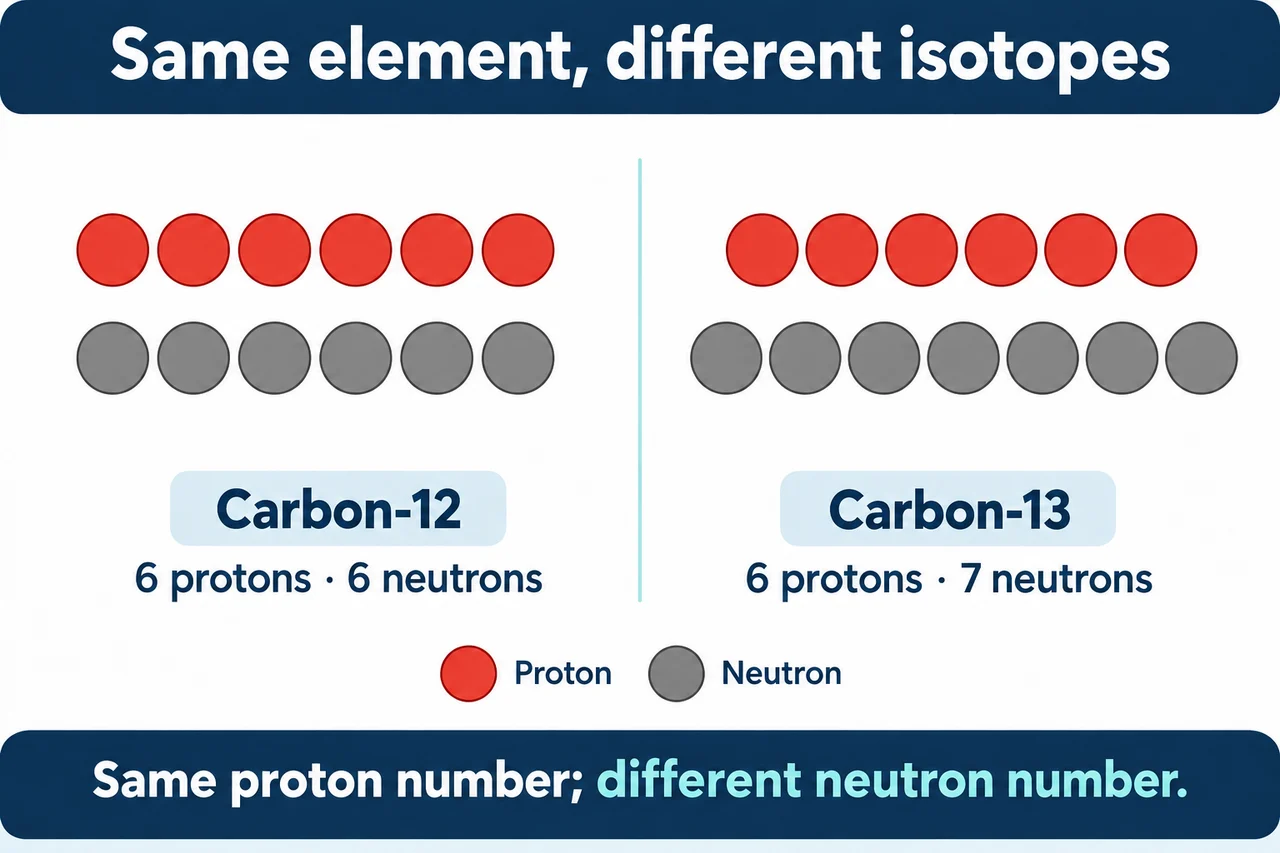
Image: illustration, not a documentary photograph. Original teaching model created for myAudience. · Original generated teaching illustration; no source textbook artwork reproduced.
Calculating relative atomic mass
Isotopes of an element have the same proton number but different neutron numbers. They occupy the same elemental place in the periodic table and usually have very similar chemistry because their electron structures are similar. Their different masses affect a weighted mean.
Relative atomic mass compares an average atom with one twelfth of the mass of a carbon-12 atom. It has no unit. An isotope that is more abundant contributes more strongly to the average. Multiply each isotope mass by its percentage abundance, add the products and divide by 100.
A mean must lie between the smallest and largest masses in the sample. If abundances do not add to 100%, first establish whether they are ratios or percentages. GCSE problems commonly use mass numbers as isotope masses; real precise isotope masses are not all exact integers.
Worked example: A sample is 75% isotope of mass 35 and 25% isotope of mass 37. Calculate its mean.
35 × 75 = 2625.
37 × 25 = 925.
(2625 + 925) ÷ 100 = 35.5.
Answer: Relative atomic mass 35.5
Check your understanding: Why is the answer closer to 35 than 37?
Answer: The lighter isotope is more abundant.
Why: A weighted average gives greater influence to the 75% portion.