Electron shells and the first twenty elements
By UK GCSE Chemistry · independent study · myAudience
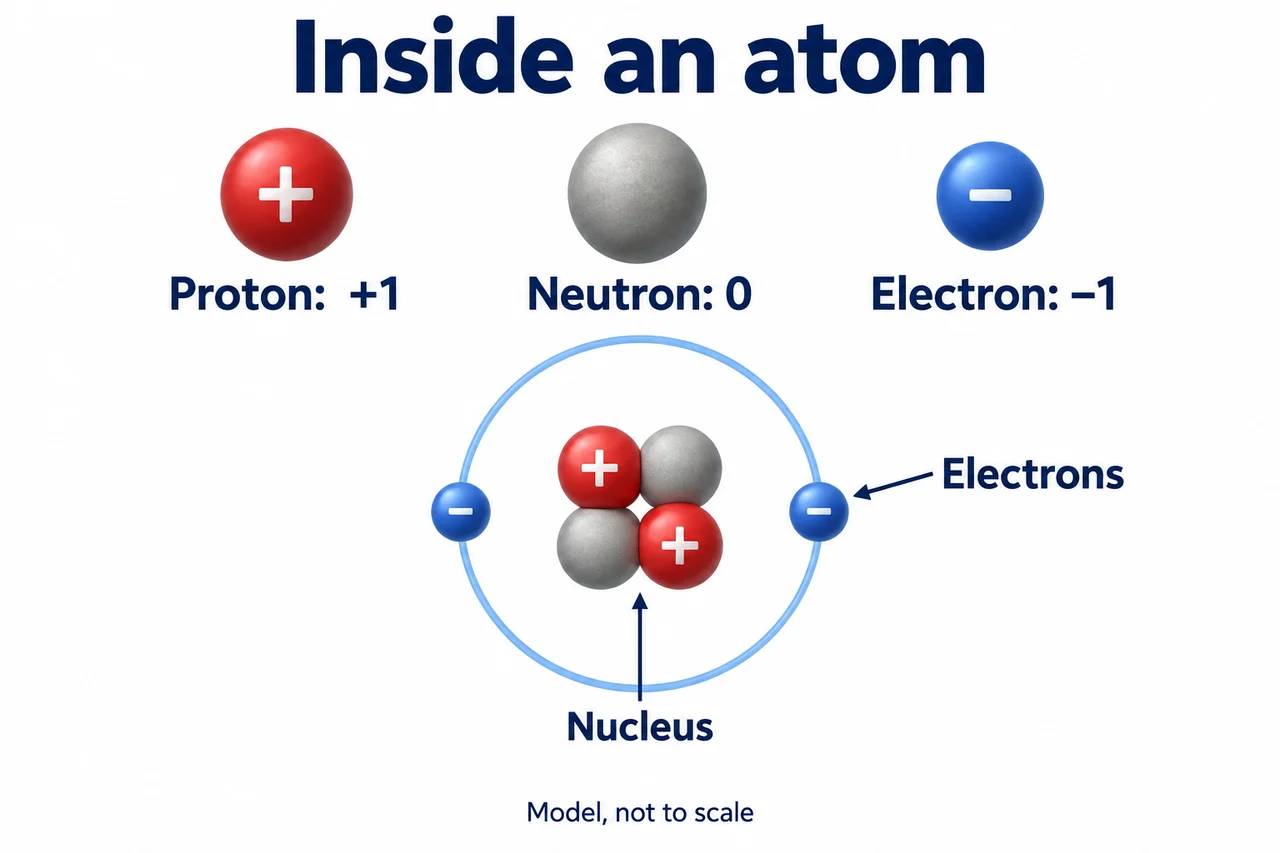
Image: illustration, not a documentary photograph. Original teaching model created for myAudience. · Original generated teaching illustration; no source textbook artwork reproduced.
Electron shells and the first twenty elements
Electrons occupy energy levels, often drawn as shells. For the first twenty elements, the GCSE shell model fills the first shell with up to two electrons, then uses up to eight in the second and third before placing electrons in the fourth. This limited rule should not be extended unchanged to all heavier elements.
A neutral atom has electrons equal to its proton number. Sodium, atomic number 11, is represented as 2,8,1. Calcium, atomic number 20, is 2,8,8,2. The number of occupied shells links to the period; for the main groups, outer-shell electrons help explain chemical similarity.
Shell structure is a model of energy organisation. Circles are not observed orbital tracks, and the spaces in a diagram do not imply electrons are stationary. When representing an ion, keep the proton number fixed and adjust the electron count to match its charge.
Worked example: Write the shell arrangement for neutral magnesium, atomic number 12.
There are 12 electrons.
Place 2 in the first shell, leaving 10.
Place 8 in the second shell, leaving 2 in the third.
Answer: 2,8,2
Check your understanding: What changes when sodium forms Na⁺?
Answer: Its outer electron is lost: 2,8,1 becomes 2,8.
Why: The nucleus remains sodium; the positive charge comes from having one fewer electron than proton.