Reading the periodic table
By UK GCSE Chemistry · independent study · myAudience
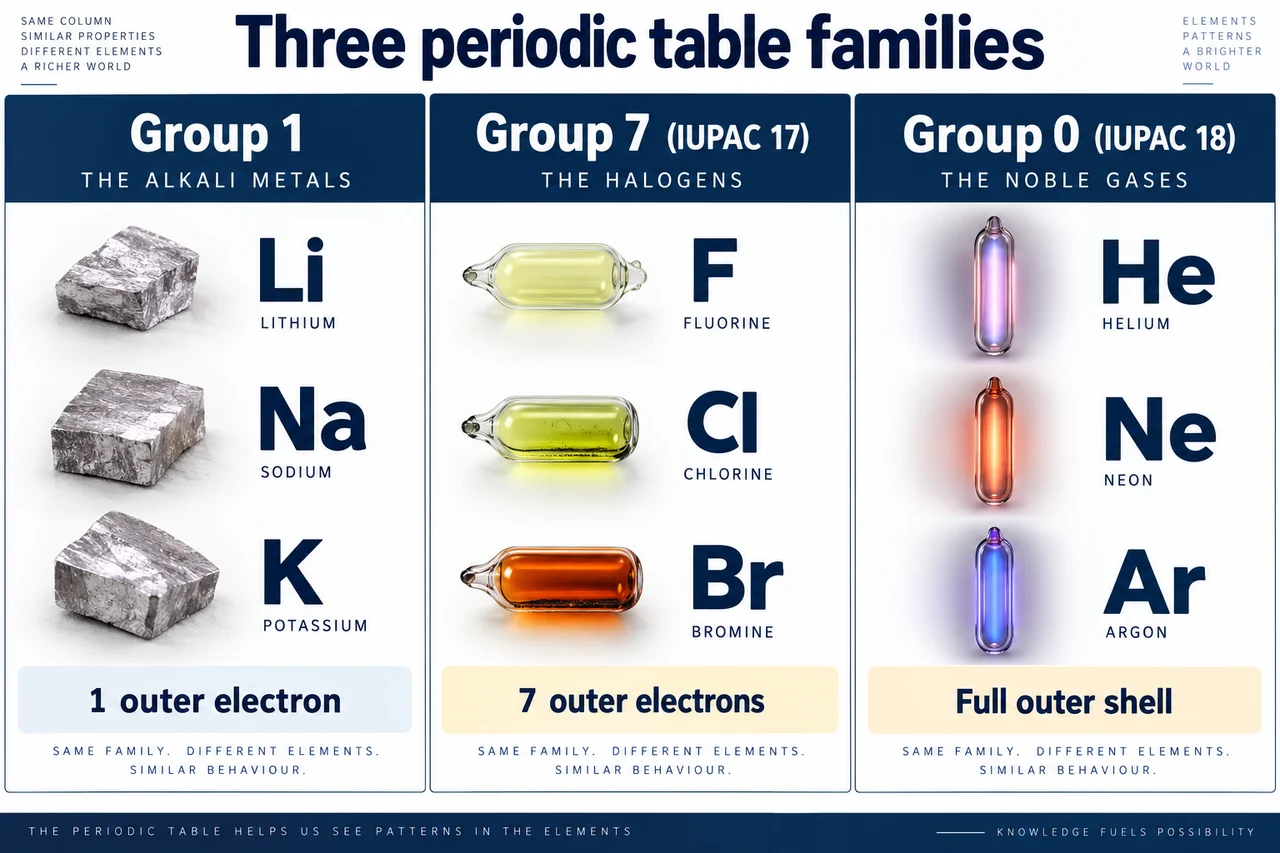
Image: illustration, not a documentary photograph. Original teaching model created for myAudience. · Original generated teaching illustration; no source textbook artwork reproduced.
Reading the periodic table
The modern periodic table orders elements by increasing atomic number. A period is a horizontal row and a group is a vertical column. Repeating outer-electron arrangements produce repeating chemical behaviour, so the layout is a predictive tool rather than merely a list.
Elements in a main group have similar chemical properties because they have related outer-shell structures. Sodium and potassium each have one outer electron in the GCSE model; chlorine and bromine each have seven. Going down a group adds occupied shells, increasing the distance between outer electrons and the nucleus.
GCSE uses Group 0 for noble gases and Group 7 for halogens. International numbering calls these Groups 18 and 17 respectively. Always establish the numbering convention; modern IUPAC Group 7 refers to a different transition-metal column.
Worked example: Compare sodium 2,8,1 with potassium 2,8,8,1.
Both have one outer electron.
Potassium has one more occupied shell.
Predict related chemistry but not identical reactivity.
Answer: They are in the same main group but different periods.
Check your understanding: Do elements in a period all have the same outer-electron count?
Answer: No.
Why: Moving across a period generally adds electrons to the outer energy level in the simple main-group model.