How the table became predictive
By UK GCSE Chemistry · independent study · myAudience
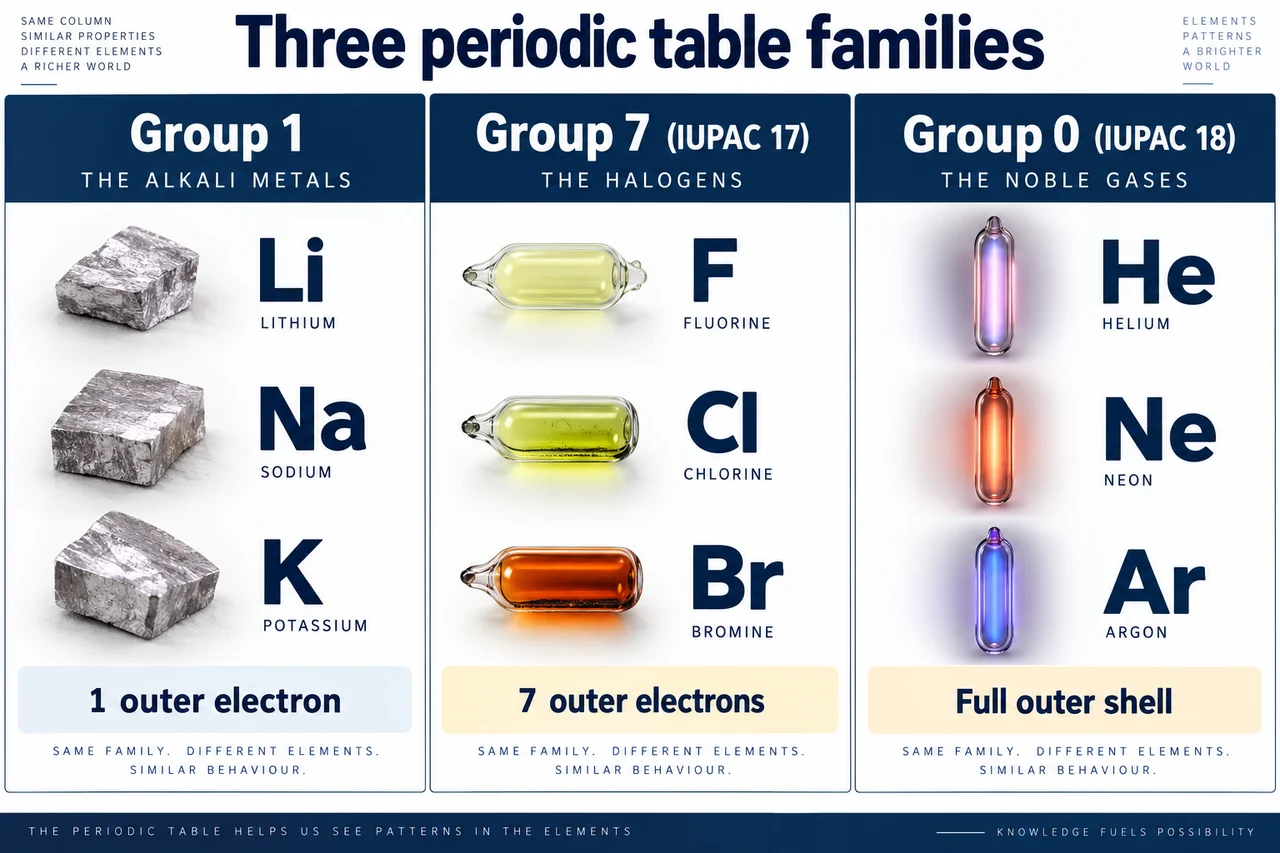
Image: illustration, not a documentary photograph. Original teaching model created for myAudience. · Original generated teaching illustration; no source textbook artwork reproduced.
How the table became predictive
Early attempts arranged elements mainly by atomic weight, before proton numbers were known. A strict mass order sometimes placed chemically dissimilar elements together. Newlands recognised repeating patterns but his arrangement had limits as more elements were considered.
Mendeleev prioritised chemical relationships when mass order conflicted with them, left gaps and predicted properties of missing elements. Later discoveries could be compared with those predictions. That made the table a testable explanatory system rather than a catalogue that simply accommodated every observation after the event.
Knowing atomic numbers later explained why mass order has exceptions: isotopic averages need not increase in exactly the same order as proton counts. The modern table preserves the useful family patterns while using a more fundamental ordering quantity. Scientific success came from revision and evidence, not from an infallible first draft.
Worked example: Why did leaving a gap strengthen a table?
A gap specified that an element was missing rather than forcing a bad fit.
Properties could be predicted from neighbouring family patterns.
A later discovery could test those predictions.
Answer: The gap allowed a risky prediction to be checked against new evidence.
Check your understanding: Why is atomic weight not the modern ordering rule?
Answer: Atomic number defines elemental identity and explains repeating electron structures.
Why: Weighted isotope masses can give exceptions to a strictly increasing mass sequence.