Metals and non-metals
By UK GCSE Chemistry · independent study · myAudience
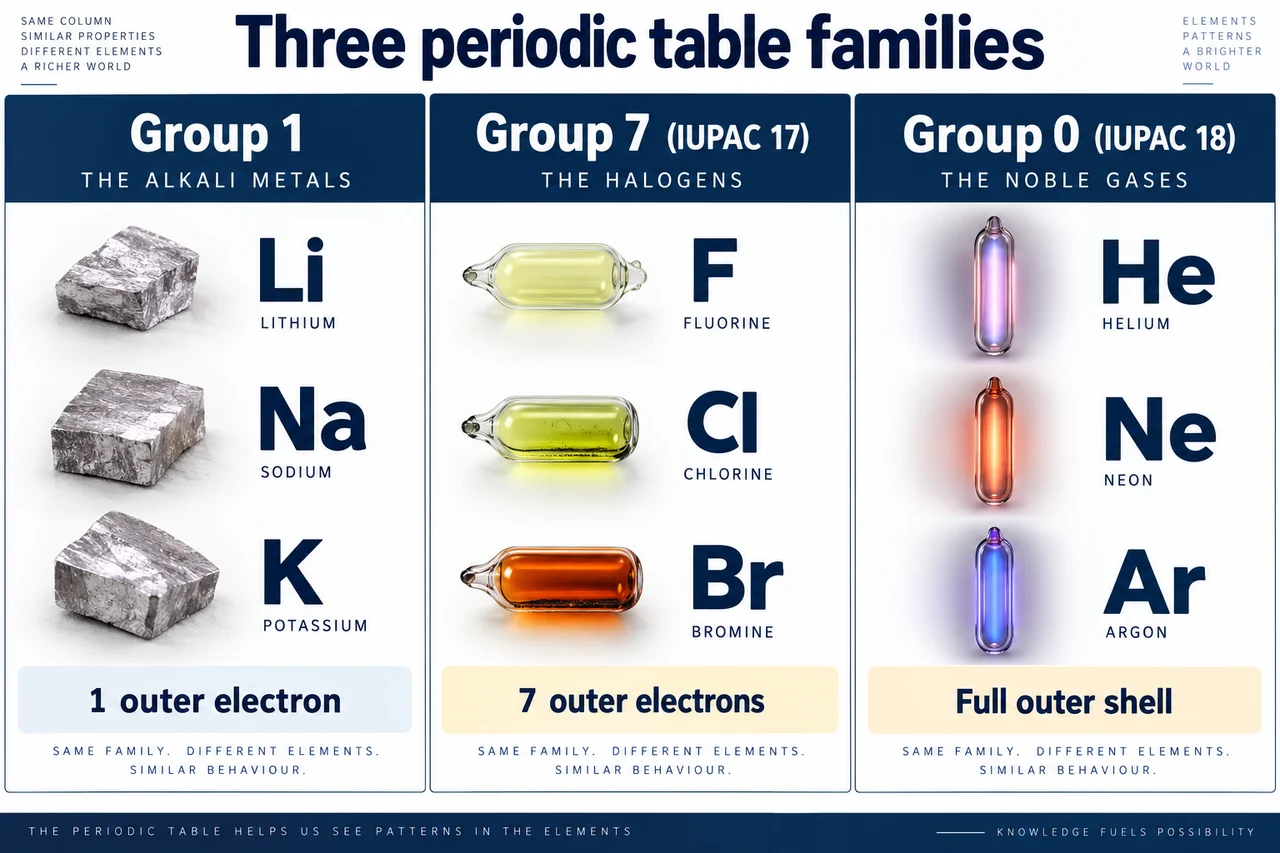
Image: illustration, not a documentary photograph. Original teaching model created for myAudience. · Original generated teaching illustration; no source textbook artwork reproduced.
Metals and non-metals
Most elements are metals, concentrated to the left and centre of the periodic table. Non-metals are mostly on the right, with hydrogen an important exception in position. A location rule is a useful guide, not a substitute for the properties of the actual element.
Metals commonly conduct heat and electricity and can be shaped without breaking. Non-metals have varied properties and are often poor electrical conductors, but graphite is a notable exception. Physical properties depend on structure; naming a category does not guarantee every property in every form.
In many reactions, metals lose electrons to form positive ions. Non-metals often gain electrons to form negative ions or share electrons in covalent bonds. These are patterns of electron behaviour, not movement of protons between ordinary reacting atoms.
Worked example: Explain the formation of Mg²⁺ from magnesium.
Neutral magnesium has two outer electrons.
Losing both leaves two more protons than electrons.
The resulting ion has charge +2.
Answer: Mg → Mg²⁺ + 2e⁻
Check your understanding: Must every non-metal be an electrical insulator?
Answer: No; graphite conducts.
Why: Broad categories summarise trends but do not erase structural exceptions.