Noble gases: a stable outer shell
By UK GCSE Chemistry · independent study · myAudience
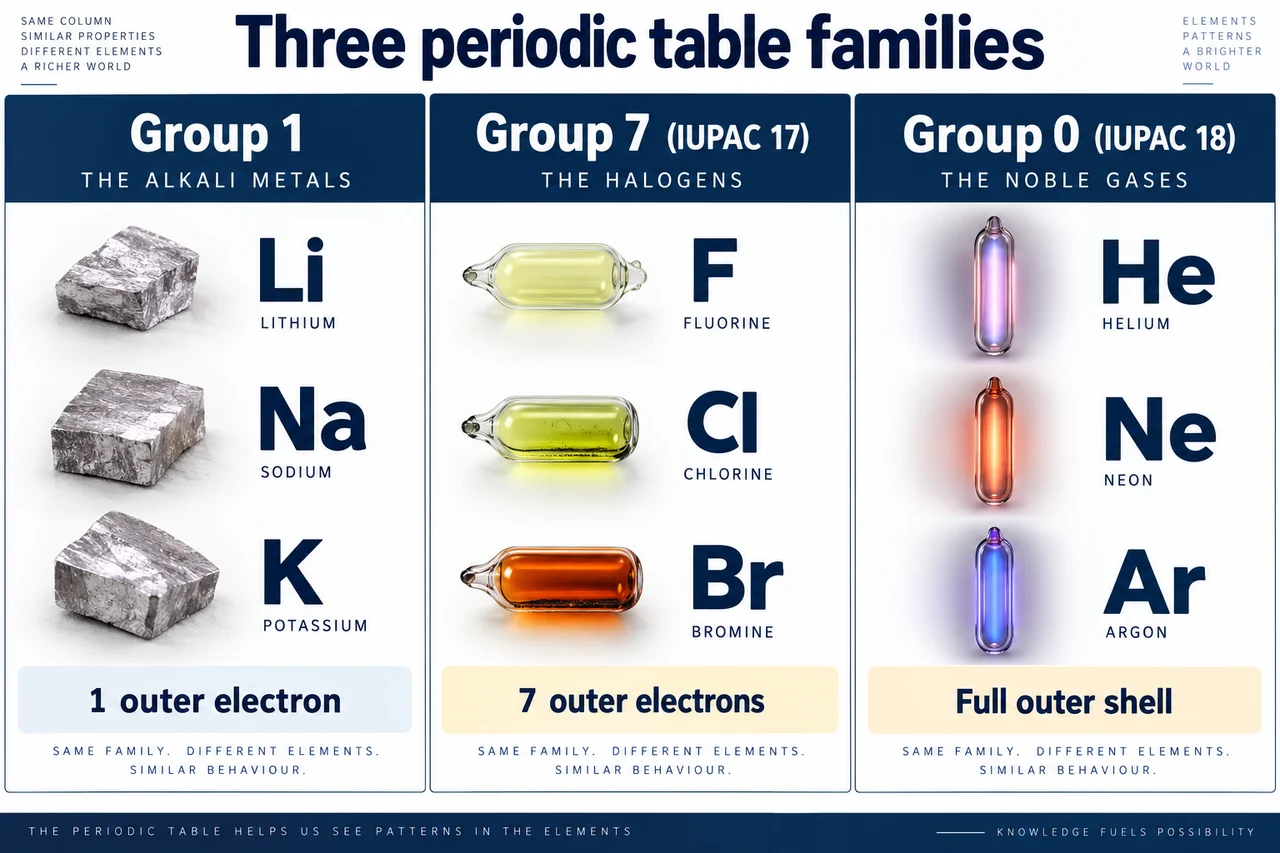
Image: illustration, not a documentary photograph. Original teaching model created for myAudience. · Original generated teaching illustration; no source textbook artwork reproduced.
Noble gases: a stable outer shell
Group 0 elements are monatomic gases under ordinary conditions: separate atoms rather than molecules such as O₂. Their outer shells are full in the simple GCSE model. Helium has a full first shell with two electrons; neon and argon have eight in their outer shell.
Because their electron arrangements are already stable, noble gases are very unreactive in ordinary conditions. Saying unreactive is more accurate than claiming absolutely no compounds can ever exist. Their everyday uses often exploit the absence of ready chemical reaction.
Boiling points increase down the group as atoms become larger and attractions between atoms become stronger. These attractions are not covalent bonds joining atoms into a noble-gas molecule. Distinguishing interactions between particles from bonds within a molecule prevents a common explanation error.
Worked example: Which is expected to have the higher boiling point: neon or argon?
Argon is below neon in Group 0.
Its larger atoms have stronger attractions between them.
More energy is needed to separate them into a gas.
Answer: Argon
Check your understanding: Does helium need eight electrons for a full shell?
Answer: No; its first shell is full with two.
Why: The capacity of the first shell differs from the outer-shell octet used for neon and argon.