Alkali metals and reactivity
By UK GCSE Chemistry · independent study · myAudience
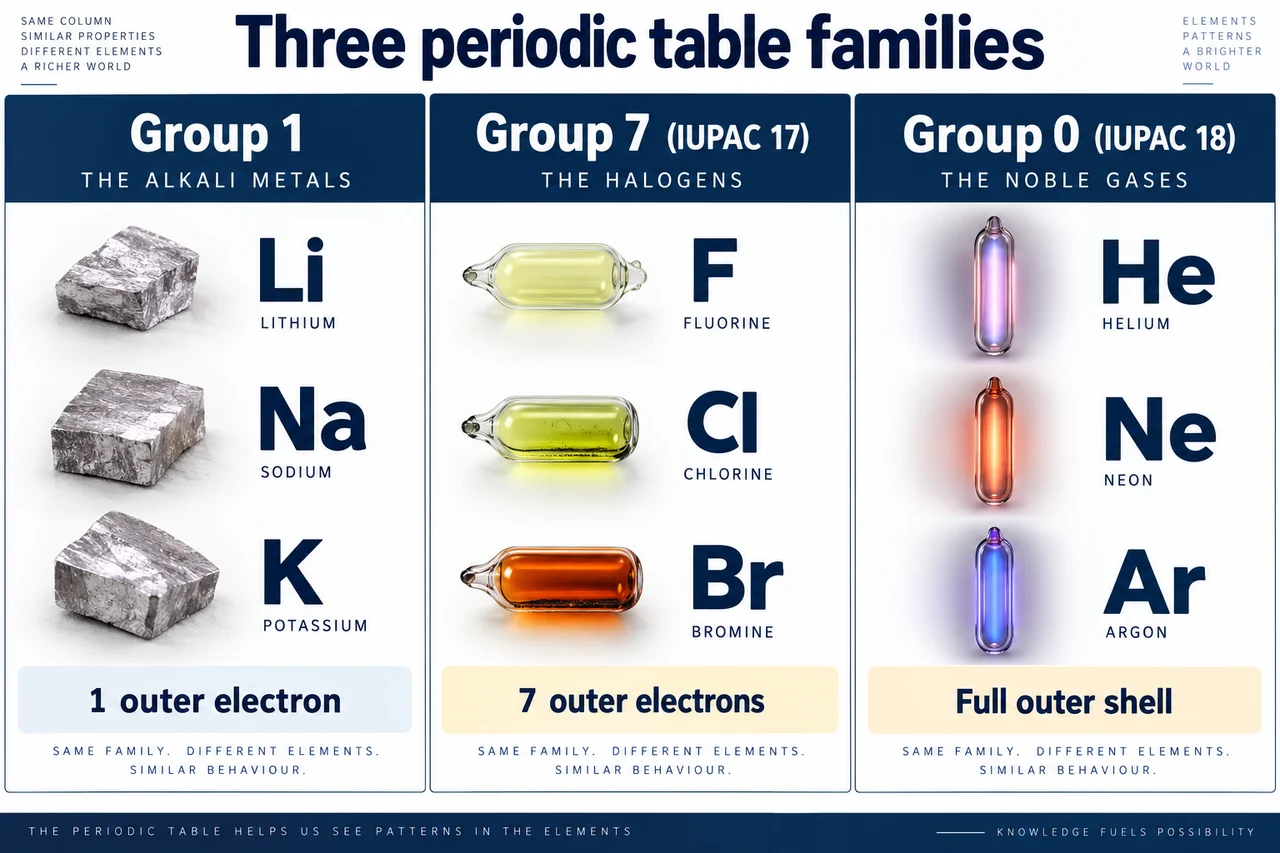
Image: illustration, not a documentary photograph. Original teaching model created for myAudience. · Original generated teaching illustration; no source textbook artwork reproduced.
Alkali metals and reactivity
Group 1 metals have one outer electron and tend to form ions with charge +1. Lithium, sodium and potassium are soft metals with relatively low melting points compared with many other metals. Their reactions are vigorous enough that demonstrations require trained supervision.
Reactivity increases down Group 1. The outer electron is farther from the nucleus and screened by more inner electrons, so it is lost more easily despite the greater nuclear charge. A correct explanation considers distance and shielding, not merely the number of protons.
With water these metals produce hydrogen and an alkaline metal-hydroxide solution. With oxygen they form oxide products, and with chlorine they form chlorides; exact oxygen-containing products can depend on the metal and conditions. GCSE predictions focus on the recurring chemical patterns, not on attempting these reactions at home.
Worked example: Balance sodium reacting with water.
Start Na + H₂O → NaOH + H₂.
Use 2Na and 2H₂O to provide two sodium atoms and four hydrogen atoms.
Use 2NaOH, leaving the other two hydrogen atoms as H₂.
Answer: 2Na + 2H₂O → 2NaOH + H₂
Check your understanding: Why is potassium more reactive than sodium?
Answer: Its outer electron is farther out and more shielded, so it is lost more easily.
Why: The explanation must account for the electron being removed, rather than treating nuclear charge alone as decisive.