Colour, variable ions and catalysts
By UK GCSE Chemistry · independent study · myAudience
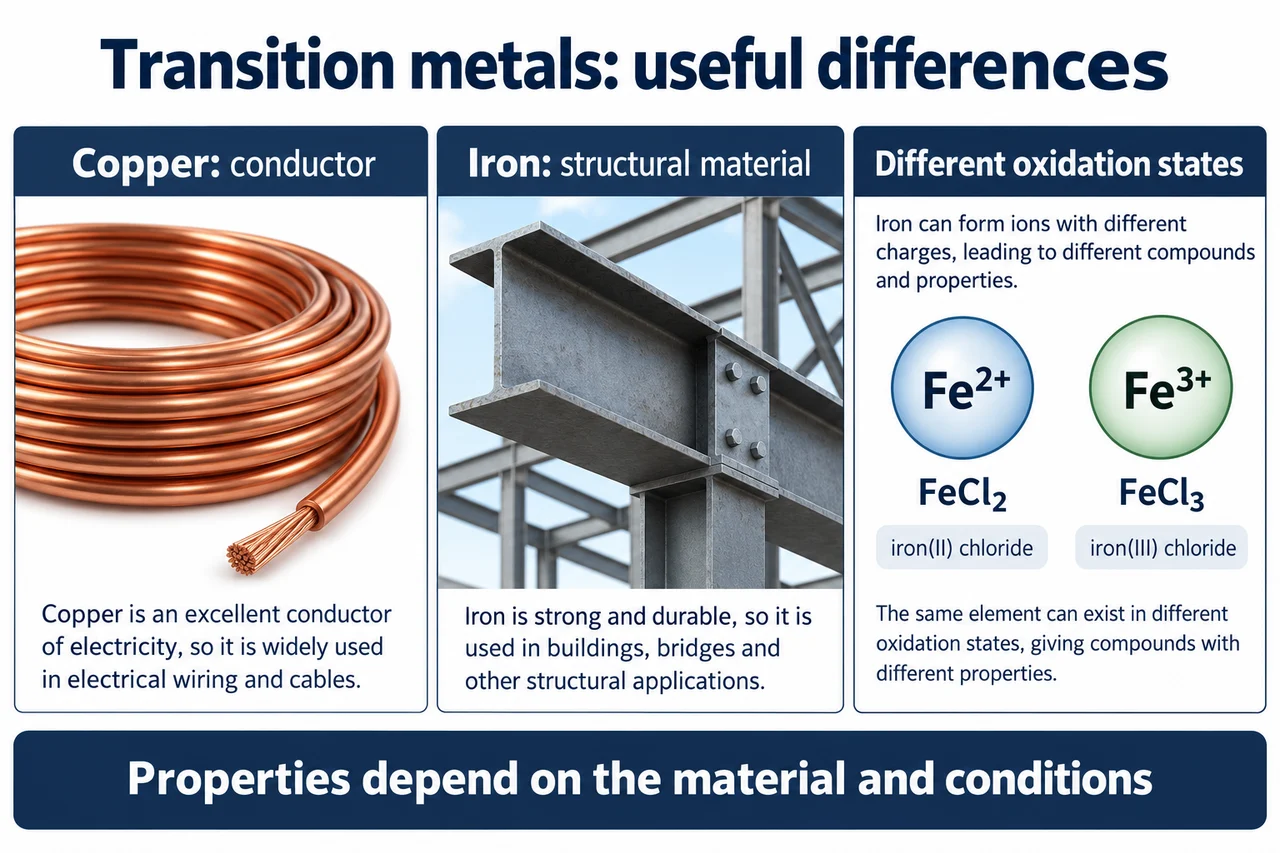
Image: illustration, not a documentary photograph. Original teaching model created for myAudience. · Original generated teaching illustration; no source textbook artwork reproduced.
Colour, variable ions and catalysts
Transition metals can form ions with different charges, produce coloured compounds and act as catalysts. Iron can form Fe²⁺ and Fe³⁺; copper compounds often illustrate colour, though colour depends on the actual compound and environment. A metallic element and its compounds need not share a colour.
A catalyst increases reaction rate without being consumed overall. It provides an alternative reaction pathway with a lower activation energy. This does not mean it supplies unlimited energy, changes the atom balance, or makes every thermodynamically possible reaction rapid under any conditions.
Iron is used in the Haber process and nickel can catalyse hydrogenation of unsaturated oils. These industrial examples connect the electronic flexibility of transition metals with useful reaction control. Catalyst choice depends on the particular reaction and operating conditions.
Worked example: Explain why iron(II) chloride and iron(III) chloride have different formulas.
Chloride has charge −1.
Fe²⁺ needs two chloride ions for neutrality.
Fe³⁺ needs three chloride ions for neutrality.
Answer: FeCl₂ and FeCl₃
Check your understanding: Is a catalyst used up in the overall equation?
Answer: No.
Why: It may participate in intermediate steps but is regenerated overall; it changes the pathway and rate.