Chemical bonds are electrical attractions
By UK GCSE Chemistry · independent study · myAudience
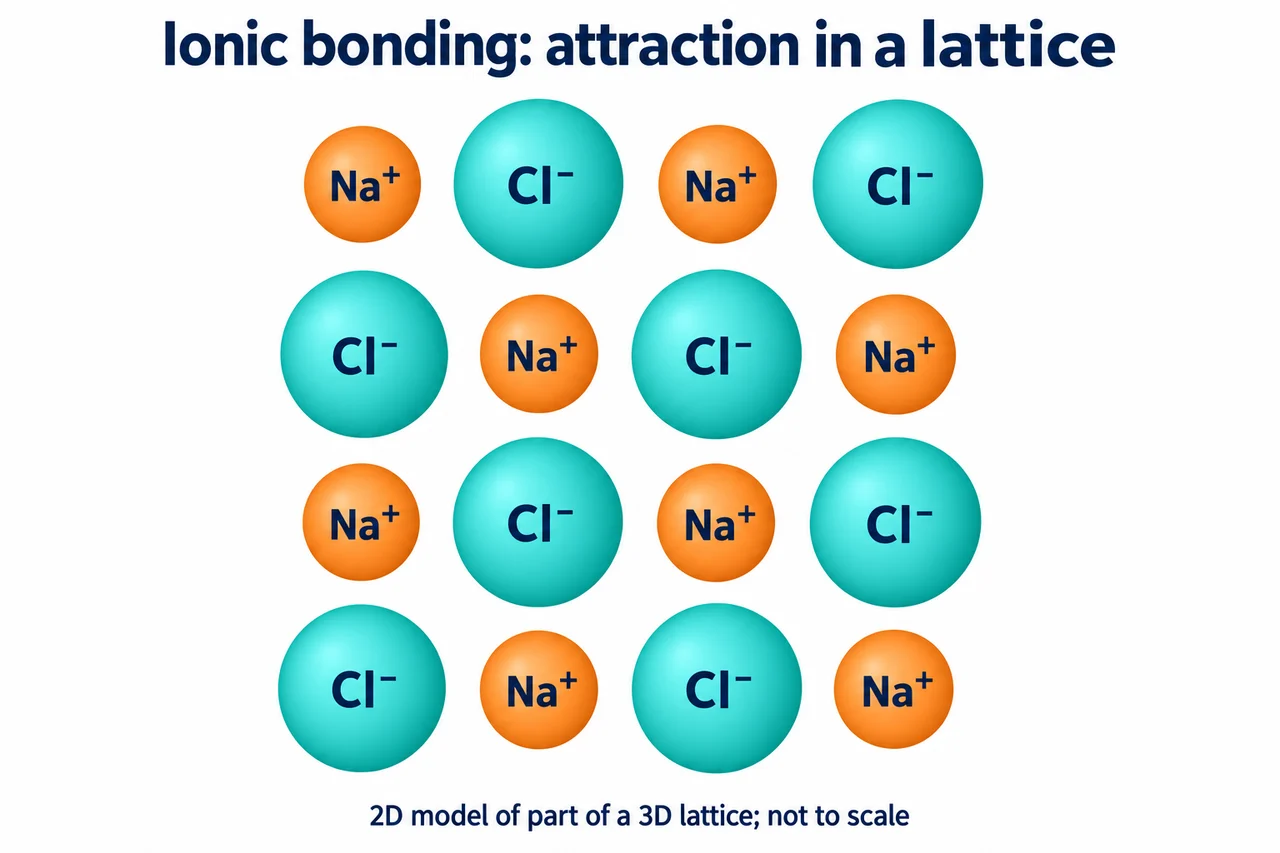
Image: illustration, not a documentary photograph. Original teaching model created for myAudience. · Original generated teaching illustration; no source textbook artwork reproduced.
Chemical bonds are electrical attractions
A chemical bond is not a physical rod or a lump of glue between particles. It is an electrical attraction involving electrons and positively charged nuclei or ions. Ionic, covalent and metallic bonding describe different arrangements of those charged components.
Ionic bonding attracts oppositely charged ions throughout a structure. Covalent bonding involves a shared pair of electrons attracted to both bonded nuclei. Metallic bonding attracts positive metal ions to a shared population of delocalised electrons. The explanation must identify the particles and attraction, not merely name the bond.
Atoms do not make a conscious effort to become stable. Electron arrangements help us predict patterns, while energy and forces explain why particular arrangements persist. A full outer shell is a useful simple-model outcome for many examples, but not a universal mechanism that replaces an explanation of the attraction.
Worked example: Classify the attraction in a sample of copper metal.
The metal is an extended structure, not separate copper molecules.
Some outer electrons are delocalised through it.
Positive ions attract these electrons.
Answer: Metallic bonding
Check your understanding: Is electron transfer itself the ionic bond?
Answer: No; the bond is the attraction between the resulting oppositely charged ions.
Why: Transfer explains how ions can form. Attraction explains why the ions are held together.