Forming ions by electron transfer
By UK GCSE Chemistry · independent study · myAudience
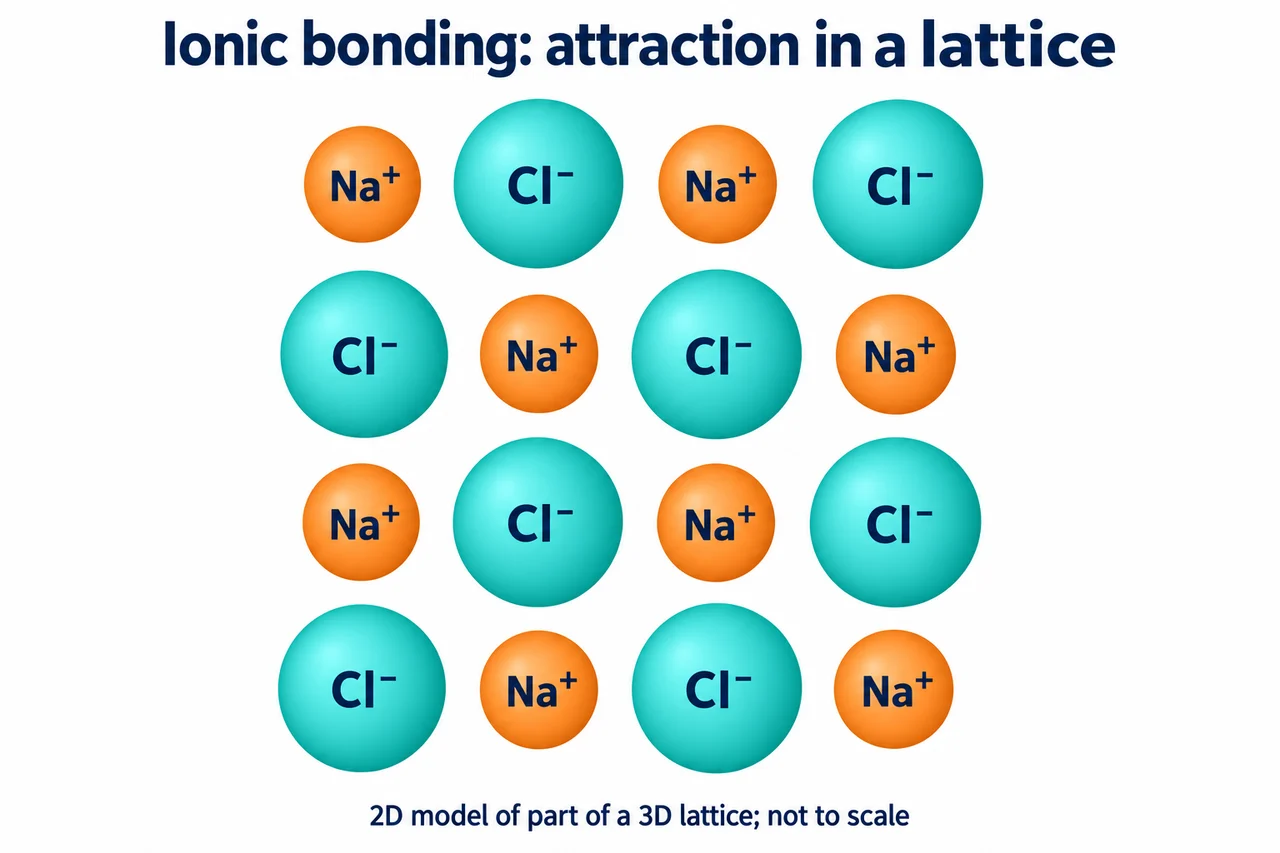
Image: illustration, not a documentary photograph. Original teaching model created for myAudience. · Original generated teaching illustration; no source textbook artwork reproduced.
Forming ions by electron transfer
When sodium reacts with chlorine, sodium loses an outer electron and chlorine gains one. Sodium becomes Na⁺ and chlorine becomes Cl⁻. The proton numbers remain unchanged, so the nuclei retain their original elemental identities.
In the main-group GCSE model, Group 1 metals form +1 ions and Group 2 metals +2 ions. Non-metals in GCSE Group 7 form −1 ions and Group 6 commonly form −2 ions. These predictions apply to the specified simple ions; they do not determine every ion charge throughout the whole periodic table.
A dot-and-cross diagram tracks the origins of outer electrons using two marks. The electrons do not become physically different species because they are drawn differently. Brackets and charge labels show that the completed particles are ions; an unlabelled electron diagram can hide a crucial charge change.
Worked example: Find the ions and simplest ratio in magnesium chloride.
Magnesium loses two electrons to become Mg²⁺.
Each chlorine gains one electron to become Cl⁻.
Two chloride ions balance one magnesium ion.
Answer: Mg²⁺ and2Cl⁻; formula MgCl₂
Check your understanding: Does a chloride ion have more protons than a chlorine atom?
Answer: No.
Why: It has one additional electron. Changing the proton number would change the element.