An ionic compound is a giant lattice
By UK GCSE Chemistry · independent study · myAudience
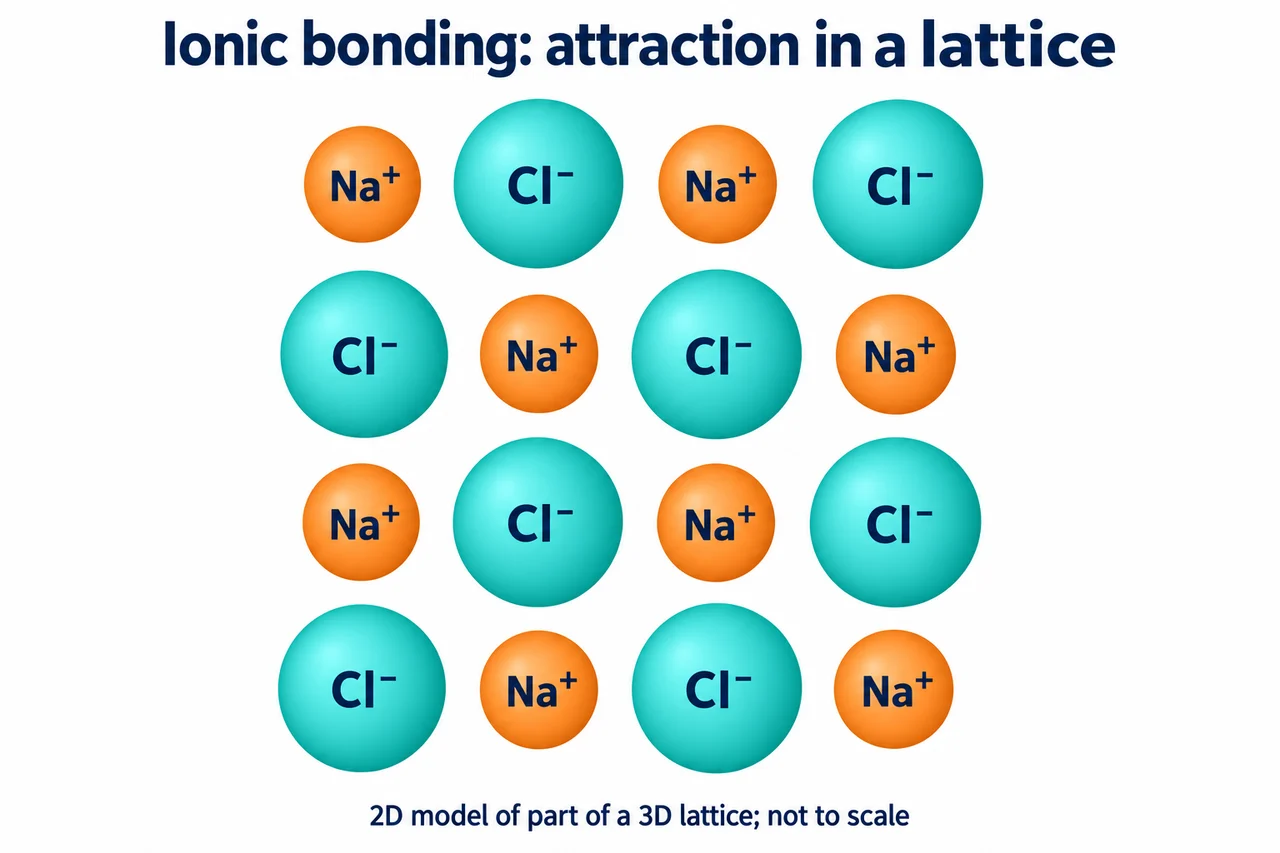
Image: illustration, not a documentary photograph. Original teaching model created for myAudience. · Original generated teaching illustration; no source textbook artwork reproduced.
An ionic compound is a giant lattice
Solid sodium chloride consists of an extended repeating arrangement of sodium and chloride ions. Each ion is attracted to oppositely charged neighbours in more than one direction. Calling it a collection of NaCl molecules would wrongly imply separate bonded pairs.
The formula gives the simplest whole-number ion ratio. Equal numbers of singly positive and singly negative ions produce NaCl. An ion of charge +2 needs two ions of charge −1 for neutrality, giving a formula such as MgCl₂. Empirical formulas communicate ratios rather than the full size of the crystal.
A drawing shows only part of a lattice. A flat grid cannot display all three-dimensional neighbours, and spheres are not literal solid balls with painted charge signs. Model limitations matter when deciding what a picture does and does not prove about bonding.
Worked example: A model contains twice as many chloride ions as calcium ions. Give its simplest formula.
Use the ratio calcium:chloride=1:2.
Ca²⁺ balances two Cl⁻ ions.
Use a small2afterCl rather than multiplying the whole formula.
Answer: CaCl₂
Check your understanding: Is an ionic bond only between one exclusive pair?
Answer: No.
Why: Electrostatic attraction extends throughout the repeating lattice in multiple directions.