Sharing pairs in covalent bonds
By UK GCSE Chemistry · independent study · myAudience
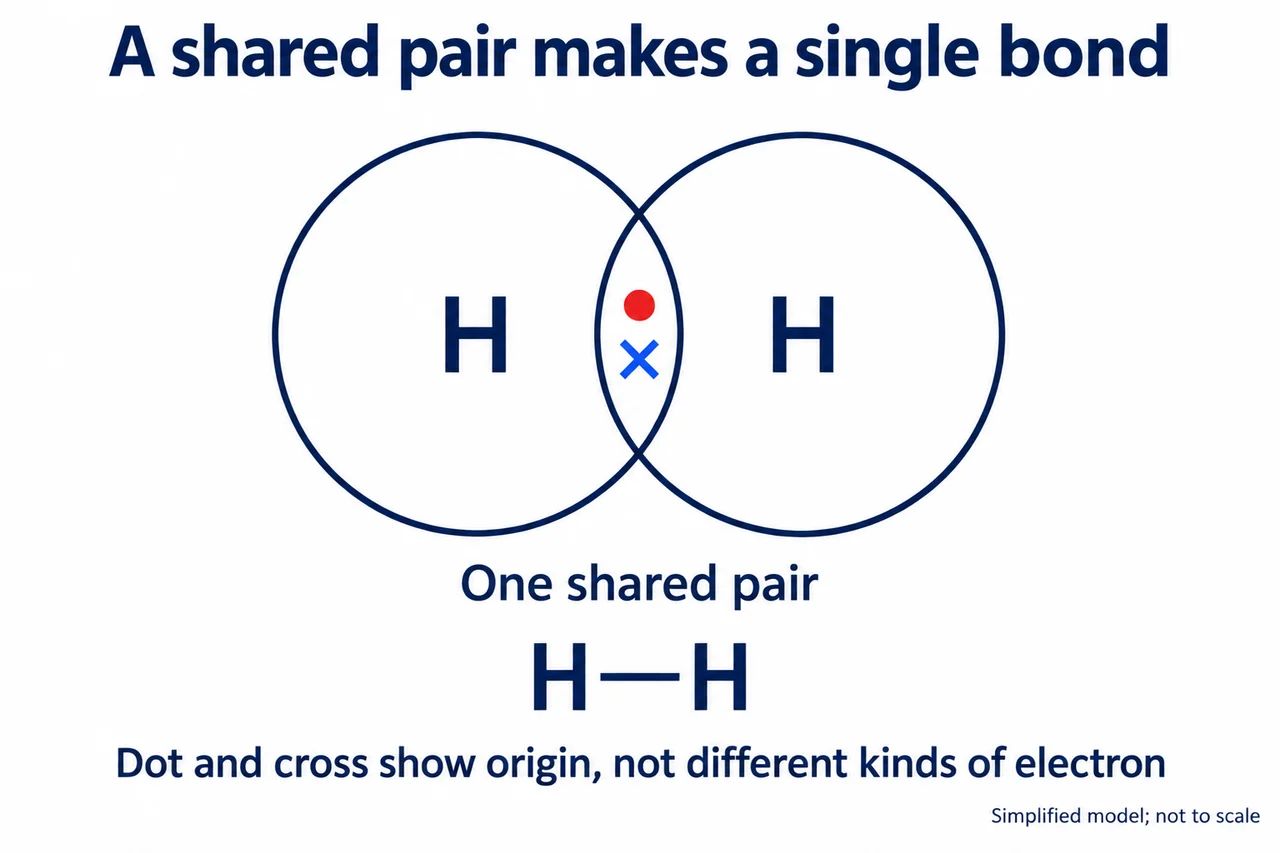
Image: illustration, not a documentary photograph. Original teaching model created for myAudience. · Original generated teaching illustration; no source textbook artwork reproduced.
Sharing pairs in covalent bonds
A covalent bond contains a shared pair of electrons attracted to both nuclei. Hydrogen needs one such pair in H₂. Oxygen shares two pairs in O₂ and nitrogen three in N₂, represented as double and triple bonds. A line in a structural formula represents one shared pair, not one electron.
In water, oxygen makes two single bonds to hydrogen and has two lone pairs in the outer-electron diagram. Methane has four C–H single bonds; ammonia has three N–H bonds and one lone pair on nitrogen. Counting both bonding and non-bonding electrons avoids drawing more electrons than the atoms contribute.
Covalent bonding can produce small molecules, long polymer molecules or giant networks. The bond name alone therefore does not predict melting point. A molecule drawing communicates composition and some connectivity, but may omit lone pairs, three-dimensional angles or relative particle sizes.
Worked example: Count the shared electrons in an oxygen molecule.
The O=O double bond represents two shared pairs.
Each pair contains two electrons.
Two pairs therefore contain four shared electrons.
Answer: 4shared electrons
Check your understanding: Does a single line represent one shared electron?
Answer: No; it represents one shared pair.
Why: Each covalent single bond contains two shared electrons.