Delocalised electrons in metals
By UK GCSE Chemistry · independent study · myAudience
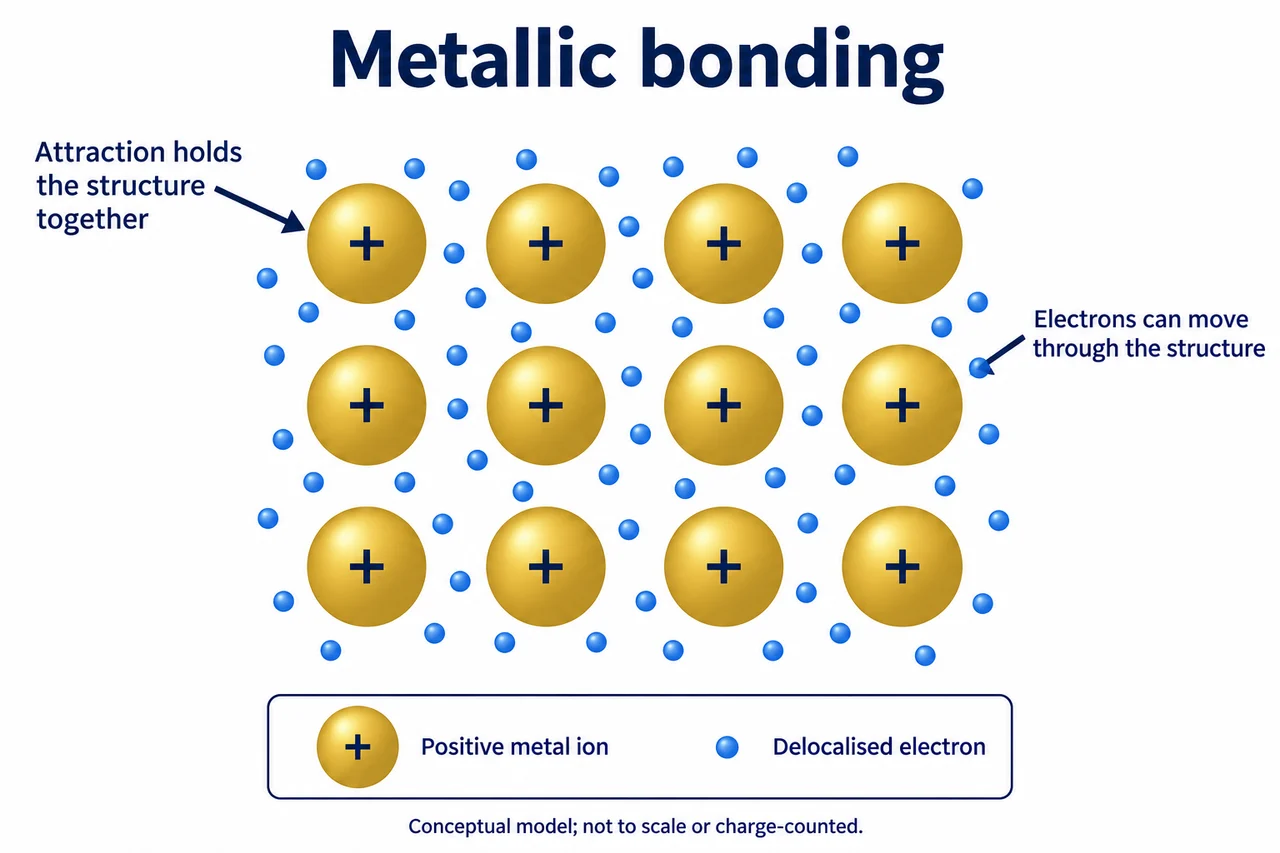
Image: illustration, not a documentary photograph. Original teaching model created for myAudience. · Original generated teaching illustration; no source textbook artwork reproduced.
Delocalised electrons in metals
A metal has an extended arrangement of positive metal ions with outer electrons that are delocalised. Delocalised means that these electrons are not restricted to one particular bond or atom within the structure. The metal as a whole remains electrically neutral.
The attraction between the ions and the delocalised electrons holds the structure together. When layers move, attraction can persist rather than requiring a fixed set of directional bonds to break at every shifted position. This helps explain why many metals can be bent and drawn into shapes.
The familiar electron-sea picture is a model, not a photograph. It should not imply that all electrons have left every atom or that positive ions drift freely through a solid metal. Electrons can carry current while ions remain organised in a solid structure.
Worked example: Explain why copper can conduct while solid sodium chloride does not.
Copper has mobile delocalised electrons.
In solid sodium chloride the ions cannot travel through the solid.
A conducting substance needs mobile charged particles.
Answer: Copper provides mobile electrons; the solid ionic lattice does not provide mobile ions.
Check your understanding: Are the metal ions themselves the main mobile charge carriers in solid copper?
Answer: No; the delocalised electrons are.
Why: The positive ions remain arranged in the solid rather than flowing along the wire.