States, energy and particle models
By UK GCSE Chemistry · independent study · myAudience
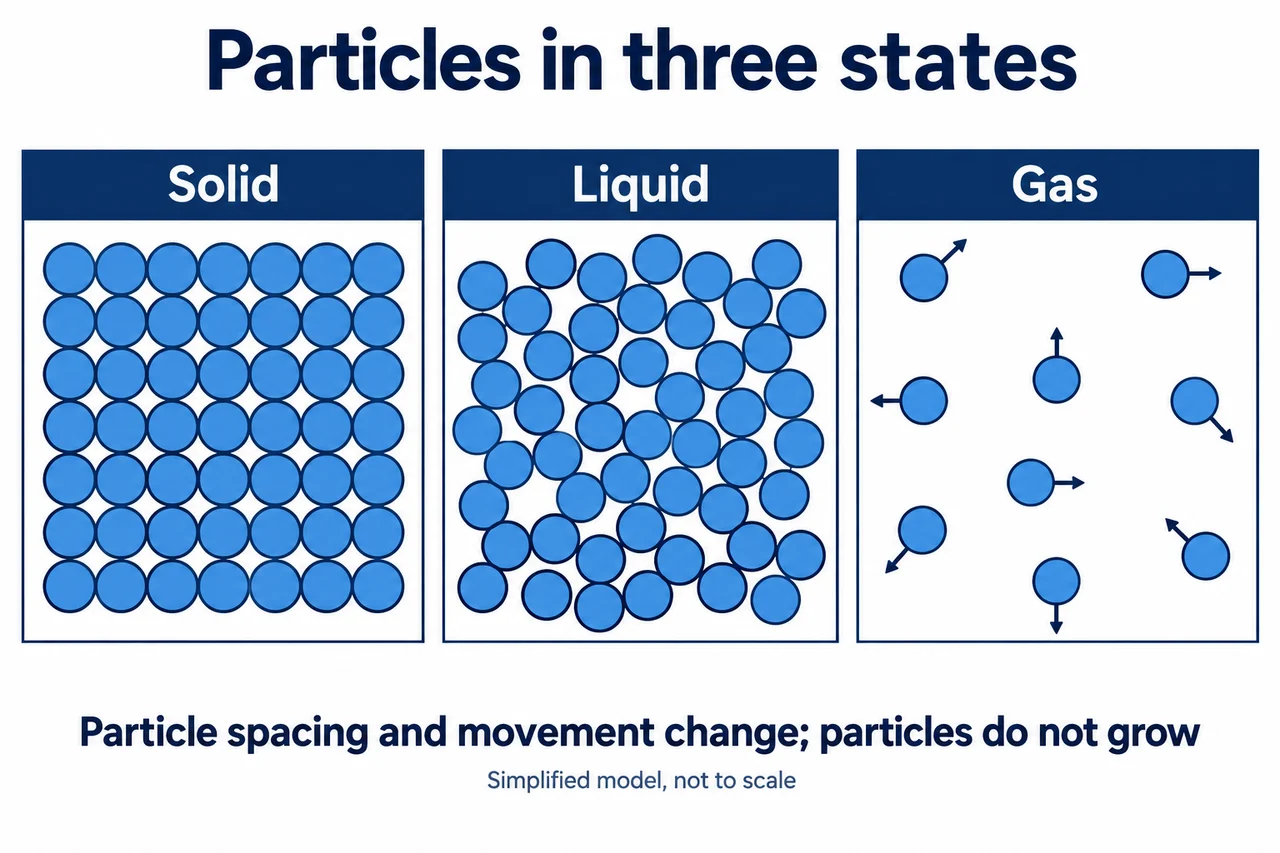
Image: illustration, not a documentary photograph. Original teaching model created for myAudience. · Original generated teaching illustration; no source textbook artwork reproduced.
States, energy and particle models
In a solid, particles remain near fixed positions while vibrating. In a liquid, particles remain close but can move past one another. In a gas, particles are far apart compared with their sizes and move through the available space. These descriptions concern bulk material, not a claim that one isolated atom is a tiny solid or liquid.
Heating can transfer energy to a substance. At melting and boiling, energy enables particles to overcome attractions sufficiently to change their arrangement. The identity of the relevant particles matters: melting a molecular solid usually disrupts attractions between molecules rather than breaking every covalent bond inside them.
For Higher-tier analysis, a diagram of identical solid spheres omits forces and internal structure and cannot show every energy transfer. Particles do not expand simply because their drawn spacing increases. Given melting and boiling data, compare a temperature with both boundaries, while recognising that a sample at a transition can contain two phases.
Worked example: A substance melts at −10°C and boils at 80°C. Predict its state at 20 °C under the specified pressure.
20 °C is above its melting point.
20 °C is below its boiling point.
Between the two transition temperatures it is liquid.
Answer: Liquid
Check your understanding: Does a particle become larger when a liquid evaporates?
Answer: No.
Why: The bulk spacing and motion change; particle expansion is not the explanation for becoming a gas.