State symbols describe the actual sample
By UK GCSE Chemistry · independent study · myAudience
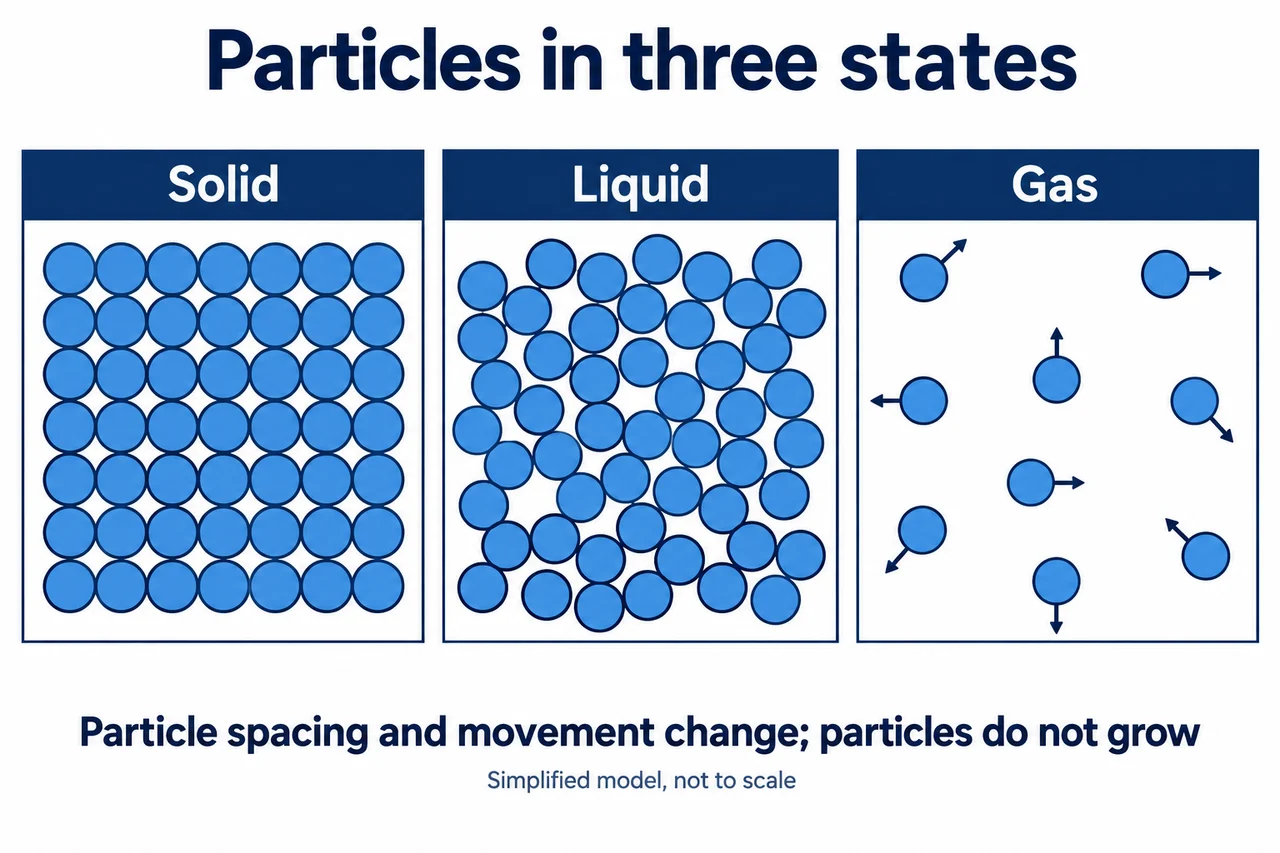
Image: illustration, not a documentary photograph. Original teaching model created for myAudience. · Original generated teaching illustration; no source textbook artwork reproduced.
State symbols describe the actual sample
The symbols (s), (l) and (g) describe solid, liquid and gas. The symbol (aq) means dissolved in water, not simply any liquid. Liquid water is H₂O(l); a salt dissolved in it can be written with (aq). Conditions matter because the same substance may occur in different states.
An equation such as NaCl(s) → Na⁺(aq) + Cl⁻(aq) distinguishes a solid crystal from its dissolved ions. State symbols do not replace coefficients, charge symbols or formulas. Each conveys different information: quantity, electrical charge, composition and physical state.
Use evidence or stated conditions to assign states. A photograph of a transparent liquid cannot by itself establish that a particular solute is dissolved in water. In a problem, data about temperature, solubility and preparation are part of the reasoning.
Worked example: Write the state symbol for carbon dioxide bubbling out of an aqueous reaction.
The bubbles identify a gas leaving the liquid.
CO₂ names the molecular substance.
Add the gaseous state symbol.
Answer: CO₂(g)
Check your understanding: Are (l) and (aq) interchangeable?
Answer: No.
Why: Aqueous describes a substance dissolved in water; liquid describes a phase.