Why ionic solids melt high and conduct only when mobile
By UK GCSE Chemistry · independent study · myAudience
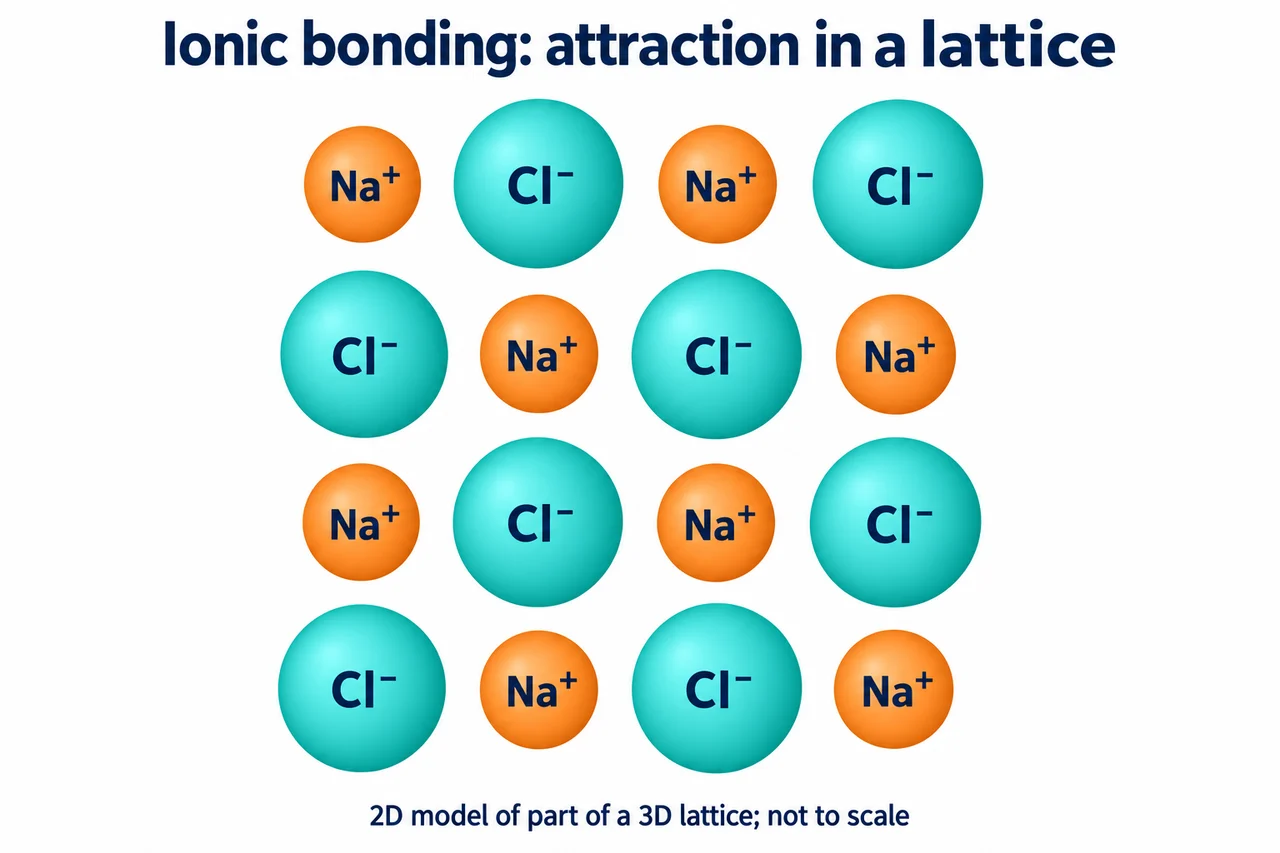
Image: illustration, not a documentary photograph. Original teaching model created for myAudience. · Original generated teaching illustration; no source textbook artwork reproduced.
Why ionic solids melt high and conduct only when mobile
An ionic lattice has strong electrical attractions between many oppositely charged neighbours. Separating ions enough to melt the structure requires substantial energy, so familiar ionic salts have high melting temperatures. The explanation concerns the extended lattice, not a single salt molecule.
In a solid, charged ions are present but cannot move freely through the sample. Melting lets ions move. Dissolving a suitable salt in water also creates mobile ions, so the melt or solution can conduct electricity. Presence of charge alone is insufficient: charge carriers need mobility.
Not every ionic compound dissolves readily. Saying ionic solutions conduct assumes that enough ions are actually in solution. An insoluble solid sitting in water does not automatically create the same conducting solution as a readily soluble salt.
Worked example: Predict conductivity of solid and molten sodium chloride.
Solid ions occupy fixed lattice positions.
Molten ions move through the sample.
Only the molten sample has mobile ionic charge carriers.
Answer: Solid: poor conductor; molten: conductor
Check your understanding: Why does a high melting point not prove electrical conduction in the solid?
Answer: Melting energy and carrier mobility describe different properties.
Why: Strong attractions can hold charged ions in place, preventing current.