Polymers are long molecules, not tiny lattices
By UK GCSE Chemistry · independent study · myAudience
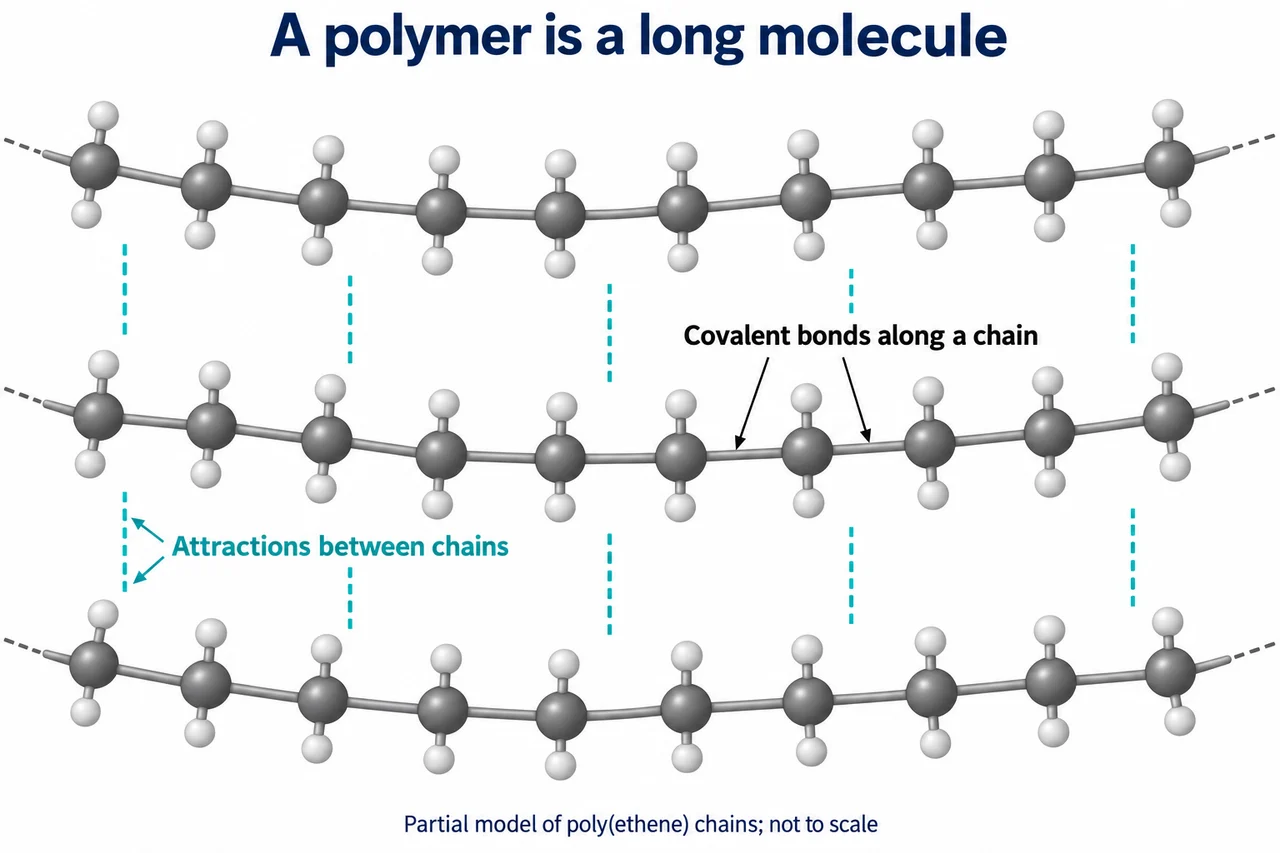
Image: illustration, not a documentary photograph. Original teaching model created for myAudience. · Original generated teaching illustration; no source textbook artwork reproduced.
Polymers are long molecules, not tiny lattices
A polymer consists of very large molecules built from repeating connected units. Strong covalent bonds link atoms along a chain. Different chains attract one another through intermolecular interactions; some polymers also contain chemical links between chains.
Long chains have many points of interaction and can become entangled, helping explain why familiar polymers are solids. Their properties depend on chain length, side groups, arrangement and cross-linking. The general GCSE chain model is useful but does not make all plastics physically identical.
A repeat-unit drawing with brackets and n describes many repeats without claiming a known chain length. Lines extending through brackets show continuation. It does not mean separate repeat units float beside one another unbonded, and it does not show every feature of the bulk material.
Worked example: Explain what n means in a bracketed polymer repeat unit.
Identify one repeating connected unit.
The chain contains many repetitions of that unit.
n represents the number of repetitions rather than a new element symbol.
Answer: A large number of repeated units in the chain
Check your understanding: Are bonds along a polymer chain the same as attractions between different chains?
Answer: No.
Why: The chain has covalent bonds; interchain interactions are a separate structural feature.