Giant covalent structures
By UK GCSE Chemistry · independent study · myAudience
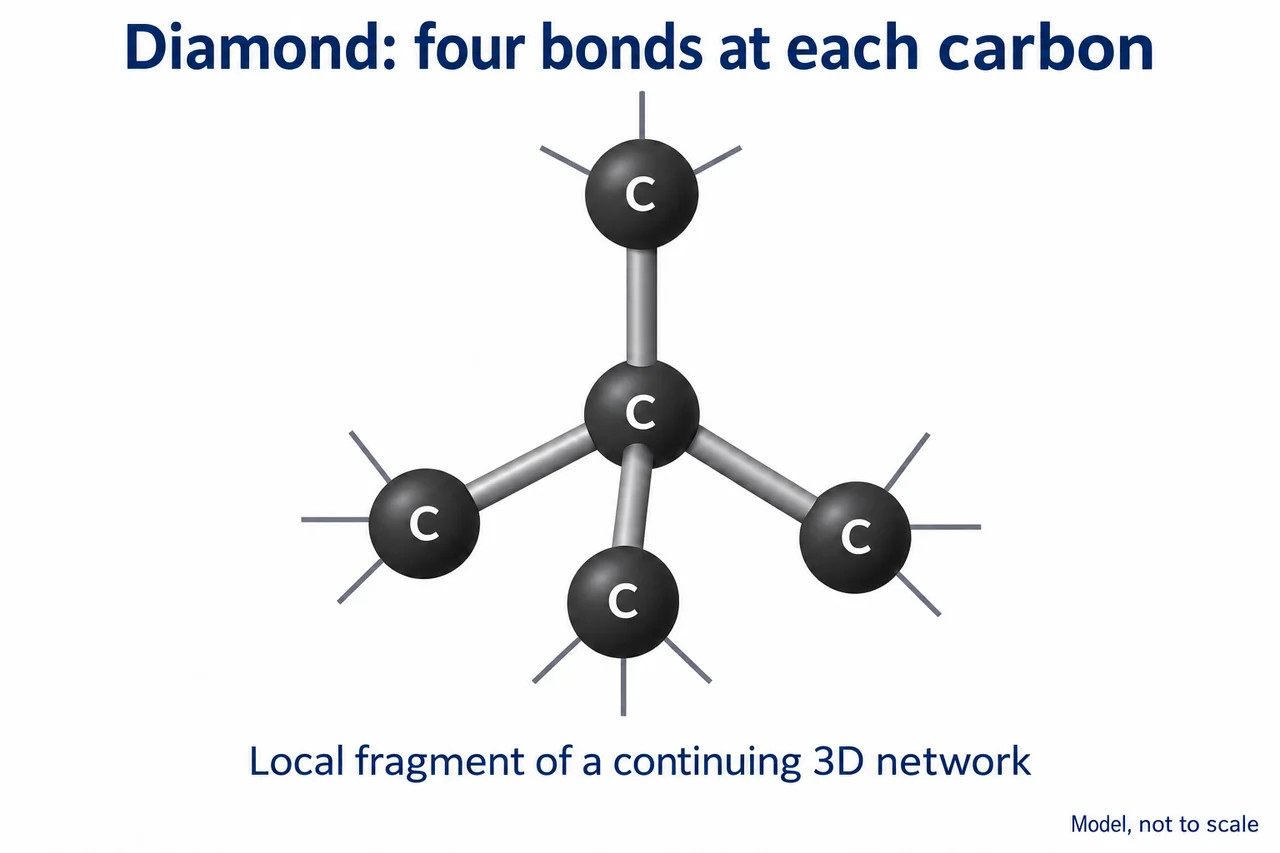
Image: illustration, not a documentary photograph. Original teaching model created for myAudience. · Original generated teaching illustration; no source textbook artwork reproduced.
Giant covalent structures
In a giant covalent structure, strong covalent bonds extend through a network rather than stopping at the edges of small separate molecules. Diamond and silicon dioxide are examples. A network drawing represents a small portion of a structure that continues beyond its borders.
Melting a covalent network requires overcoming many strong covalent bonds, accounting for its very high melting temperature. This explanation differs from melting a molecular solid, where intermolecular attractions are usually the principal obstacle. Always name which interaction must be overcome.
Conductivity is not decided by the words covalent or giant alone. Diamond lacks suitable mobile charge carriers, whereas graphite and graphene have delocalised electrons. Different arrangements of the same element can create sharply different properties.
Worked example: Compare melting diamond with melting a molecular solid.
Diamond belongs to an extended covalent network.
Many strong covalent bonds must be overcome.
A molecular solid usually separates intact molecules by overcoming intermolecular attractions.
Answer: Different structural interactions account for different melting behaviour.
Check your understanding: Are all giant covalent materials electrical insulators?
Answer: No.
Why: Graphite and graphene provide counterexamples with delocalised electrons.