Why alloys can be harder
By UK GCSE Chemistry · independent study · myAudience
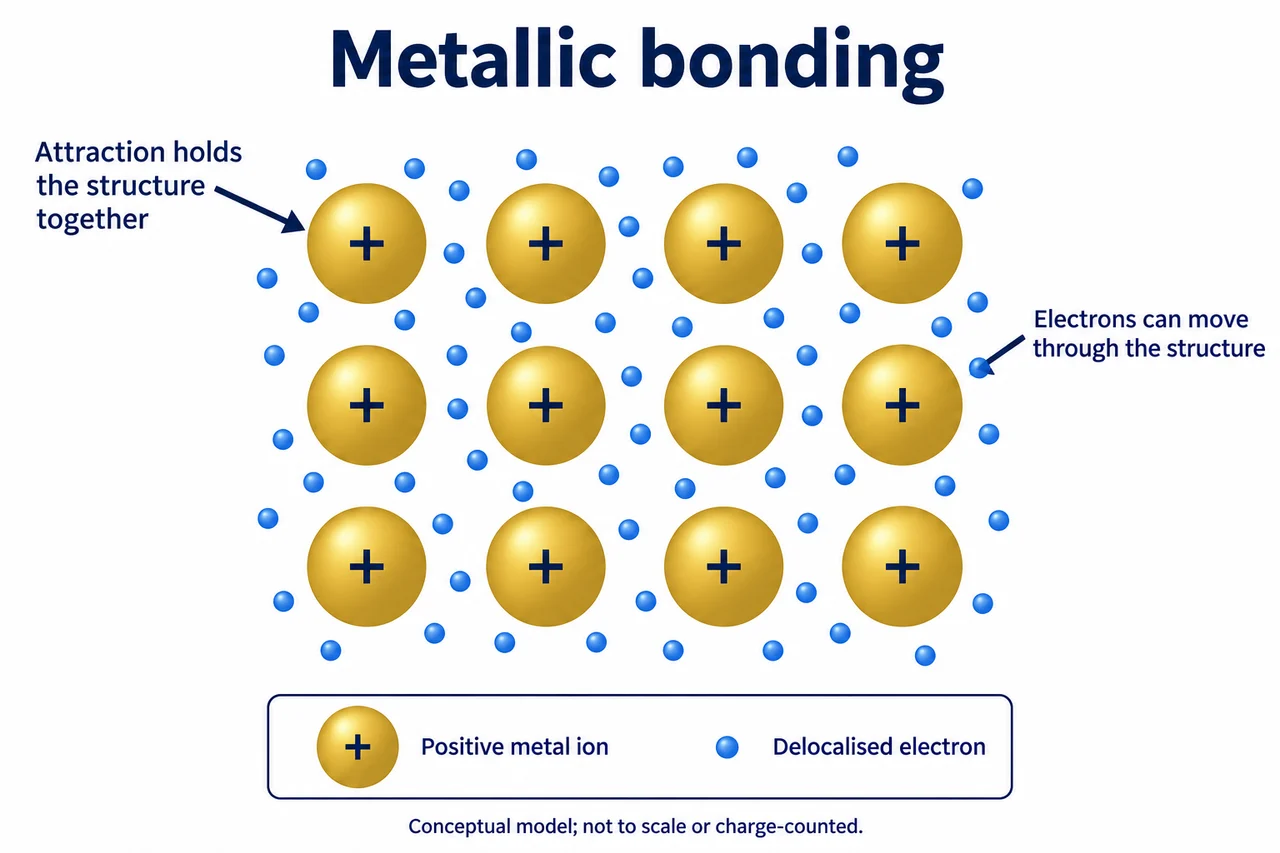
Image: illustration, not a documentary photograph. Original teaching model created for myAudience. · Original generated teaching illustration; no source textbook artwork reproduced.
Why alloys can be harder
A pure metal often has an orderly arrangement of similar-sized atoms. Layers can slide while metallic bonding persists, allowing deformation. This useful ability becomes a disadvantage when a material must resist being bent or dented.
An alloy combines a metal with other elements. Different-sized atoms disrupt the regular arrangement, making layer movement more difficult. The result can be harder than the pure metal. Hardness means resistance to deformation or scratching; it is not identical to strength, stiffness or corrosion resistance.
A small diagram of mixed sphere sizes isolates one explanation. Real alloys also depend on composition, processing and microscopic structure. Not every alloy is simply an ideal random mixture, so the school model supports a trend rather than a complete materials-engineering prediction.
Worked example: Explain why an alloy with different-sized atoms resists layer sliding.
A regular pure-metal layer can move more easily past another.
Different-sized atoms disturb that regular arrangement.
The disruption obstructs movement.
Answer: The distorted arrangement makes sliding more difficult.
Check your understanding: Does harder automatically mean corrosion-proof?
Answer: No.
Why: Hardness and chemical resistance are different properties requiring different evidence.