Diamond: a three-dimensional carbon network
By UK GCSE Chemistry · independent study · myAudience
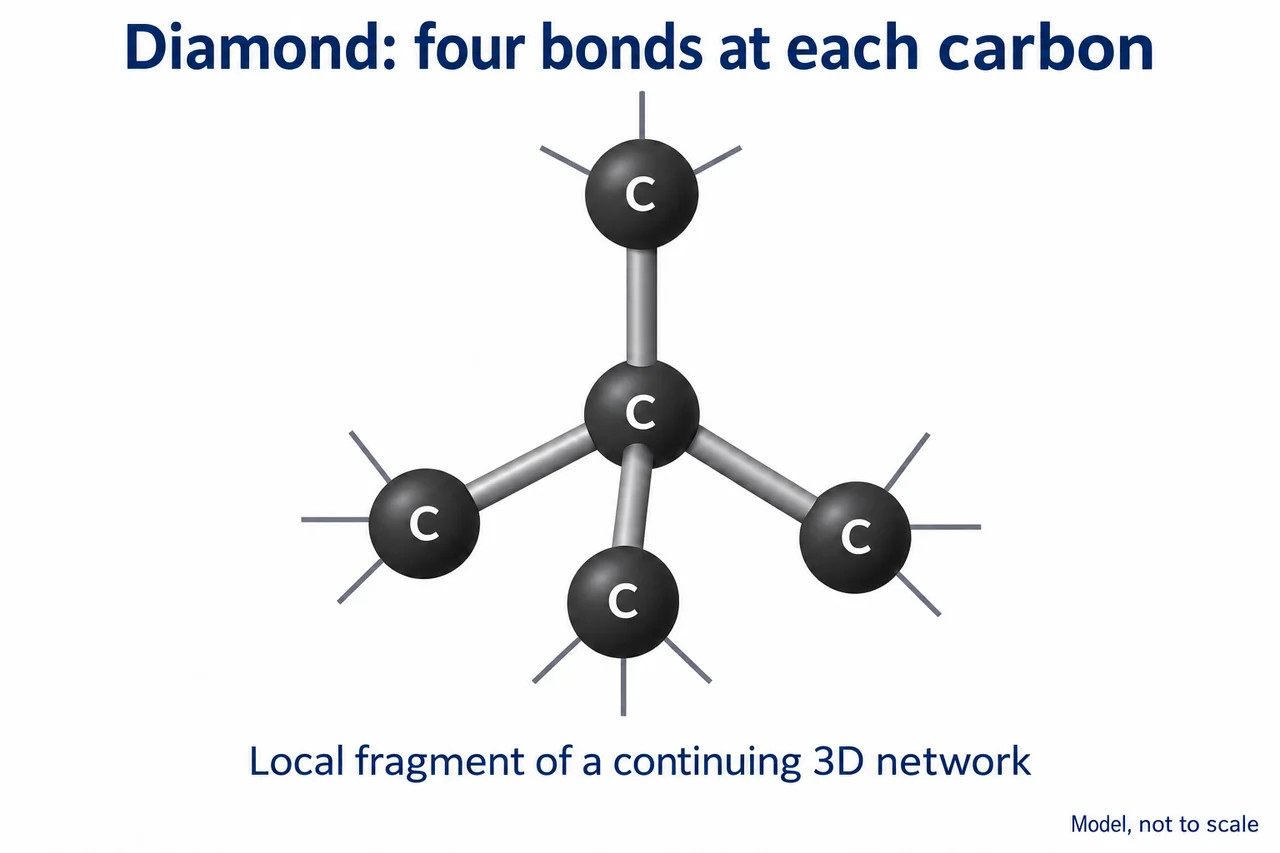
Image: illustration, not a documentary photograph. Original teaching model created for myAudience. · Original generated teaching illustration; no source textbook artwork reproduced.
Diamond: a three-dimensional carbon network
In diamond each carbon atom forms four covalent bonds to other carbon atoms in a three-dimensional network. This is not a collection of separate four-carbon molecules. The network continues through the crystal, and the local bonding arrangement is tetrahedral.
The many strong bonds make diamond very hard and give it very high temperature stability before structural change. Cutting and abrasive uses depend on that hardness. A model showing four sticks on one atom must still make clear that neighbouring atoms are part of the same continuing network.
All four outer electrons are involved in covalent bonding in the simple GCSE account, so diamond has no delocalised electrons available to carry current. Its poor electrical conductivity contrasts with its ability to transfer thermal energy: the two properties need not rise and fall together.
Worked example: Explain why diamond is hard but does not conduct electricity.
A strong three-dimensional network resists rearrangement.
Outer electrons are involved in covalent bonds.
There are no suitable freely moving electrons in the simple model.
Answer: Strong network gives hardness; absence of mobile electrons limits electrical conduction.
Check your understanding: Does being carbon guarantee graphite-like conductivity?
Answer: No.
Why: The arrangement and bonding of carbon atoms determine the available charge carriers.