Graphite: strong sheets and sliding layers
By UK GCSE Chemistry · independent study · myAudience
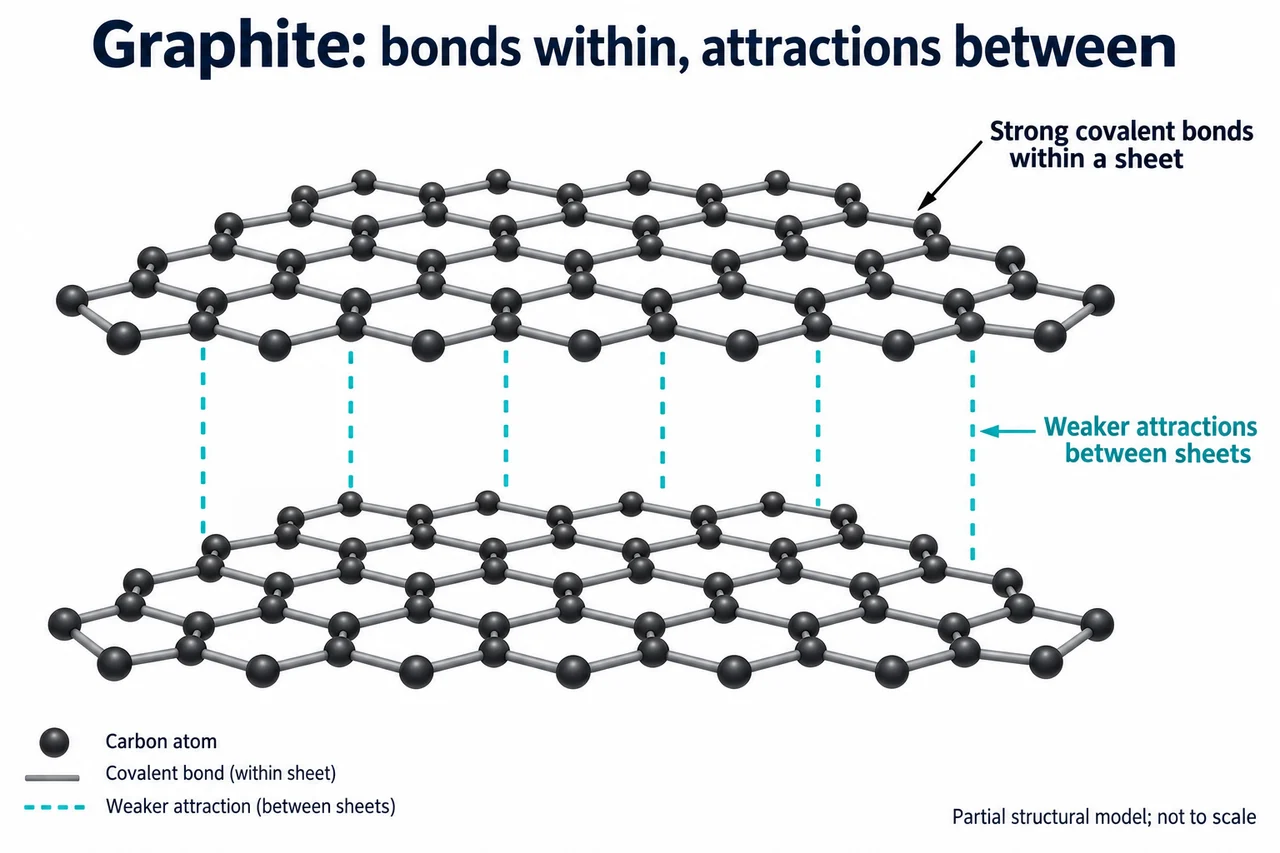
Image: illustration, not a documentary photograph. Original teaching model created for myAudience. · Original generated teaching illustration; no source textbook artwork reproduced.
Graphite: strong sheets and sliding layers
In graphite each carbon atom forms three covalent bonds within a sheet of connected hexagons. Strong bonds extend across each layer, while weaker attractions hold different layers together. Do not describe all the bonds in graphite as weak.
Layers can slide relative to one another, helping graphite act as a lubricant and leave marks from a pencil. The high-temperature stability of the sheets reflects their strong covalent bonds even though layer sliding is relatively easy. Different structural directions lead to different mechanical behaviour.
Each carbon contributes an electron to a delocalised system within the layers. These electrons can carry charge, so graphite conducts electricity. This contrasts with diamond, where all four outer electrons participate in its three-dimensional bonding arrangement.
Worked example: Explain why graphite can lubricate while retaining strongly bonded sheets.
Covalent bonds within a sheet are strong.
Attractions between sheets are weaker.
Sliding separates or moves sheets without breaking all bonds within them.
Answer: Different strengths within and between layers explain the behaviour.
Check your understanding: Why is saying graphite has only weak bonds misleading?
Answer: Its sheets contain strong covalent bonds.
Why: The weaker interactions are between layers, not all throughout the structure.