Graphene, fullerenes and nanotubes
By UK GCSE Chemistry · independent study · myAudience
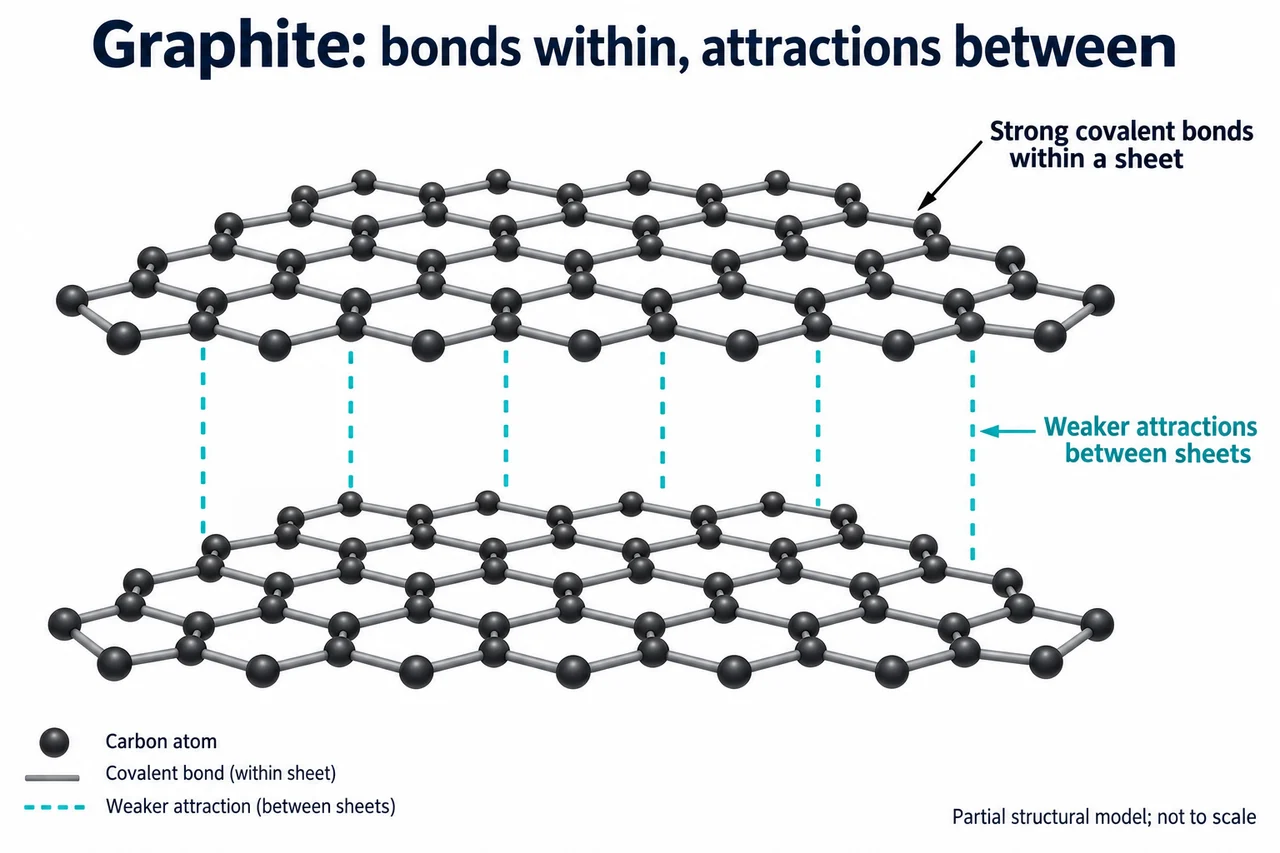
Image: illustration, not a documentary photograph. Original teaching model created for myAudience. · Original generated teaching illustration; no source textbook artwork reproduced.
Graphene, fullerenes and nanotubes
Graphene is a single carbon sheet related to one layer of graphite. Its connected hexagonal network, strength and delocalised electrons make it interesting for conducting and reinforcing materials. A one-layer model should not accidentally depict many stacked sheets.
Fullerenes are carbon structures containing cages or tubes. Buckminsterfullerene has sixty carbon atoms arranged into a cage with pentagons and hexagons. A cartoon football can suggest its shape, but it is not enough to establish a correct molecular formula or every bond.
Carbon nanotubes have high length-to-diameter ratios and useful mechanical and electrical properties. Applications depend on purity, size, structure and manufacturing. Proposed uses do not guarantee every laboratory material is immediately ready for commercial or medical use.
Worked example: Distinguish graphene from graphite.
Graphene is one sheet.
Graphite has many sheets with attractions between them.
Their common in-sheet bonding does not erase the difference in bulk structure.
Answer: One sheet versus a layered structure
Check your understanding: Is every round carbon cage automatically C₆₀?
Answer: No.
Why: Different fullerene sizes exist; a formula requires actual atom-count or structural information.