Nanoparticle size and surface area
By UK GCSE Chemistry · independent study · myAudience
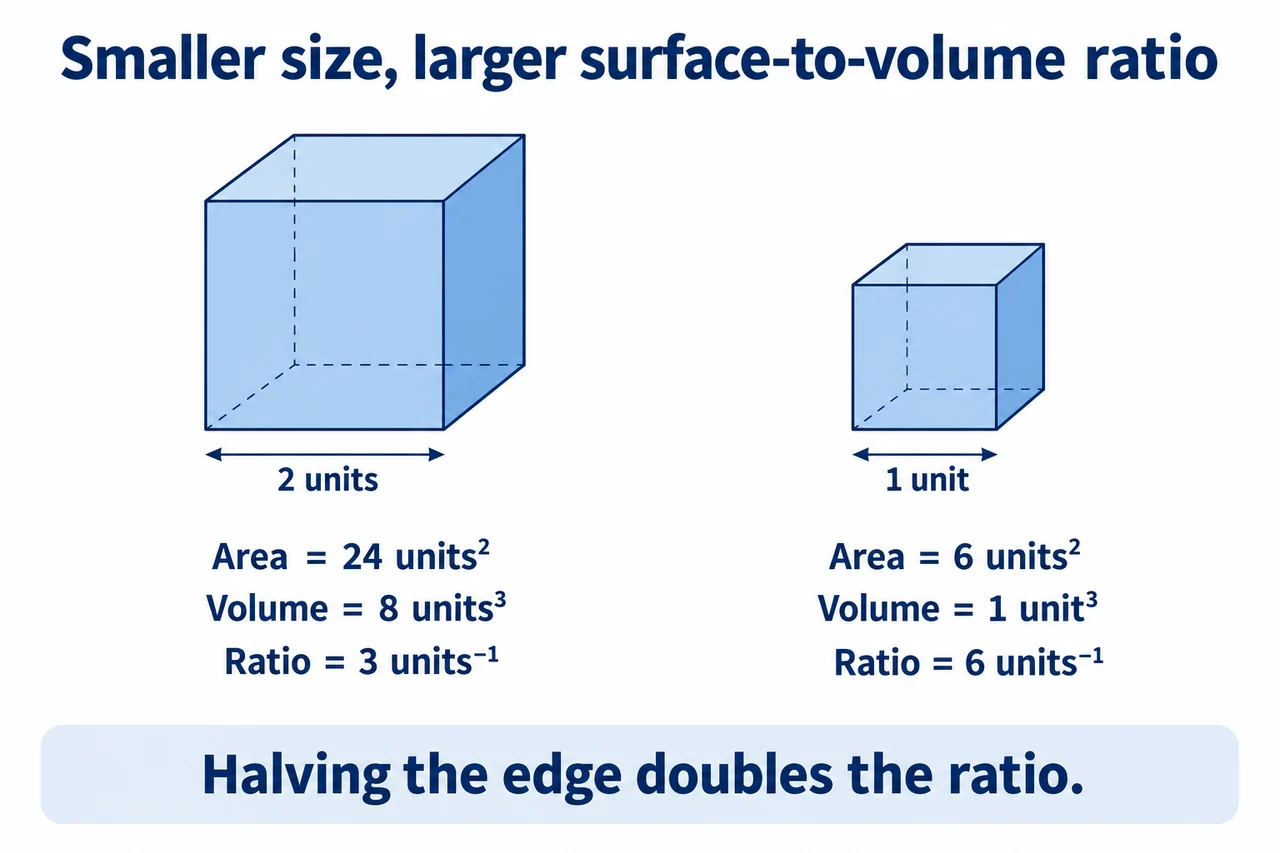
Image: illustration, not a documentary photograph. Original teaching model created for myAudience. · Original generated teaching illustration; no source textbook artwork reproduced.
Nanoparticle size and surface area
Nanoparticles are commonly described in this course as particles roughly 1–100 nm across. A nanometre is 10⁻⁹ m. This range is much smaller than an ordinary grain visible to the unaided eye, but particles in it still have many atoms rather than necessarily being single atoms.
For a cube of side length L, surface area is 6L² and volume is L³, so their ratio is 6/L. Smaller cubes therefore have more surface area relative to their volume. A high proportion of atoms can be near a surface, making surface interactions especially important.
Nanoparticle properties can differ from those of larger pieces of the same substance. Shape, composition, coating and surrounding conditions also matter. A size label alone does not prove a particular effectiveness or hazard; measurements need an actual material and exposure context.
Worked example: Compare surface-area-to-volume ratios for cubes of side 2 units and1unit.
For side 2: area 24, volume 8, ratio 3.
For side 1: area 6, volume 1, ratio 6.
Halving length doubles the ratio for this geometry.
Answer: The smaller cube has twice the surface-area-to-volume ratio.
Check your understanding: Why is nm not the same as μm?
Answer: 1 μm equals 1000 nm.
Why: The prefixes differ by a factor of 1000, so confusing them causes a large scale error.