Put numbers in order
By UK GCSE Mathematics · independent study · myAudience
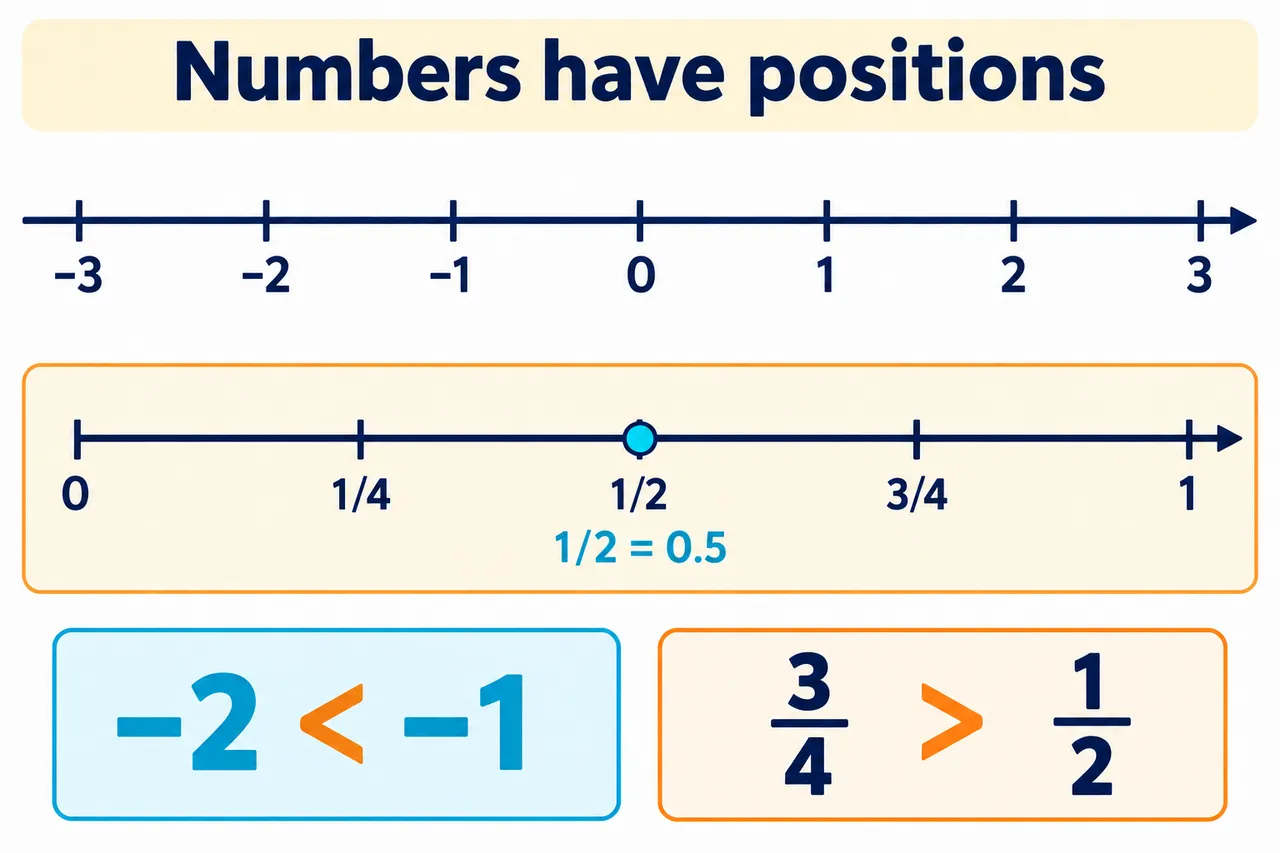
Original myAudience AI-generated mathematics teaching illustration; labels and relationships checked by the authoring agent. Independent integration review pending. · Original project artwork; no exam-board figures or textbook illustrations reused.
Put numbers in order
On a number line, moving right increases the value. A negative number can have a large distance from zero while still being smaller than a positive number. Thus −7 is less than −2: it sits farther left. The minus sign describes the signed value; the absolute value describes distance from zero.
Compare fractions using a common denominator or an exact decimal. For example, 3/4 is 0.75 and 2/3 is 0.666…. Decimal comparison works place by place from the left. Adding trailing zeros changes the written form, not the value: 0.6 and 0.60 are equal.
The pointed end of < or > faces the smaller value. An equality sign asserts the same value; ≠ means the values differ. The symbols ≤ and ≥ include equality. A condition such as x ≤ 3 permits 3 itself, whereas x < 3 does not.
Worked example: Order −1/2, −0.7, 0.4 and 1/4 from least to greatest.
Write −1/2 as −0.5 and 1/4 as 0.25.
Compare positions: −0.7 is left of −0.5, and 0.25 is left of 0.4.
Answer: −0.7 < −1/2 < 1/4 < 0.4.
Check your understanding: Is −3 > −2 true?
Answer: No; −3 < −2.
Why: The number farther left is smaller, even though its distance from zero is greater.