Calculate with signed numbers and decimals
By UK GCSE Mathematics · independent study · myAudience
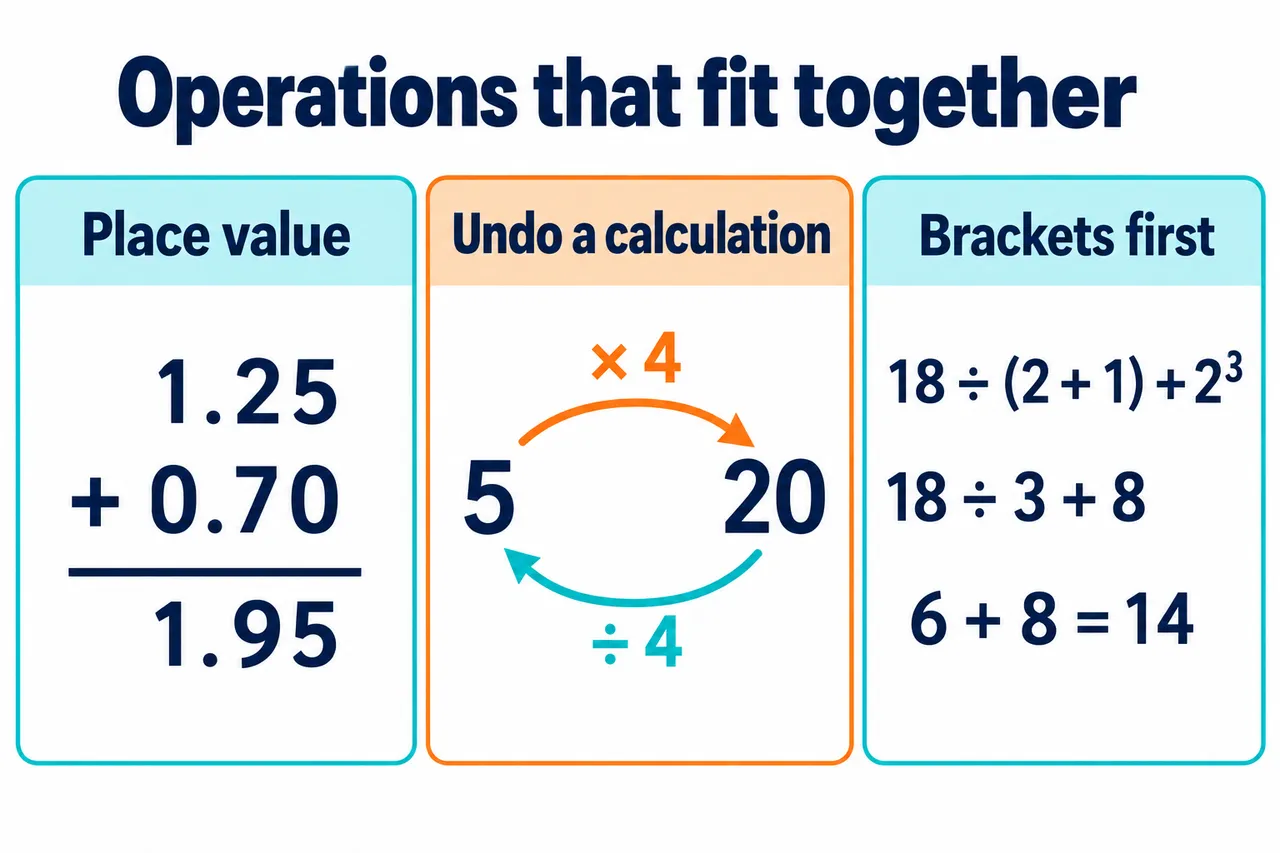
Original myAudience AI-generated mathematics teaching illustration; labels and relationships checked by the authoring agent. Independent integration review pending. · Original project artwork; no exam-board figures or textbook illustrations reused.
Calculate with signed numbers and decimals
Place value makes written calculation work. Align decimal points when adding or subtracting, because hundredths must combine with hundredths. In multiplication, first multiply the integer forms, then restore the total number of decimal places. In division, multiplying both dividend and divisor by the same nonzero power of ten leaves the quotient unchanged.
Adding a negative number moves left; subtracting a negative number reverses that movement. Multiplication or division of two numbers with the same sign gives a positive result; opposite signs give a negative result. These are different rules from addition: −8 + 3 is negative, even though the terms have opposite signs.
Estimate before completing a written method. For 3.6 × 0.24, the second factor is less than one, so the product should be less than 3.6. A result of 86.4 cannot fit this check. A calculator supplies digits, but you still choose the operation and interpret their size.
Worked example: Calculate 3.6 × 0.24 and check its scale.
Multiply 36 × 24: 36 × 20 + 36 × 4 = 720 + 144 = 864.
The original factors have one and two decimal places, so divide 864 by 1000.
The second factor is roughly one quarter; a result near 0.9 is plausible.
Answer: 0.864.
Check your understanding: Calculate −12 ÷ 3 and 1.25 + 0.7.
Answer: −4 and 1.95.
Why: Opposite signs give a negative quotient; align 0.70 with 1.25 before addition.