Operate with fractions and mixed numbers
By UK GCSE Mathematics · independent study · myAudience
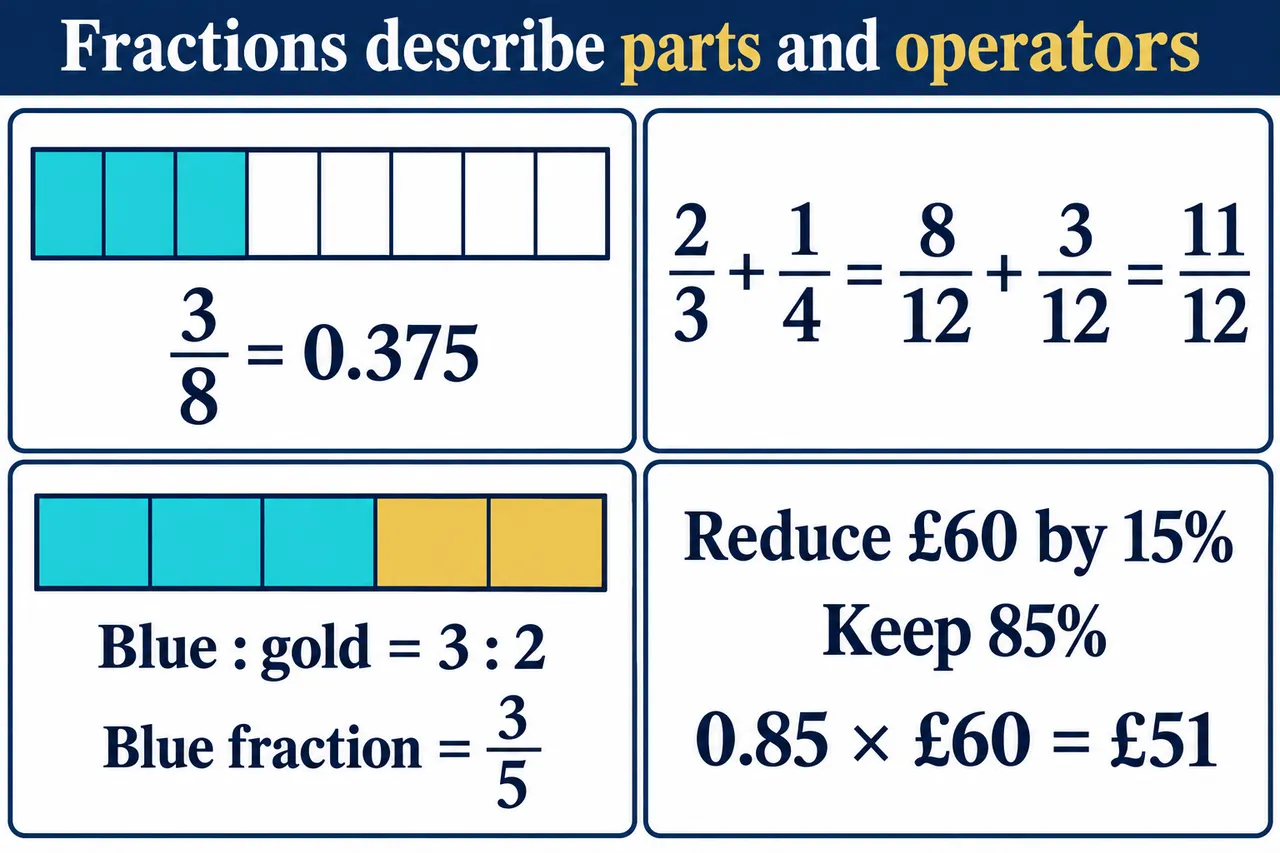
Original myAudience AI-generated mathematics teaching illustration; labels and relationships checked by the authoring agent. Independent integration review pending. · Original project artwork; no exam-board figures or textbook illustrations reused.
Operate with fractions and mixed numbers
A fraction represents division by a nonzero denominator. For addition or subtraction, rewrite the fractions with the same denominator so that their parts have equal size. Adding denominators would change the size of a part and therefore cannot describe the original sum.
To multiply fractions, multiply numerators and denominators, cancelling common factors beforehand when convenient. To divide by a nonzero fraction, multiply by its reciprocal. Cancellation is a property of products; you cannot cancel one term from a sum across a fraction bar.
Convert mixed numbers to improper fractions before multiplication or division: 1 1/2 = 3/2. Retain negative signs throughout. An exact simplified fraction is often more useful than a rounded decimal, because later calculations preserve the exact value.
Worked example: Calculate 1 1/2 ÷ 3/4.
Convert the mixed number to 3/2.
Multiply by the reciprocal: (3/2) × (4/3).
Cancel the common factor 3, then simplify 4/2.
Answer: 2.
Check your understanding: What is 2/3 + 1/4?
Answer: 11/12.
Why: The common denominator 12 gives 8/12 + 3/12, so the denominator stays 12.