Use inverses and operation priority
By UK GCSE Mathematics · independent study · myAudience
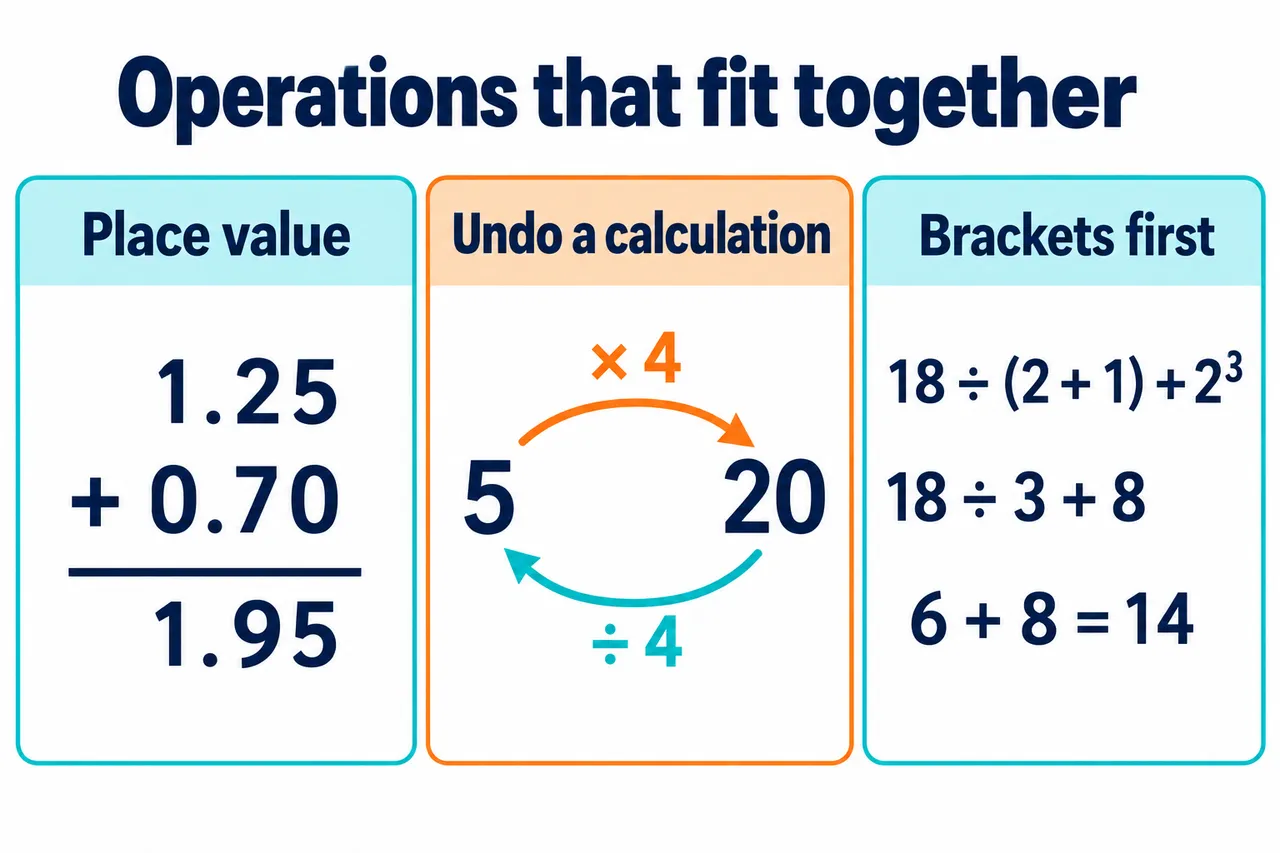
Original myAudience AI-generated mathematics teaching illustration; labels and relationships checked by the authoring agent. Independent integration review pending. · Original project artwork; no exam-board figures or textbook illustrations reused.
Use inverses and operation priority
Inverse operations undo one another when their domain conditions allow it. Adding 5 then subtracting 5 returns the starting value. Multiplying by 4 then dividing by 4 does the same. The reciprocal of a nonzero number a is 1/a; zero has no reciprocal because division by zero is undefined.
Evaluate brackets first, then powers and roots, then multiplication and division at equal priority from left to right, then addition and subtraction from left to right. Multiplication does not always precede division: 12 ÷ 3 × 2 equals 8, because the equal-priority operations are completed in reading order.
A square root sign denotes the nonnegative square root. Although both 3 and −3 have square 9, √9 is 3. Brackets distinguish (−3)² = 9 from −3² = −9, where the power applies before the leading negative sign. Use these conventions to read an expression rather than relying on a slogan alone.
Worked example: Evaluate 18 ÷ (2 + 1) + 2³.
Complete the bracket: 2 + 1 = 3.
Calculate the power: 2³ = 8.
Divide 18 by 3, then add 8.
Answer: 14.
Check your understanding: Why is 0 not a possible denominator or reciprocal divisor?
Answer: Division by zero is undefined.
Why: No number multiplied by zero can produce 1, so no reciprocal of zero exists.