Use primes to find common factors and multiples
By UK GCSE Mathematics · independent study · myAudience
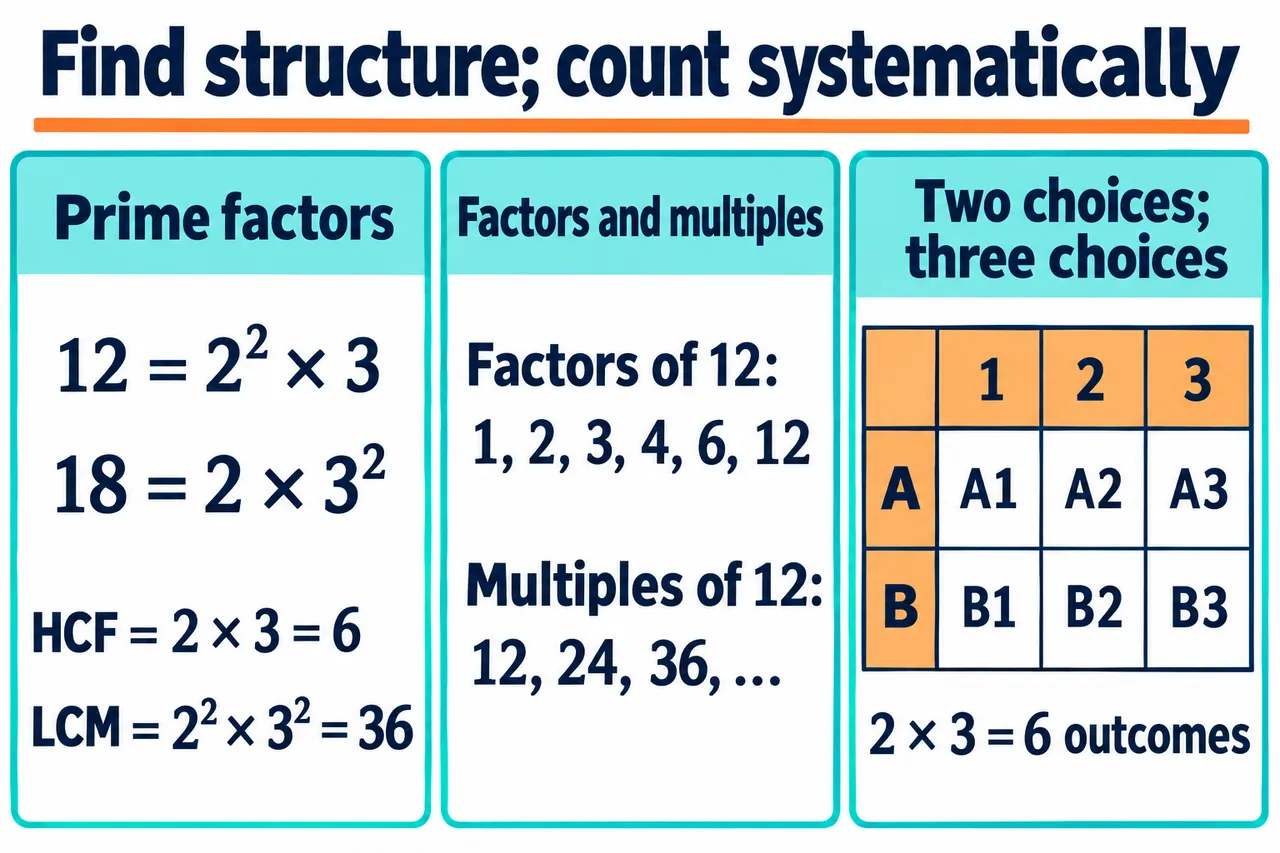
Original myAudience AI-generated mathematics teaching illustration; labels and relationships checked by the authoring agent. Independent integration review pending. · Original project artwork; no exam-board figures or textbook illustrations reused.
Use primes to find common factors and multiples
A factor divides a number exactly; a multiple is obtained by multiplying that number by an integer. A prime is an integer greater than 1 with exactly two positive factors. The number 1 is not prime. Repeatedly splitting composite factors produces a product of primes.
Every integer greater than 1 has a unique prime factorisation, apart from the order of the factors. Powers record repeated primes compactly. This shared structure explains the highest common factor: take only primes present in both numbers, with the smaller exponent for each.
For the lowest common multiple, include every prime needed by either number, taking the larger exponent. HCF answers a largest-equal-group problem; LCM answers a first-common-repeat problem. Neither is found by simply choosing the smaller or larger of the two starting numbers.
Worked example: Find the HCF and LCM of 12 and 18.
Write 12 = 2² × 3 and 18 = 2 × 3².
Shared factors at their lower powers give 2 × 3 = 6.
All required factors at their higher powers give 2² × 3² = 36.
Answer: HCF 6; LCM 36.
Check your understanding: Is 21 prime?
Answer: No: 21 = 3 × 7.
Why: Its positive factors include 3 and 7 as well as 1 and 21.