List possibilities without missing or repeating them
By UK GCSE Mathematics · independent study · myAudience
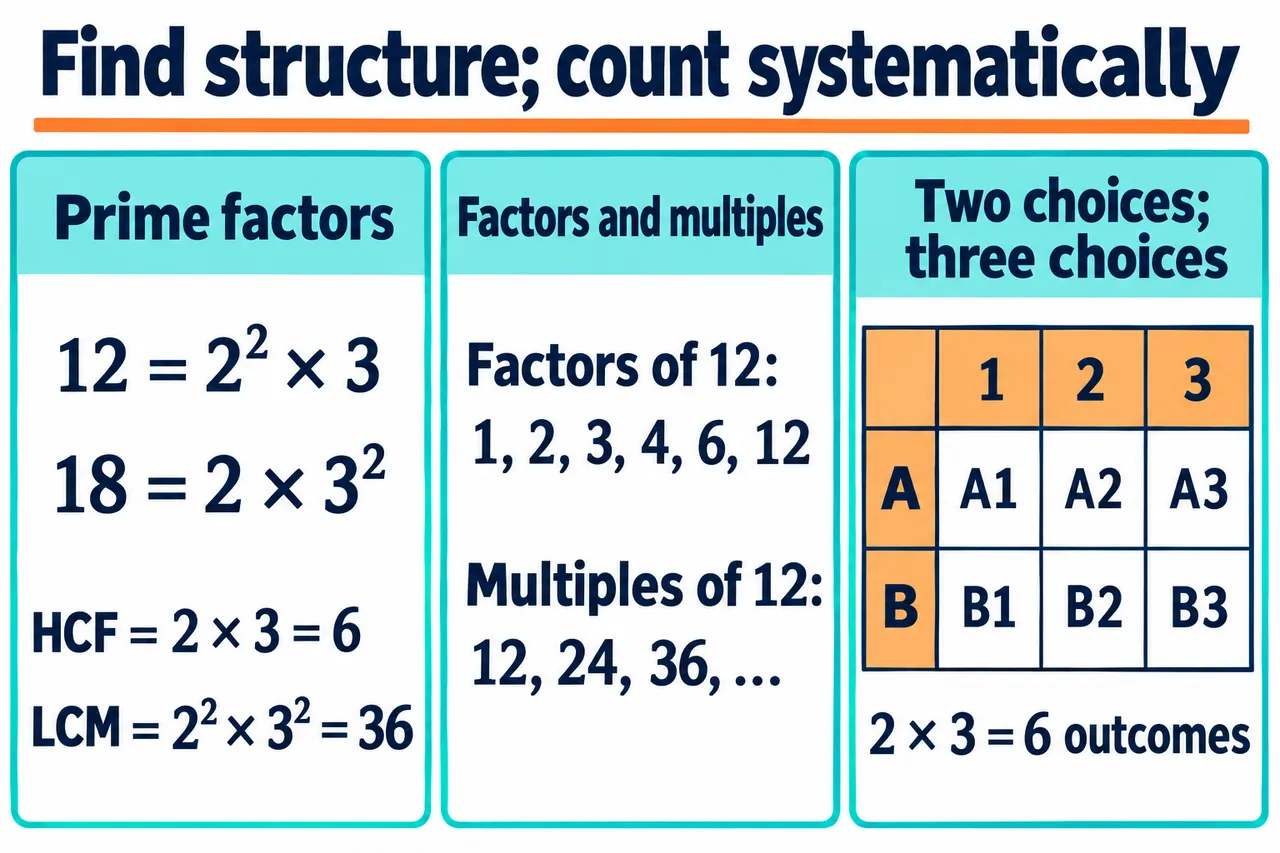
Original myAudience AI-generated mathematics teaching illustration; labels and relationships checked by the authoring agent. Independent integration review pending. · Original project artwork; no exam-board figures or textbook illustrations reused.
List possibilities without missing or repeating them
A systematic list follows a fixed rule. For two choices, hold the first choice still while varying the second, then move to the next first choice. This creates an organised table or tree rather than a collection of guesses.
Whether order matters changes the outcomes. Choosing a starter then a main course has distinct roles. Choosing two different classmates for an unordered pair does not: Anna–Ben and Ben–Anna are the same pair. State the restrictions before listing, including whether repetition is permitted.
A complete list should have a checkable pattern. If each row uses the same available second choices, its length should match the other rows. If choices are excluded, show why the shorter row is valid instead of filling it with impossible outcomes.
Worked example: List all outfits using shirts A, B and trousers 1, 2, 3.
Keep shirt A fixed: A 1, A 2, A 3.
Keep shirt B fixed: B 1, B 2, B 3.
Each row contains every permitted trouser choice exactly once.
Answer: A 1, A 2, A 3, B 1, B 2, B 3.
Check your understanding: How many unordered pairs can be chosen from A, B, C without repetition?
Answer: Three: AB, AC, BC.
Why: Reverse-order names do not create new pairs, and a person cannot be chosen twice.