Understand powers and real roots
By UK GCSE Mathematics · independent study · myAudience
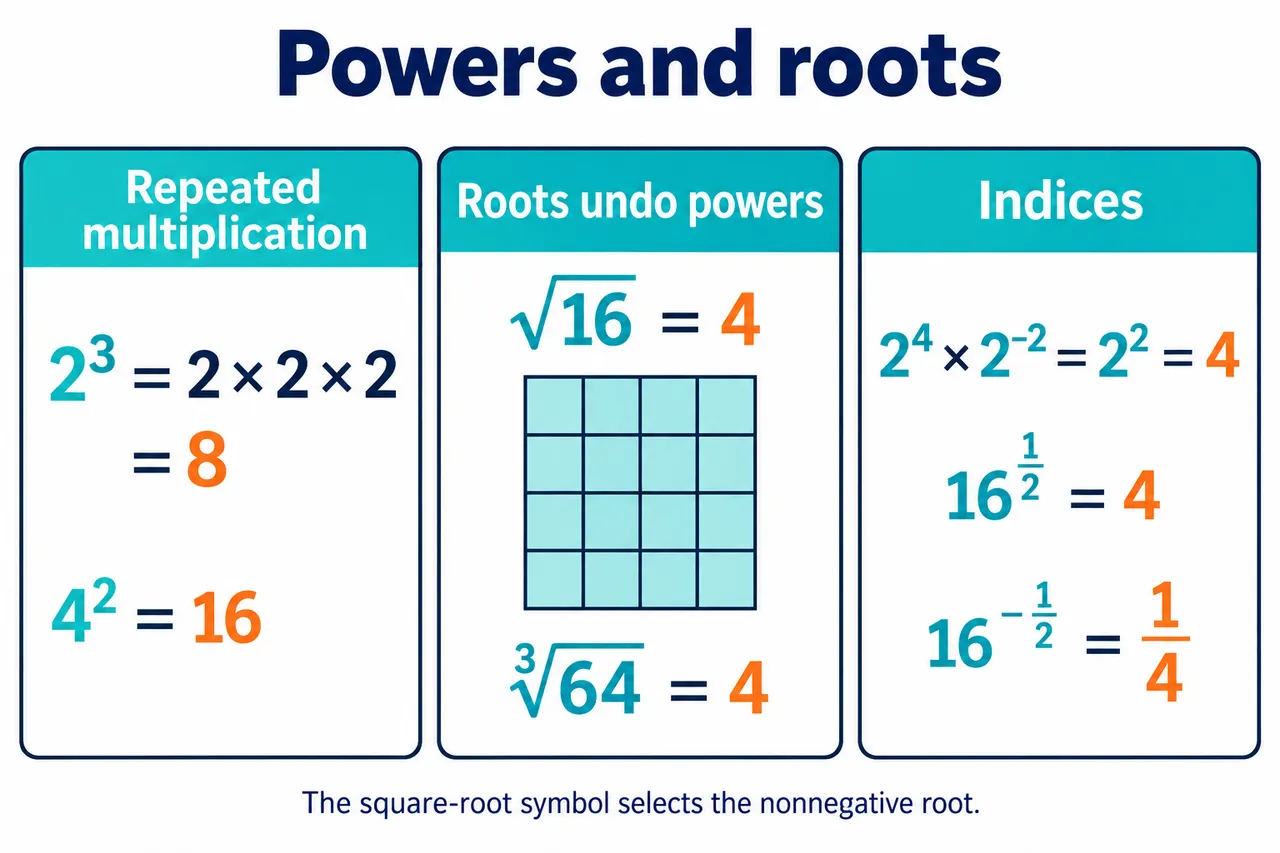
Original myAudience AI-generated mathematics teaching illustration; labels and relationships checked by the authoring agent. Independent integration review pending. · Original project artwork; no exam-board figures or textbook illustrations reused.
Understand powers and real roots
An integer power describes repeated multiplication, not repeated addition. For example, 3⁴ is 3 × 3 × 3 × 3 = 81. Recognising familiar powers of 2, 3, 4 and 5 helps you estimate size and check calculations.
A root reverses a power within a stated convention. The square root √25 is 5; the real cube root of −8 is −2, because cubing −2 gives −8. An even root of a negative number is not real. The principal even root of a positive number is nonnegative.
Keep power notation and solution notation separate. √36 = 6, but solving x² = 36 gives x = 6 or x = −6. The equation asks for all values whose squares fit, while the root symbol selects a particular value.
Worked example: Calculate 4³ and the real cube root of 64.
Multiply 4 × 4 × 4 to obtain 64.
Find the real number whose cube is 64.
Answer: 4³ = 64 and ∛64 = 4.
Check your understanding: Is √49 equal to ±7?
Answer: No; √49 = 7.
Why: The principal square root is nonnegative; x² = 49 is the equation with two solutions.