Calculate with integer indices
By UK GCSE Mathematics · independent study · myAudience
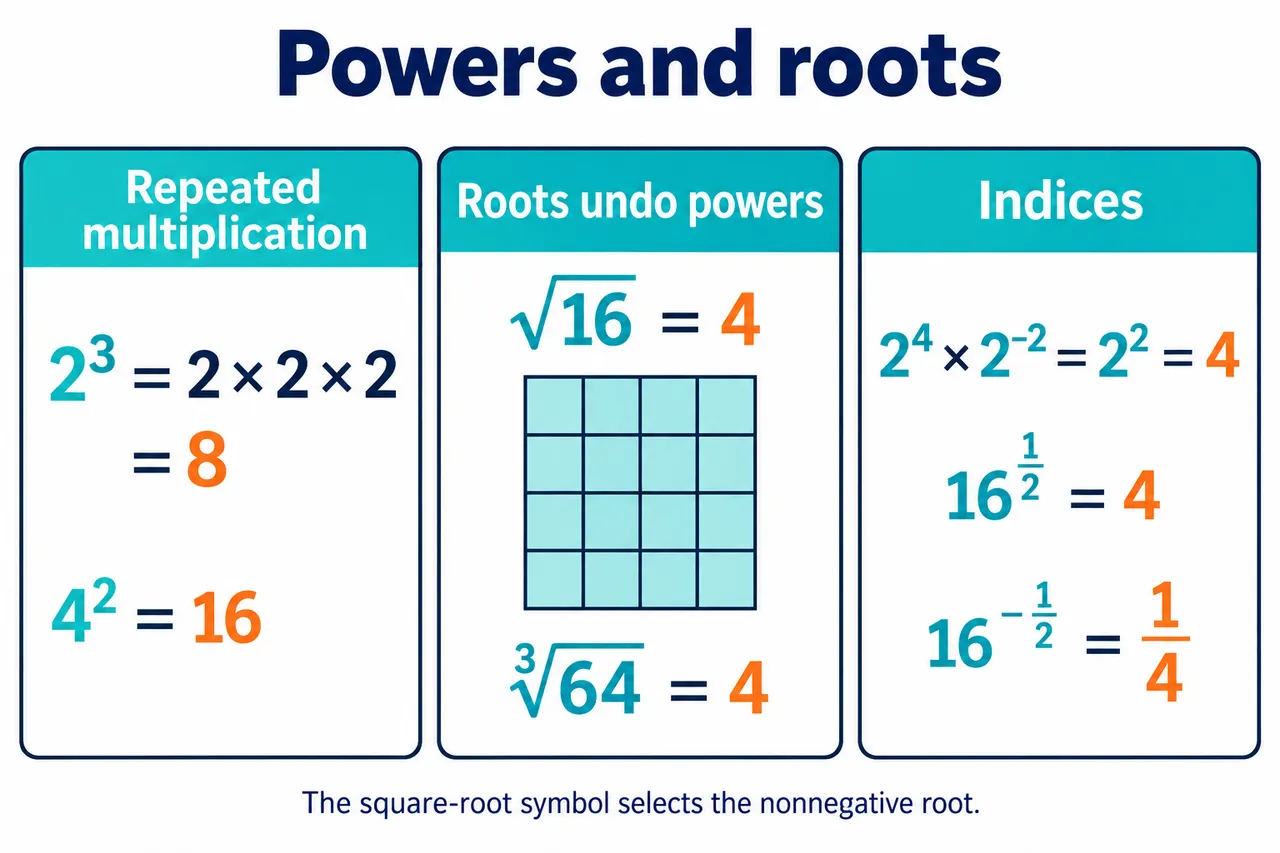
Original myAudience AI-generated mathematics teaching illustration; labels and relationships checked by the authoring agent. Independent integration review pending. · Original project artwork; no exam-board figures or textbook illustrations reused.
Calculate with integer indices
For the same nonzero base, multiplication adds exponents and division subtracts them. Expanding powers explains why: a³ × a² contains five copies of a, while a⁵ ÷ a² cancels two copies. A power raised to another power multiplies the exponents.
The laws extend to zero and negative indices. Since a³ ÷ a³ = 1, a⁰ = 1 for a ≠ 0. Since a² ÷ a⁵ = 1/a³, a⁻³ means a reciprocal, not a negative value. A base must satisfy the domain restrictions of the expression.
Index laws do not combine addition in the same way. 2³ + 2² is 8 + 4 = 12, not 2⁵. When an expression contains different bases, inspect their numerical or algebraic relationships before trying to use a same-base law.
Worked example: Simplify 2⁴ × 2⁻².
The bases match, so add the indices: 4 + (−2) = 2.
Calculate 2².
Answer: 4.
Check your understanding: What is 5⁻¹?
Answer: 1/5.
Why: A negative index asks for a reciprocal; it does not change the sign of 5.