Use powers of ten to represent scale
By UK GCSE Mathematics · independent study · myAudience
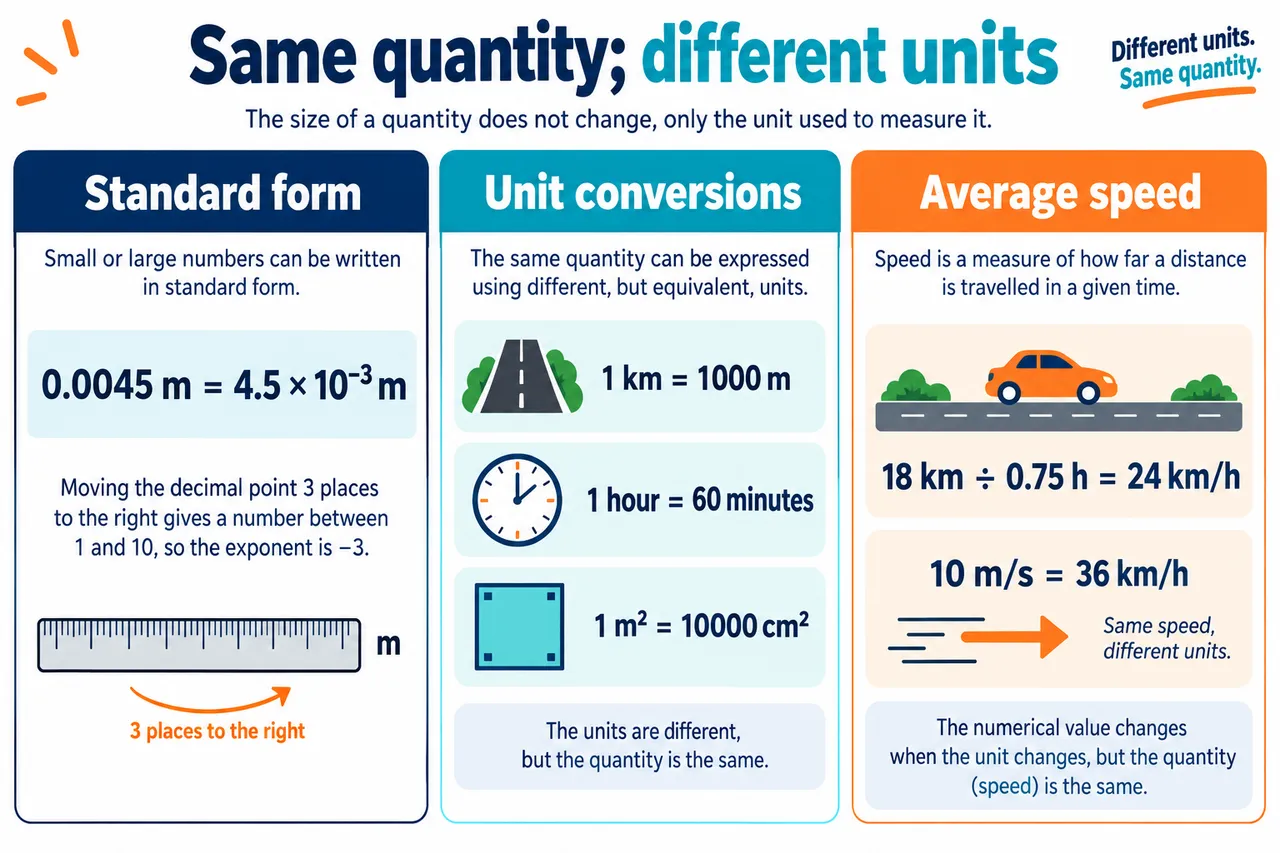
Original myAudience AI-generated mathematics teaching illustration; labels and relationships checked by the authoring agent. Independent integration review pending. · Original project artwork; no exam-board figures or textbook illustrations reused.
Use powers of ten to represent scale
Standard form writes a nonzero magnitude as A × 10ⁿ with 1 ≤ A < 10 and integer n. Moving the decimal point changes A, so adjust the exponent to preserve the original value. Very small positive numbers have negative exponents.
Multiply coefficients and add exponents; divide coefficients and subtract exponents. Renormalise if the resulting coefficient falls outside the interval from 1 inclusive to 10 exclusive. Addition instead requires matching powers of ten before combining the coefficients.
Standard form makes orders of magnitude visible, but it does not erase units or measurement uncertainty. Convert units before comparing coefficients. Writing 0.0045 m as 4.5 × 10⁻³ m describes the same length, not a new unit.
Worked example: Calculate (3 × 10⁴)(4 × 10⁻²) in standard form.
Multiply the coefficients to get 12.
Add exponents: 4 + (−2) = 2, giving 12 × 10².
Rewrite 12 as 1.2 × 10, then combine powers.
Answer: 1.2 × 10³.
Check your understanding: Write 0.00072 in standard form.
Answer: 7.2 × 10⁻⁴.
Why: Multiplying 7.2 by 10⁻⁴ moves the value four places toward smaller place values.