Move between terminating decimals and fractions
By UK GCSE Mathematics · independent study · myAudience
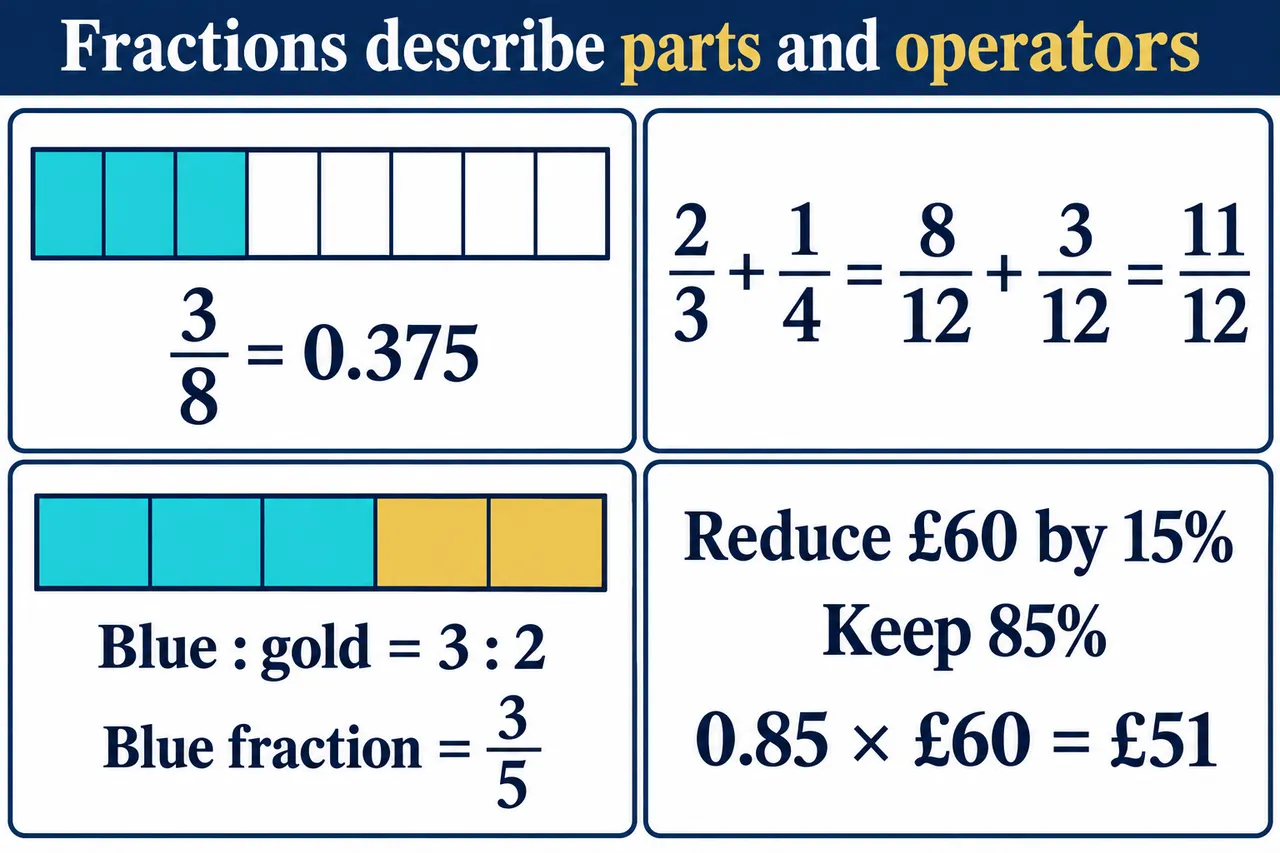
Original myAudience AI-generated mathematics teaching illustration; labels and relationships checked by the authoring agent. Independent integration review pending. · Original project artwork; no exam-board figures or textbook illustrations reused.
Move between terminating decimals and fractions
A terminating decimal is a fraction with a power-of-ten denominator. For example, 0.375 means 375 thousandths. Simplifying gives a more economical fraction without changing its value.
Dividing numerator by denominator converts a fraction to a decimal. A reduced fraction terminates exactly when its positive denominator contains only prime factors 2 and 5. Those are the prime factors of 10, so enough powers of 10 can provide a matching denominator.
A mixed decimal can still be represented exactly: 3.5 = 35/10 = 7/2. Percent means per hundred. To compare a decimal, fraction and percentage, convert them to a consistent form and distinguish an exact conversion from a rounded approximation.
Worked example: Write 0.375 as a fraction in simplest form.
Use place value: 0.375 = 375/1000.
Divide numerator and denominator by 125.
Answer: 3/8.
Check your understanding: Does 3/20 have a terminating decimal?
Answer: Yes; 3/20 = 0.15.
Why: The denominator 20 contains only 2 and 5 and can be scaled to 100.