Connect ratios with fractions of a whole
By UK GCSE Mathematics · independent study · myAudience
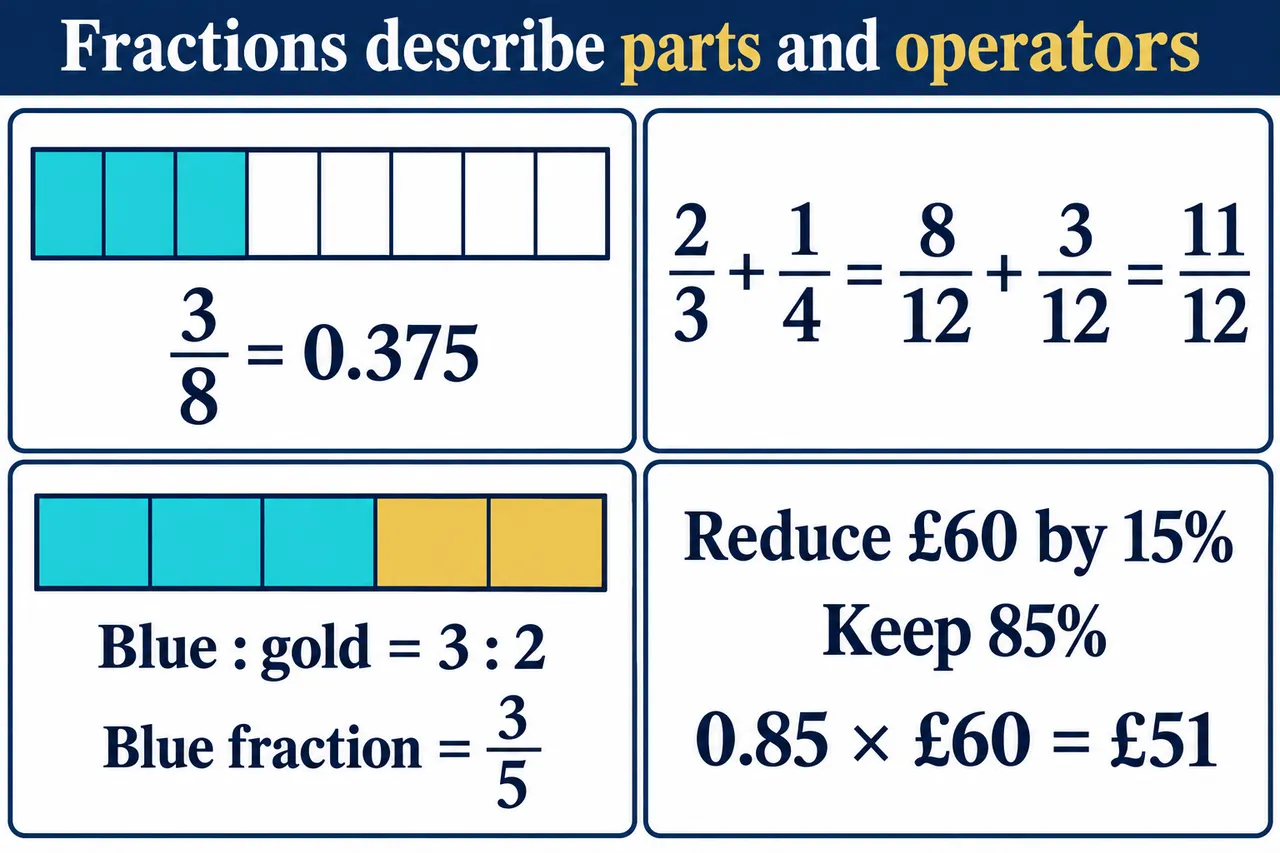
Original myAudience AI-generated mathematics teaching illustration; labels and relationships checked by the authoring agent. Independent integration review pending. · Original project artwork; no exam-board figures or textbook illustrations reused.
Connect ratios with fractions of a whole
A ratio compares quantities in a stated order. If red:blue = 3:2, there are five equal shares in the total. Red accounts for 3/5 of the total and blue for 2/5. The fraction 3/2 compares red with blue, so it answers a different question.
To divide a total in a ratio, add the ratio parts, find one equal share, then multiply by the parts. Quantities must use compatible units before forming a ratio. A ratio 3 m:50 cm becomes 300:50 = 6:1, not 3:50.
An increase to one group can change the ratio even if another group stays fixed. State whether a problem fixes the total, fixes one quantity or merely describes a comparison. These constraints determine which fraction is useful.
Worked example: Divide £40 in the ratio 3:2.
There are 3 + 2 = 5 shares.
One share is £40 ÷ 5 = £8.
Multiply £8 by 3 and by 2.
Answer: £24 and £16.
Check your understanding: If boys:girls = 2:3, what fraction of the group are girls?
Answer: 3/5.
Why: The whole group has five equal shares, not two.